

Drawings and documents
National Archives restored drawings: drawing
G. Tieman's Patent Drawing for a Machine for Scarification

National Archives, Restored Patent Drawings (Record Group 241) · Full-size scan at the National Archives · Catalog record
Show the text on the drawing Hide (281 words)
Words on the drawing as machine-read by the National Archives; not checked. Useful mainly for searching.
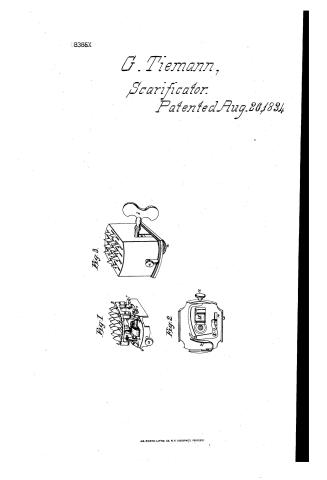
Cop from drawing attac to Patent / april 3 1846 / 128. SURGERY. / Scarificater Saukets-Sung- / [156] Scarificators & Lancets. / G. TIEMANN'S SCARIFICATOR / CLASSIFICATION / Patented August 26th 1834 / 8386. / DIVISION. / Fig. eferesents, the lancet plate on which the lancets are / Fig. 3. / fixed.- - 6.7 is the lower plate on which is placed the axle / Eig.1. / 4.5. the end of which 5. projects out so as to admit of a / key bring applied on the box. 8. 9.10.11. are the levers- / by which the lancet plate is raised on turning the axle / 4.5. 12. is the exterior end of the lever, by which the / spring or click represented in Fig: 3, is moved. / in this figt the lancets are half set, and is the position / in which they must be in order to be placed in the / box. / Fig: Represents the under side of the plate numbered / Fig.2. / 6.7 in Fig. 1. 12. is the lever which is connected with / the end of the click 13.- the view of the axle in which the click catches is / represented at 14. - 15. is the stul spring wound round the asle, which / draws back the axle, when the click is raised out of the notches / 12 / 16. is a small spring, which acts against the lever, and holds the click / 16 / in its place except when pressure is applied. / Fig. 3, is the box in which the apparatus before described is enclosed. - / 12. is the projecting end of the axle 4.5. in fig 2. a is the exterior / part of a serew by which the apparatus represented in fig: 1, may / be raised or depressed a mortice C being cut in the box to permit / the free passage of the asle up and down.
USPTO scan
The patent as scanned by the USPTO
-
 Page 1
-
 Page 2
-
 Page 3
-
 Page 4


U.S. Patent and Trademark Office · Google Patents
Show the transcription Hide (965 words)
Machine transcription (LightOnOCR) of the pages as scanned by the USPTO, most of them the handwritten copies made when the records were restored after the 1836 fire. Not checked; it can misread handwriting, so compare it with the scan.
Page 1.
8386X
G. Tiemann,
Scarificator.
Patented Aug. 26, 1834
Fig. 3.
Fig. 1.
Fig. 2.
AM. PHOTO-LITHO. CO. N.Y. (OSBORNE'S PROCESS.)
Page 2.
George Tiemann City of New York
Letter Patent
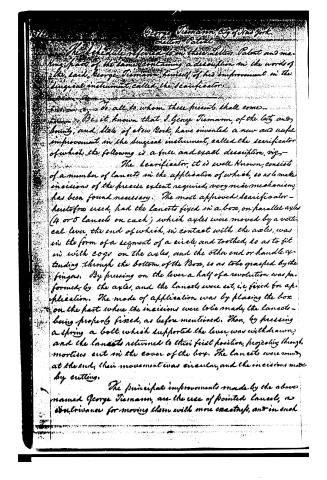
The Schedule referred to in these Letters Patent and making part of the same, containing a description in the words of the said George Tiemann himself, of his improvement in the surgical instrument called the Scarificator.
To all to whom these presents shall come—
Be it known that I George Tiemann, of the City and County, and State of New York, have invented a new and useful improvement in the surgical instrument, called the Scarificator of which the following is a full and exact description, viz—
The Scarificator, it is well known, consists of a number of lancets in the application of which, so as to make incisions of the precise extent required, very nice mechanism has been found necessary. The most approved Scarificator heretofore used, had the lancets fixed in a box, on parallel axles (4 or 5 lancets on each), which axles were moved by a vertical lever, the end of which, in contact with the axles, was in the form of a segment of a circle, and toothed, so as to fit in with cogs on the axles, and the other end or handle extending through the bottom of the Box, so as to be grasped by the fingers. By pressing on the lever a half of a revolution was performed by the axles, and the lancets were set, i.e., fixed for application. The mode of application was by placing the box on the part where the incisions were to be made, the lancets being properly fixed, as before mentioned. Then, by pressing a spring a bolt which supported the lever, was withdrawn, and the lancets returned to their first position, projecting through mortices cut in the cover of the box. The lancets were round at the end, their movement was circular, and the incisions made by cutting.
The principal improvements made by the above named George Tiemann, are the use of pointed lancets, as contrivance for moving them with more exactness, and in such
Page 3.
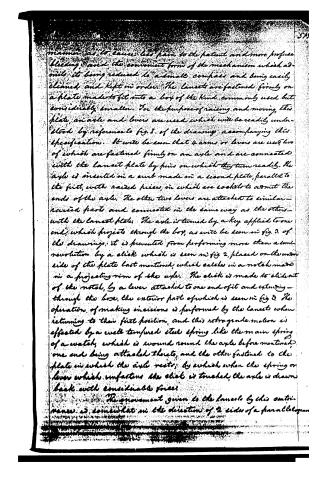
manner as to cause less pain to the patient, and more profuse bleeding, and the convenient form of the mechanism which admits its being reduced to a small compass and being easily cleaned and kept in order. The lancets are fastened firmly on a plate made to fit into a box of the kind commonly used but considerably smaller. For the purposes of raising and moving this plate, an axle and levers are used which will be readily understood by reference to fig. 1. of the drawing accompanying this specification. It will be seen that 4 arms or levers are used, two of which are fastened firmly on an axle and are connected with the lancet plate by pins on which they turn readily. The axle is inserted in a curb made in a second plate, parallel to the first, with raised pieces, in which are sockets to admit the ends of the axle. The other two levers are attached to similar-ruised parts and connected in the same way as the others with the lancet plate. The axle is turned by a key applied to one end, which projects through the box, as will be seen in fig. 2. of the drawings; it is prevented from performing more than a semirevolution by a click which is seen in fig. 2, placed on the under side of the plate last mentioned, which catches in a notch made in a projecting rim of the axle. The click is made to slide out of the notch, by a lever attached to one end of it and extending through the box, the exterior part of which is seen in fig. 3. The operation of making incisions is performed by the lancets when returning to their first position, and this retrograde motion is effected by a well tempered steel spring like the main spring of a watch, which is wound round the axle before mentioned, one end being attached thereto, and the other fastened to the plate in which the axle rests; by which when the spring or lever which unfastens the click is touched, the axle is drawn back with considerable force.
The movement given to the lancets by this contrivance is somewhat in the direction of 2 sides of a parallelogram
Page 4.
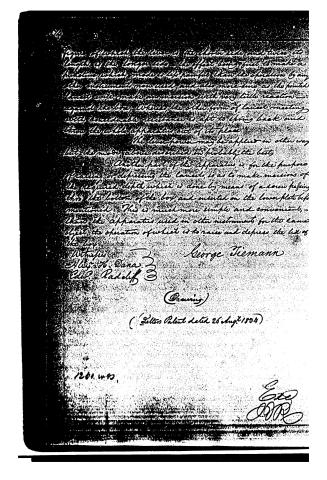
figure of which the lever is the shorter side and twice its length is the longer side. The effect being first to make a function which would be less painful than the operation by any other instrument now used and also more sure as the point of the lever will make a connection with very little reaction against the box. Where the other form of lever meeting with considerable resistance is apt to spring back and throw the whole apparatus out of its place.
The lever power may be applied in other ways but the mode above described is probably the best.
Another part of the apparatus is for the purpose of raising or depressing the lance is so as to make measures of the required depth which is done by means of a screw passing through the bottom of the box and inserted on the lower plate before mentioned. This is much more simple and convenient than the apparatus used in other instruments for the same object, the operation of which is to raise and depress the lid of the box.
Witnesses
Alley H. Dana
E.W. Radcliff
George Tiemann
(Drawing)
(United States Patent dated 26 Augt 1804)
1261. w. 95.
[Signature]
Published accounts: journal notice
Notice in the monthly list of patents, with remarks
Journal of the Franklin Institute, new ser., vol. 15 (1835), p. 205 · View the page
53. For an improvement in the surgical instrument called a Scarificator; George Tiemann, city of New York, August 26.
Remarks. The improvement in the construction of the Scarificator, which forms the subject of this patent, appears to us to deserve the appellation, as we think that both in construction and in operation, it will be found superior to those made either in the English or the German manner. The patentee, after describing the usual mode of forming this instrument, informs us that the principal improvements made by him are, the use of pointed lancets, instead of those with rounded ends; a contrivance for using them with more exactness, and so as to cause less pain, and produce a more profuse bleeding than heretofore, whilst the mechanism is more compact, and more easily kept clean, and in order, than in the old instrument. The lancets, instead of standing in rows upon an axis, or shaft, are all fixed upon a flat plate, which fits into a box, similar to those now in use, but smaller. For the purpose of moving the plates containing the lancets, an axis and jointed levers are placed underit, which are operated upon by suitable springs, and other appendages, that are fully described, and perfectly represented in the drawing. There is no distinct claim made, but the difference between this and other instruments for the same purpose, is clearly designated, so as to leave no doubt whatever respecting the points upon which the dependence for originality is placed.
About this record
- Patentee
- DATAMP
- Date
- the Name and Date index of patents, DATAMP, USPTO records
- Invention
- DATAMP
- Listed in
- the Name and Date index of patents, DATAMP, USPTO records, Jim Shaw's X-patent list, the Journal of the Franklin Institute, Burke's List of Patents (1847)
- Burke's 1847 Patent Office list gives the same patent.