

Drawings and documents
National Archives restored drawings: drawing
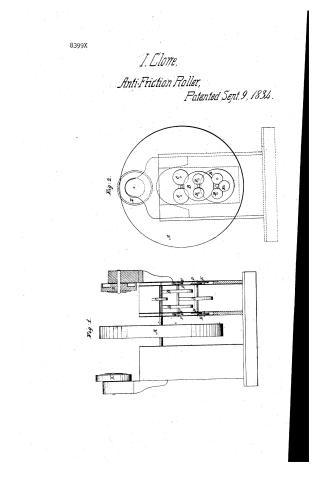
Isaac Clowe's Patent Drawing for Compound Friction Rollers

National Archives, Restored Patent Drawings (Record Group 241) · Full-size scan at the National Archives · Catalog record
Show the text on the drawing Hide (85 words)
Words on the drawing as machine-read by the National Archives; not checked. Useful mainly for searching.
64. IOURNA! se BEARNIGS. / 64 loan Boxes B, llers. / Patent april 211 "1838 / Roller Bearmage, / Oylinder, / of / ISAAC CLOWE'S / Oct / 13th / of / March / 1837. / 11L Ellburth / Compound Friction Rollers / Commissioner Patents / Patented Sept 9ᵗʰ1834. / 8399-+ t / DIV ISION. / Fis1 / Fiz.2. / References. / A. Ballance Wheel. / B. Large friction Rollers, / C.Side frition rollers. / small rollers. / Es,Smally rollers. / F. Metal frames. / OIR / EO / Irrenough .Dez / The rollers marked X are not mentionedin 9 the specification
USPTO scan
The patent as scanned by the USPTO
-
 Page 1
-
 Page 2
-
 Page 3
-
 Page 4


U.S. Patent and Trademark Office · Google Patents
Show the transcription Hide (795 words)
Machine transcription (LightOnOCR) of the pages as scanned by the USPTO, most of them the handwritten copies made when the records were restored after the 1836 fire. Not checked; it can misread handwriting, so compare it with the scan.
Page 1.
8399X
I. Clone,
Anti-Friction Roller,
Patented Sept. 9, 1834.
Fig. 2.
Fig. 1.
Page 2.
8399x
Sept. 9, 1834
Lease blowes.
Letters Patent.
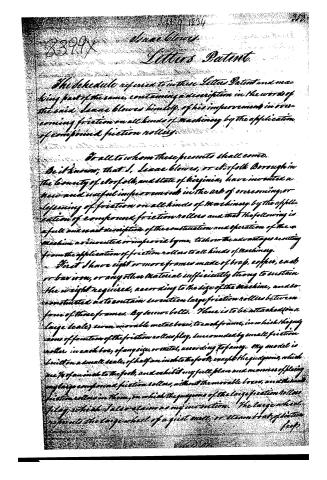
The schedule referred to in these Letters Patent and making part of the same, containing a description in the words of the said Lease blowes himself, of his improvement in overcoming friction on all kinds of machinery by the application of compound friction rollers.
To all to whom these presents shall come.
Be it known; that I, Lease blowes, of Norfolk Borough in the county of Norfolk, and state of Virginia, have invented a new and useful improvement in the art of overcoming, or lessening of friction on all kinds of machinery by the application of compound friction rollers and that the following is a full and exact description of the construction and operation of the machine as invented or improved by me, to show the advantages resulting from the application of friction rollers to all kinds of machinery.
First I have eight or more frames made of brass, copper, cast or bar iron, or any other material sufficiently strong to sustain the weight required, according to the size of the machine, and so constructed as to contain seventeen large friction rollers between four of those frames. By screw bolts. There is to be attached (on a large scale) seven movable metal boxes, to each frame, in which the grooves of fourteen of the friction rollers play, surrounded by small friction rollers in each box, of any size, or metal, according to fancy. My model is built on a small scale, of half an inch to the foot, except the grooves, which are 1/4 of an inch to the foot, and exhibit my full plan and manner of placing my large compound friction rollers, without the movable boxes, and the small friction rollers in them, on which the grooves of the large friction rollers play, which I also claim as my invention. The large wheel represents the large wheel of a joint mill, or steam boat, if better
feep
Page 3.
4. 83497
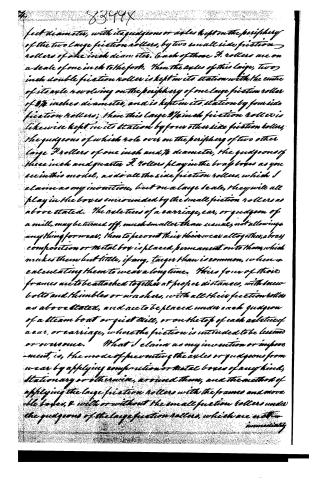
feet diameter, with its quidgons or axles kept on the periphery of the two large friction rollers, by two small side friction rollers of one inch diameters. Each of those 3" rollers are on a scale of one inch to the foot. Then the axles of this large, two inch double friction roller is kept in its station with the centre of its axle revolving on the periphery of one large friction roller of 3¾ inches diameter, and is kept in its station by four side friction rollers; then this large 3¾ inch friction roller is likewise kept in its station by four other side friction rollers, the quidgons of which roll over on the periphery of two other large 3" rollers of one inch and ¼ diameter, the quidgons of these inch and quarter 3" rollers play in the brass boxes as you see in this model, and so all the side friction rollers, which I claim as my invention, but on a large scale, they will all play in the boxes surrounded by the small friction rollers as above stated. The axletrees of a carriage, car, or quidgon of a mill, may be turned off, much smaller than usual, not allowing anything for wear; then to prevent their wear altogether, a brass composition or metal box is placed permanent on to them, which makes them but little, if any, larger than is common, when calculating them to wear a long time. These four of these frames are to be attached together at proper distances, with screw bolts and thimbles or washers, with all their friction rollers as above stated, and are to be placed under each quidgon of a steam boat or quiet mill, or on the top of each axletree of a car, or carriage, where the friction is intended to be lessened or overcome. What I claim as my invention or improvement, is, the mode of preventing the axles or quidgons from wear by applying composition or metal boxes of any kind, stationary or otherwise, around them, and the method of applying the large friction rollers with the frames and movable boxes, & with or without the small friction rollers under the quidgons of the large friction rollers, which are not immediately
Page 4.
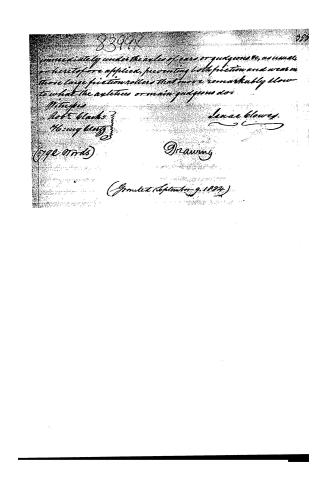
immediately under the axles of cars or guideways, as usual, or heretofore applied, preventing both friction and wear on those large friction rollers that have remarkably slow to what the axletrees or main guideways do.
Witnesses
Robert blacks?
Henry burt?
(ype mids)
Drawing
(Granted September 9, 1874)
Senae blowes.
Published accounts: journal notice
Notice in the monthly list of patents, with remarks
Journal of the Franklin Institute, new ser., vol. 15 (1835), p. 251 · View the page
11. For Lessening Friction, by friction rollers; Isaac Clowes, Norfolk, Norfolk county, Virginia, September 9.
Remarks. It has, more than once, happened that contrivances for lessening friction, have actually produced the reverse effect; and should the plan now proposed be carried into operation in "steamboats, grist mills, carriages," &c., another example of such an effect will be added to the existing list. In the principle upon which the present patentee depends, there is not any thing of novelty, as it consists merely in the revolution of the axle of one wheel upon the periphery of another; and whatever there may be of novelty in the arrangement, or rather in the complication of the parts as contrived by the inventor, will not be accompanied by any portion of the utility he anticipates. He informs us that there are to be eight, or more, frames made of metal, to contain the rollers which are to be employed; that seventeen large friction rollers are to be sustained between four of the frames, and that there are to be seven movable metal boxes to each frame, in which fourteen of the friction rollers play, surrounded by small friction rollers in each box; and much more to the same effect. The claim is to "the preventing the axles, or gudgeons, from wear, by applying composition or metal boxes of any kind, stationary or otherwise, around them; and the method of applying the large friction rollers, with the frames and movable boxes, and with or without the small friction rollers under the gudgeons of the large friction rollers, which are not immediately under the axles of cars, or gudgeons, &c., as usual, or heretofore applied, preventing both friction and wear." If the patentee can discover some materials which are perfectly hard, and perfectly inflexible, and a workman who can give to such articles a finish perfectly smooth, and perfectly true, he may derive some advantage from his contrivance; should he not do this, he will find that when he gets one of his complex friction boxes into actual operation, not one-half of the rollers will turn round when there is any load upon them, and that, after a little while, his circles will be converted into polygons.
About this record
- Patentee
- DATAMP
- Date
- the Name and Date index of patents, DATAMP, USPTO records
- Invention
- DATAMP
- Listed in
- the Name and Date index of patents, DATAMP, USPTO records, Jim Shaw's X-patent list, the Journal of the Franklin Institute, Burke's List of Patents (1847)
- Burke's 1847 Patent Office list gives the same patent.