

Drawings and documents
National Archives restored drawings: drawing
J. Wilson's Patent Drawing for Heating-Stoves

National Archives, Restored Patent Drawings (Record Group 241) · Full-size scan at the National Archives · Catalog record
Show the text on the drawing Hide (48 words)
Words on the drawing as machine-read by the National Archives; not checked. Useful mainly for searching.
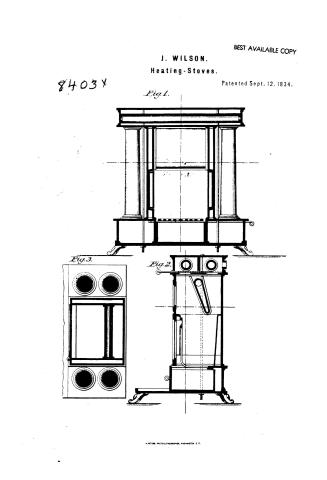
120 / 126, STOVES & FURNACES, / Heating Stoves-Open Front. / Div. 19 / Dec1.ˢᵗ 1874. Thisdrawing was madefrom the Model andis Correct. / E.W.D. / J. WILSON. / CLASSINLATION / Heating - Stoves. / 8403-x 84 X / Patented Sept. 12, 1834. / DIVISION. / Fig.1. / Fug.3. / Fig. 2.
USPTO scan
The patent as scanned by the USPTO
-
 Page 1
-
 Page 2
-
 Page 3
-
 Page 4
-
 Page 5
-
 Page 6
-
 Page 7
-
 Page 8
-
 Page 9
-
 Page 10


U.S. Patent and Trademark Office · Google Patents
Show the transcription Hide (3,434 words)
Machine transcription (LightOnOCR) of the pages as scanned by the USPTO, most of them the handwritten copies made when the records were restored after the 1836 fire. Not checked; it can misread handwriting, so compare it with the scan.
Page 1.
BEST AVAILABLE COPY
J. WILSON.
Heating-Stoves.
Patented Sept. 12, 1834.
8403Y
Fig. 1.
Fig. 2.
Fig. 3.
H. PETER, PHOTO-LITHOGRAPHER, WASHINGTON, D.C.
Page 2.
Sept. 12, 1834
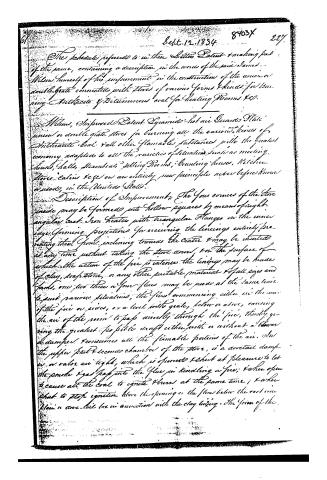
The schedule referred to in these Letters Patent making part of the same, containing a description in the words of the said James Wilson himself of his improvement in the construction of the union or double grate connected with stoves of various forms & kinds for burning Anthracite & Bituminous coal for heating Rooms &c.
Wilson, Improved Patent Pyramids hot air Grates Plate union or double plate stoves for burning all the various kinds of Anthracite coal & all other flammable substances with the greatest economy adapted to all the varieties of situations such as meeting houses, halls, steamboats, selling Rooms, Counting houses, Kitchen Stores, cabins &c. & on an entirely new principle never before known or used, in the United States.
Description of Improvement. The four corners of the stove inside may be formed into hollow squares by means of right angular cast Iron heaters with triangular flanges on the inner edge forming projections for receiving the linings entirely preventing them from inclining towards the centre & may be inserted at any time without taking the stove apart, & on the surface of which the action of the fire is intense, the linings may be made of clay, soapstone, or any other suitable material & of all sizes and kinds, one, two, three or four flues may be made at the same time to suit various situations, the flues commencing either in the rear of the fire or sides, or a level with grate, below or above, causing the air of the room to pass directly through the fire, thereby giving the greatest possible draft either with or without a damper & consumes all the flammable portions of the air. In the upper part & second chamber of the stove, is a cast-iron damper or valve air tight, which is opened & shut at pleasure to let the smoke & gas pass into the flue in kindling a fire; & when open to cause all the coal to ignite & burn at the same time; & when shut to stop ignition above the opening or the flue below the cast iron plan a cone-tail box in connection with the clay lining. The form of the
Page 3.
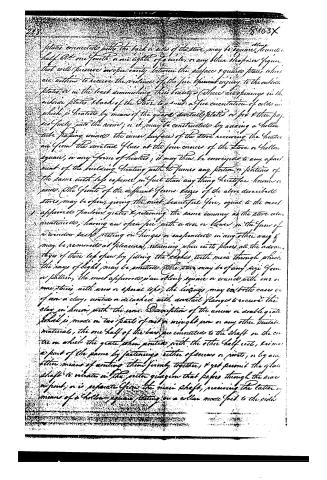
plates connected with the back or side of the stove, may be square, round, half or one fourth or one eighth of a circle, or any other shape or figure that will preserve an open cavity between the surface & guard plates, which are within to receive the violence of the fire & prevent injury to the outside plates or in the least diminishing their beauty. There are openings in the outside plates, back of the stove, to admit a free circulation of cold air which is heated by means of the guard, and tail plates or box & then passes freely into the room; or it may be constructed by adding a hollow tube passing round the inner surface of the stove receiving the heated air from the annular flues at the four corners of the stove or hollow square, or any form of heated; it may then be conveyed to any apartment of the building heating with it furnaces any portion or portions of the same with less expense in fuel than any thing heretofore known or used. The fronts of the different forms, sizes of the above described stoves, may be opened, giving the most beautiful fire, equal to the most approved parlor grates & retaining the same economy as the stove above mentioned, having an open fire with a door or blower in the form of a window sash, resting on hinges or suspended in any other way & may be removed at pleasure, retaining when in its place all the advantages of those left open by filling the spaces with mica through which the rays of light may be permitted. The stove may be of any size, form or pattern, the most approved plan being square or round, with one or more stoves with iron or special tops, the linings may in both cases be of iron or clay, united or detached with annular flanges to receive the clay or iron with the iron. Description of the union or double grate which is made in two parts of cast or wrought iron or any other suitable material, the one half of the bar are connected to the shaft on the centre on which the grate when united with the other half rests, is made a part of the same by fastenings either of screws or pivots, or by any other means of uniting them firmly together, & yet permit the grate shaft to vibrate in the outer grating that passes through the side or front, or is separate from the main shaft, receiving the latter in means of a hollow square resting on a collar more fast to the side
Page 4.
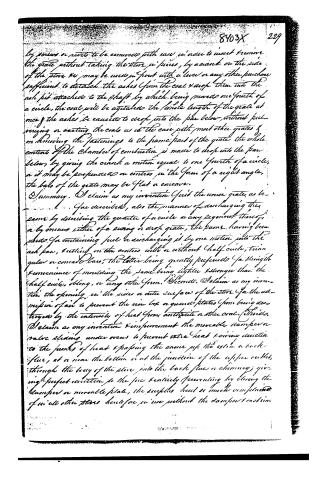
by screws or rivets to be removed with ease in order to insert & remove the grate without taking the stove in pieces, by a crank on the side of the stove & may be used in front with a lever or any other punch or sufficient to detach the ashes from the coal & drop them into the ash pit attached to the shaft, by which being moved one fourth of a circle, the coal will be agitated the whole length of the grate at once & the ashes be caused to drop into the pan below, without pulverizing or wasting the coals as is the case with most other grates & on removing the fastenings to the frame part of the grate the whole contents of the chamber of combustion is made to drop into the pan below, by giving the crank a motion equal to one fourth of a circle, & it may be suspended on centres in the form of a right angle, the bars of the grate may be flat or concave.
Summary. I claim as my invention first the union grate as before described, also the manner of discharging the same by describing the quarter of a circle or any segment thereof, or by means either of a swing or drop grate, the same having been used for containing fuel or discharging it by one motion into the ash pan, & resting on the centres with or without half circle, triangular or concave bars, the latter being greatly preferred for strength & convenience of moulding the same being lighter & stronger than the half circle, oblong, or any other form. Second. I claim as my invention the opening on the sides or outer surface of the stove for the admission of air to prevent the iron box or guards plates from being destroyed by the intensity of heat from anthracite or other coal. Third. I claim as my invention & improvement the movable damper or valve sliding under ovens to prevent extra heat passing directly to the fronts of heat & passing the same up the extra or back flue, at or near the bottom or at the junction of the upper outlets, through the body of the stove into the back flue or chimney, giving perfect direction to the fire & entirely preventing by closing the damper or movable plate, the surplus heat so much complained of in all other stoves heretofore, & we without the damper & cast iron
Page 5.
quar plates or box. Contrary to claim as my invention the cast iron quar plates or box, either round square or any other form, which are separate from the sides or back of the stove & make a part of the same by being separate or fastened either by screws, rivets or any other way, has to make the same an airtight, which may be of a circular form or any segment of a circle; & which when united to the sides or back will form an open cavity for the circulation of air & also retain the heat in the room without destroying the quar plates or box; and prevent any injury to the surface plates, as well as keep any thing from burning that may chance to come in contact with the outside of the stove, & also preventing the same beautiful surface as the other plates. Also in connection with the above described movable grate or damper. I claim the upper damper in the chamber of combustion to let off the smoke & gas in making a fire, & to cause the whole contents of the stove to be ignited at the same time if desired. The chamber of combustion may be made a part of the said stove or separate, so as to be removed at pleasure & of any form or size desired, observing the same be made airtight that combustion may be prevented when the damper is closed. The hopper or urn may be made large enough to contain a sufficient quantity of fuel to keep up combustion for days if required. By raising or lowering the tube made of iron, clay or soapstone, of any form & suitable size to discharge the coal at or near the grate, presenting a sufficient distance from the floor or grate of the furnace to graduate the quantity of coal to be consumed to any degree of heat wished for. (By means of this tube less than one quart of soft coal can be made to burn & the consumption of fuel confined to any given quantity by raising or lowering the same & thus regulating it at pleasure. By one part of the tube being movable & sliding upon the outer or inner surface of the main tube connected with the hopper, receiver or urn, which may be raised or lowered to increase or diminish the quantity of fuel to be consumed, observing at the time of using the tube to keep the upper damper in the chamber of combustion closed to prevent the air
Page 6.
from passing through the tube if possible; which can be effected only by having the valve or damper airtight & keeping it constantly closed, especially in the use of the fine or soft coal & when combustion is designed to be kept up for a length of time without replenishing the fuel, & the hopper or urn may be sufficient in size to keep up any given temperature for days. The same construction of Hopper as described in the within specification except that the feeders are on the outside of the furnace instead of the centre or inside, in order to increase the quantity of fuel to last a length of time if required to keep up the fire without constantly changing the same as in the case with all other furnaces now in use. By which means three or more kinds of coal can be injected to any given point below the mouth of the furnace or cupola, to wit, charcoal in the lower part, coke or lampool in the centre, & anthracite at the top or mouth, or any other suitable material can be used. The ore or metal to be melted is suspended over the top of the furnace or cupola in a Hopper or reservoir to receive the fire from the top of the furnace heating & drying the ore the better preparing it for the furnace or cupola, as it diminishes the quantity of fuel; gives greater facility in fusing & melting; & producing greater uniformity in the quantity of the ore. By the aid of machinery attached to the Hopper at the top of the furnace, the ore can be kept constantly discharging from the Hopper into the top of the furnace, & the supply increased or diminished to supply the wants of the furnace, working fast or slow. The same constructed Hopper or receiver can be used in or on the outside of any stove for culinary purposes as well as for the purposes above & may be made of any suitable material either sheet or cast iron, copper, tin or of any other substance that may answer.
No. 1 Improvement in the management of heat, as applied to cooking stoves of every form & kind, for all culinary purposes, in the use of wood or coals, in applying the same to the oven & boilers in the most economical manner, never before known or used, without the usual destruction of the oven plates & dampers, sliding under or
Page 7.
prolonging outside of said oven, giving a more perfect direction to the flame conveying it to the entire outside of the boiler, increasing & diminishing the quantity of heat by shoving the guard plate sliding under the oven from 2 to 4 inches, the same to be moved at pleasure or remain stationary, to suit the point of heat in the oven for baking, boiling, roasting or any other purpose. The above guard plate resting on flanges cast on the inner lower edge of the side oven plate sufficient distance from the bottom oven plate to pass all the flame, or frames of heat between the guard plate & the bottom oven plate if required on any part of it, the guard plate giving perfect direction & impeding any portion of fire for the purpose above named, by means of a handle piercing through the outside of the stove, or may be used by any other suitable instrument resting on or between the flanges cast on the inner side of the guard plate for that purpose, near the front lower side. The same sliding damper is used, putting sheets of copper directing the fire to & from the sheets in its passage in the sheet metal & having discovered the great inconvenience of the former plan & expense of the former sliding damper under the ovens of cooking stoves, its destruction by intense heat to which they were exposed & the manner they were made to act under the oven, have substituted the following sliding or revolving damper, resting on a wide flange cast on & making a part of the upright side oven plate from one to six inches more or less, at right angles, with the upright side oven plate, themselves forming an impenetrable guard plate to the dampers sliding or revolving on the upper side of the same. The fire passing under the guard & projecting wing of the upright side oven plate, the said projecting part of said plate to extend to nearly the outer surface of the stove conveying the flame or fumes of heat to the outside of the boiler, thereby consuming much less fuel than any other stove of like construction known or used before, & by means of stops cast on the sides of the stove to receive the dampers as it revolves, any given quantity of heat may be applied to the boiler by its motion if required, and by
Page 8.
8463X 293
shaping the fire under the surface of the projecting wing of the upright side oven plate is heated more effectively than formerly, with great economy, in carrying the flame or fumes from the furnace to the outside of the boiler, the same right angle plate cast on & making a part of the top or bottom oven plate, to all kinds of coal stove plate, such as stove bottoms, backs, &c., when the action of the fire is confined to a certain or small portion of the plate, movable curve plate forming at pleasure an inclined plane to convey the coal from the feeder to the side near the front of stove. The improvement herein described consists, first, in the setting or placing square plate cross or lengthways of the oven, in cooking stoves on flanges cast on the inside of upright oven plate, one or more inches below the bottom of oven, leaving sufficient space to pass the flames & fumes of heat between the oven plate & the stove, the heat to the bottom of diminishing it at pleasure by the motion of the plate from two to four inches from front to rear under the oven, the same damper is used in turning off fire. Connected with said upright side oven plate is a right angle or wing cast on & making a part of said side oven plate, upon which the sliding damper rests on the upper side of the flame, saving the damper from injury by fire as heretofore, giving direction to the fire to the outside of the boiler, consuming much less fuel & securing a regular degree of heat to the oven not before known or used.
Having recently discovered by various experiments that cast iron plates, upon which the fire acts upon a part of the surface is sound from breakage by turning it the thickness of the plate, and bottom of all kinds of stoves for cooking 6 & 9 plate stove stoves, bottoms, all fire plates & backs to Franklin, heat face with straight or level plates, by turning them are entirely prevented from breakage by fire as heretofore, the same right angle plates are attached to the top & bottom oven plate forming an entire fire plate in front of all coal or wood cooking stoves, gives additional heat to the top & bottom oven plate in baking or frying.
Having discovered the great advantage in burning anthracite coal in all Pyramid stoves, of all sizes & forms especially the oblong square
Page 9.
by attaching the flange to the end of the firebox to form a chamber of combustion of an open space between them for the purpose of forming a chamber for the circulation of air to be heated to remove from the consumption of fuel, to prevent entirely, preventing the meeting with fire, by various experiments recently made, have succeeded in a new plan, also in the formation of all cast iron plate, where the action of the fire is intense in any part or section of its, and all of the surfaces, and a round bottom to cool and cool by carrying the surface of the same at least the thickness of the plate by expansion, it makes it entirely, returns again to the former state without leakage or the least injury to the plates, back to Franklin, and all other cast plates exposed back to the action of the fire. Sheets now made with a flat or straight surface are now made convex on one side, to prevent leakage as hereafter.
Summary
1. I claim as my invention and improvement the invention of guarding the iron of all cooking stoves from burning at bottom by a stationary or movable plate, under oven, for all ordinary purposes, giving any portion of heat to the same in baking, frying, etc.
2. I claim as my invention and improvement the flange or wing at right angles, with the upright side iron plate, extending outward from one to six inches more or less, carrying the fire to the value of the boiler, to provide for the heating of the upright part of said side iron plate by the action of the fire under the surface of projecting part of said plate, the resulting dampness resting on the same, preventing its destruction by fire.
3. I claim the application of said sliding guard plate in a direction with a new and untried, placed over or any other formed face for training sheets of effect, thereby regulating the action of the fire to the same at pleasure.
4. I claim as my invention and improvement the guard or projecting plate, making a part bottom or top over the upright side iron as above, forming an entire new protection to the sliding or revolving guard plate or damper, giving the same from the usual condition of its revolving on its upper surface, shielding the same.
Page 10.
9 8107X 235.
from fire. 5th I claim as my invention & discovery the saving from breakage all stoves or cast iron plates by cutting the same at least the thickness of the melting of the outer surface plate of each dimension by opening the sides of the plates or in the bottom of top plates.
Witness
G.H. Van Vunhis
Isaac Adrianes
James Wilson
Expt. 11/6.
(3800 words)
(Patented September 12, 1834)
About this record
- Patentee
- DATAMP
- Date
- the Name and Date index of patents, DATAMP, USPTO records
- Invention
- DATAMP
- Listed in
- the Name and Date index of patents, DATAMP, USPTO records, Jim Shaw's X-patent list, Burke's List of Patents (1847)
- Burke's 1847 Patent Office list gives the same patent.