

Drawings and documents
National Archives restored drawings: drawing
Dyer Cleaveland's Patent Drawing for a Horse Collar Block

National Archives, Restored Patent Drawings (Record Group 241) · Full-size scan at the National Archives · Catalog record
Show the text on the drawing Hide (131 words)
Words on the drawing as machine-read by the National Archives; not checked. Useful mainly for searching.
A1 / HARNESS / Harness Machurat / 54. HARNESS. / Shaping / Harness Machine / Collar Shaping / CLASSIFICATION / 8405-x / DIV ISION. / DYER CLEATELAND / Horse Collar Block. / Patented Sept 15th 1834. Recor "Vol: 18. Page 509. / Reference. / A. Collar block. / B, the part that fits to the roll,or rm of / the collar / C, parl that fits the pad or belly of / the collar / D, channel or groove / E, screw & nut. / F, piece of wood that slides zzz channel (D.) / G, end of (F) which fits zzz the small end or / Patent Office / top of a collar / May / made under the direction of the Commisioner / of Patents in conformity with the act / of 3rd of march 1837 / A.A. Von Schmidt Dell / Commisioner of Patent
USPTO scan
The patent as scanned by the USPTO
-
 Page 1
-
 Page 2
-
 Page 3


U.S. Patent and Trademark Office · Google Patents
Show the transcription Hide (668 words)
Machine transcription (LightOnOCR) of the pages as scanned by the USPTO, most of them the handwritten copies made when the records were restored after the 1836 fire. Not checked; it can misread handwriting, so compare it with the scan.
Page 1.
8405X
D. Cleaveland,
Horse-Collar Block,
Patented Sep. 13, 1834.

Page 2.
Dyer Cleveland
Letters Patent
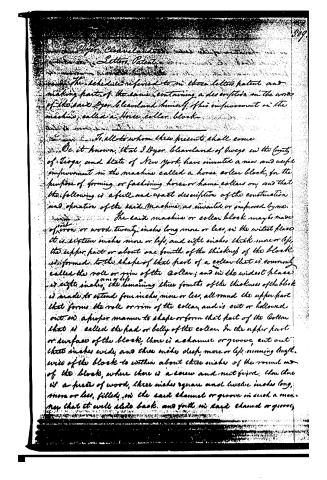
The schedule referred to in these letters patent and making part of the same, containing a description in the words of the said Dyer Cleveland himself, of his improvement in the machine, called a Horse collar block.
To all to whom these presents shall come
Be it known, that I Dyer Cleveland of Oswego in the County of Tioga, and State of New York, have invented a new and useful improvement in the machine called a horse collar block, for the purpose of forming or fashioning horse or hams collars on, and that the following is a full and exact description of the construction and operation of the said machine as invented or improved by me.
The said machine or collar block may be made of iron or wood, twenty inches long more or less, in the widest place it is sixteen inches more or less, and eight inches thick more or less, the upper part or about one fourth of the thickness of the block is formed to the shape of that part of a collar that is commonly called the roll or rim of the collar; and in the widest place is eight inches more or less, the remaining three fourths of the thickness of the block is made to extend four inches, more or less, all round the upper part that forms the roll or rim of the collar, and is cut or hollowed out in a proper manner to shape or form that part of the collar that is called the pad or belly of the collar. In the upper part or surface of the block, there is a channel or groove, cut out three inches wide, and three inches deep, more or less, running lengthwise of the block to within about three inches of the round end of the block, where there is a screw and nut fixed; then there is a piece of wood, three inches square and twelve inches long, more or less, fitted in the said channel or groove in such a manner that it will slide back and forth in said channel or groove,
Page 3.
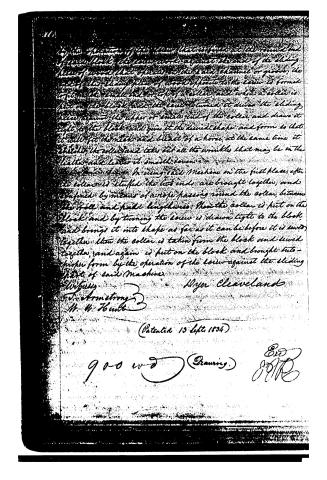
by the operation of the screw that is fixed at the round end of said block, the screw works against the end of the sliding piece of wood that operates in the said channel or groove, the end of this sliding piece of wood opposite to the screw is formed to fit on the small end or top of a collar, and when a collar is put on the block and the screw turned, it drives the sliding piece against the upper or small end of the collar, and draws it tight to the block and gives it the desired shape and form so that it will fit the neck and breast of a horse, at the same time it stretches the collar and takes out all the wrinkles that may be in the leather and leaves it smooth even.
In using said Machine in the first place, after the collar is stuffed the two ends are brought together, and confined by means of a rope passing round the collar, between the roll and pads lengthwise. Then the collar is put on the block and by turning the screw is drawn tight to the block, and brings it into shape as far as it can be before it is sewn together. Then the collar is taken from the block and sewed together, and again is put on the block and brought into proper form by the operation of the screw against the sliding part of said Machine.
Witness
J. Armstrong
W. W. Houtt
Myer Cleaveland
(Patented 13 Sept 1834)
900 w d (Drawing)
Published accounts: journal notice
Notice in the monthly list of patents, with remarks
Journal of the Franklin Institute, new ser., vol. 15 (1835), p. 253 · View the page
15. For an improvement in the Horse Collar Block; Dyer Cleaveland, Owego, Tioga county, New York, September 13.
Remarks. A block is to be made in the usual form of those used by collar makers, and this, it is stated, may be either of wood, or of cast iron. The collar, with a rope passed round it in the ordinary way, is to be placed upon the block, and, by means of a screw, a slide, is made to work horizontally in a groove along the middle of the block, is to be forced against the rope at that part of it which passes round the small end of the collar; after the collar has been properlyshaped by the force of the screw, its two ends are to be sewed together, and again placed upon the block, that the slide may be forced against it a second time, to give it a final shaping. On turning to No. 40, for the last month, p. 108, it will be seen that three patents have been obtained, within three months, for what is essentially the same thing; in the plan described in the specification before us, the rope is pushed, instead of being drawn, by a screw; but this is only a colourable difference, which any common mechanic might devise, without possessing the least talent for invention. From the circumstance of the entire similarity of the inventions, as well as from the residence of each of the patentees in the same state, and in counties not very remote from each other, the conviction that they are not all "true and original inventors," is irresistibly forced upon us.
About this record
- Patentee
- DATAMP
- Date
- the Name and Date index of patents, DATAMP, USPTO records
- Invention
- DATAMP
- Listed in
- the Name and Date index of patents, DATAMP, USPTO records, Jim Shaw's X-patent list, the Journal of the Franklin Institute, Burke's List of Patents (1847)
- Burke's 1847 Patent Office list gives the same patent.