

Drawings and documents
National Archives restored drawings: drawing
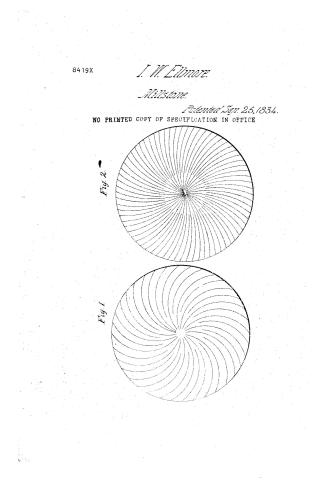
J.W. Ellmore's Patent Drawing for Mill Stones

National Archives, Restored Patent Drawings (Record Group 241) · Full-size scan at the National Archives · Catalog record
Show the text on the drawing Hide (123 words)
Words on the drawing as machine-read by the National Archives; not checked. Useful mainly for searching.
$15 / 83. MILLS. / [57] Mill Stone Dress. / S. / as / p1- / CLASSIFICATION / 8419-x / Mill Itones / Patented 25th Lept.1834, / division. / Fief.1, / Fig.2. / References, / Constitute / Fids1, five feet mill stom. / with seg segments faircles / Patent Office Febry 22 1842. / of three fat diameter, / Made under the direct tion of / Fig.2, five ft stonewith segments / farily of Seven ft diameter, / Patents in conformity with act of 3 1837, / another alpetion to the in that there intus guater aif findt April / Commipion of Patents / druft green cel a nin / Han ise "I the show in propostem Q lse / draft at or the verie for on, the / Gmry the morge 3 naary / myth 25mmaty dion heat very / Izjom, Arm
USPTO scan
The patent as scanned by the USPTO
-
 Page 1
-
 Page 2
-
 Page 3
-
 Page 4
-
 Page 5


U.S. Patent and Trademark Office · Google Patents
Show the transcription Hide (1,887 words)
Machine transcription (LightOnOCR) of the pages as scanned by the USPTO, most of them the handwritten copies made when the records were restored after the 1836 fire. Not checked; it can misread handwriting, so compare it with the scan.
Page 1.
8419X
I. W. Elmore.
Millstone.
Patented Sep. 25, 1834.
NO PRINTED COPY OF SPECIFICATION IN OFFICE
Fig. 2.
Fig. 1.
Page 2.
8419x
Sept. 25, 1854
Isaac W. Elmore of Lyons New York
Letters Patent
The schedule referred to in this letter, and making part of the case containing a description in the words of the said Isaac W. Elmore himself, of his improvement in dressing Mill Stones.
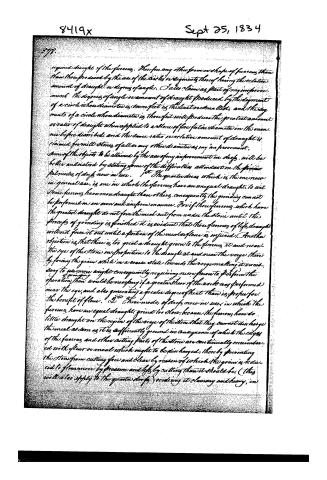
To all whom these presents shall come, Be it known that I Isaac W. Elmore of the Town of Lyons in the county of Wayne and State of New York have invented a new and useful improvement in the dress of mill stones for the manufacture of flour and for grinding any substance or substances usually ground in mills, and that the following is a full and exact description of said improvement as invented by me.
My improvement consists 1st In giving to the furrows of mill stones a greater degree of angle or draught at and near the region of the verge of the stone in proportion to the degrees of angle or draught near the eye or centre than has heretofore been used. 2nd In giving to the furrows at and near the region of the verge a greater degree of angle or draught than has heretofore been used or given to furrows of mill stones in which the degrees of angle or draught were equal in the furrows. The amount or degrees of angle or draught which I claim as part of my improvement or invention may be determined in the following manner, to wit. By using the segments of circles of any diameter from 800 to that of three feet and also the segments of circles of all or any intermediate diameter, between those of 800 and of three feet, on a stone the diameter of which is five feet (and in that proportion for stones of any other diameter) as follows. Place one of the points of an instrument proper for drawing or describing circles at or as near the centre of the stone as you choose (or in other words commencing with or without draught at the eye) using the other point as a pivot, and except or describe the segment of a circle from thence to the verge, the radius or arc used must be in proportion to the diameter of the stone to which it is applied in the ratio above claimed. All the I have used the circle and segments of circles to convey a knowledge of the principle of my improvement yet I do not consider myself bound or confined to this use of them to obtain the
Drawing
Page 3.
8419x
Sept 25, 1834
378
required draught of the furrows. There are any other form or shape of furrows than those produced by the use of the circles or segments thereof having the relative amount of draught, or degree of angle. I also claim as part of my improvement, the degrees of angle or amount of draught produced by the segment of a circle whose diameter is seven feet is the least or smallest, and the segments of a circle whose diameter is three feet will produce the greatest amount or ratio of draught when applied to a stone of five feet in diameter in the manner before described, and the same ratio or relative amount of draught is claimed for mill stones, of all or any other diameters as my improvement.
Some of the objects to be attained by the use of my improvement in drays, will be better understood by stating some of the difficulties attendant on the principal modes of drays now in use. 1st The quarter drays, which is the one now in general use, is one in which the furrows have an unequal draught, to wit some furrows have more draught than others, consequently the grinding cannot be performed in an even and uniform manner. For if those furrows, which have the greatest draught do not force the meal out from under the stone until the process of grinding is finished it is evident that those furrows of less draught will not force it out until a portion of the meal or flour is injured. Another objection is, that there is too great a draught given to the furrows, and near the eye of the stone in proportion to the draught at and near the verge thereof, by forcing the grain while in a coarse state towards the verge, making it necessary to use more weight consequently requiring more power to perform the operation, than would be necessary if a greater share of the work was performed near the eye, and also generating a greater degree of heat than is proper for the benefit of flour. 2nd Those modes of drays now in use, in which the furrows have an equal draught, grind too slow, because the furrows have so little draught on the region of the verge of the stone that they cannot discharge the meal as soon as it is sufficiently ground in consequence of which the edges of the furrows and other cutting parts of the stone are continually encumbered with flour or meal which ought to be discharged, thereby preventing the stone from cutting free and clearly reason of which the grain is reduced to flour more by pressure and less by cutting than it should be, (this will also apply to the quarter drays) rendering it clumsy and heavy, in
Page 4.
8419x
Sept 25, 1834
which state it will not bolt free, neither will it rise so well in baking.
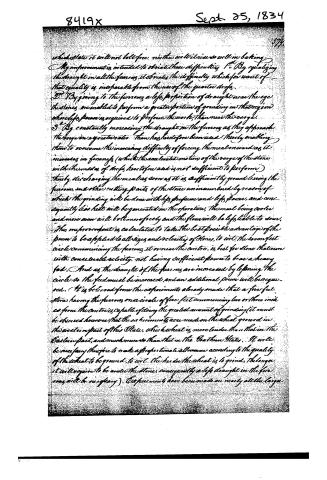
My improvements are intended to obviate these difficulties: 1st. By equalizing the draught in all the furrows it obviates the difficulty which for want of that equality is inseparable from the use of the quarter drops.
2d. By giving to the furrows a less proportion of draught near the eye the stones are enabled to perform a greater portion of grinding in that region where less power is required to perform the work, than near the verge.
3d. By constantly increasing the draught in the furrows as they approach the verge in a greater ratio than has heretofore been used, thereby enabling them to overcome the increasing difficulty of forcing the meal onward as it increases in fineness (which the accelerated motion of the verge of the stone with the modes of drops heretofore used is not sufficient to perform) thereby discharging the meal as soon as it is sufficiently ground, leaving the furrows and other cutting parts of the stone uninumbered by reasons of which the grinding will be done with less pressure and less power, and consequently less heat will be generated in the operation, the meal being cooler and more even will bolt more freely and the flour will be less liable to sour.
This improvement is calculated to take the best possible advantage of the power to be applied to all sizes and velocities of stones, to wit: the seven feet circle commencing the furrows it over near the centre, is best for stone that run with considerable velocity, not having sufficient power to bear a heavy load. And as the draught of the furrows are increased by lessening the circle so the feed must be increased, and an additional power will be required. (It is believed from the experiments already made that a five feet stone having the furrows one circle of five feet commencing two or three inches from the centre is capable of doing the greatest amount of grinding (it must be observed however that the experiments were made on the wheat grown in the western part of this State, which wheat is more tender than that in the Eastern part, and much more so than that in the Southern States. It will be necessary therefore to make a proportional allowance according to the quality of the wheat to be ground, to wit: the harder the wheat is to grind, the longer it will require to be under the stone, consequently a less draught in the furrows will be necessary.) Experiments have been made on nearly all the large
Page 5.
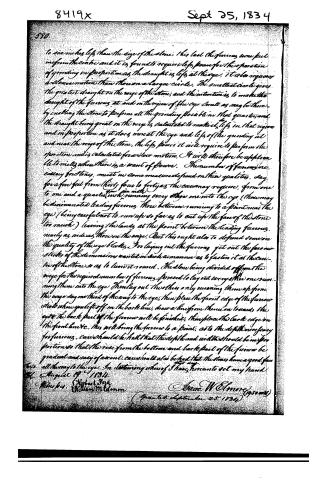
to six inches less than the size of the stone: this last the furrows were put in from the centre and it is found to require less power for the operation of grinding in proportion as the draught is less at the eye; it also requires a slower motion than thou on a larger circle. The smallest circle gives the greatest draught on the verge of the stone, and the intention is to make the draught of the furrows at and on the region of the eye small as may be there. by enabling the stone to perform all the grinding possible in that quarter, and the draught being great on the verge is calculated to make the less in that region and in proportion as it does more at the eye and less of the grinding at and near the verge of the stone, the less power it will require to perform the operation and is calculated for a slow motion. It will therefore be applicable to mills where there is a want of power. The number of furrows necessary for stones, must in some measure depend on their qualities. Say for a few feet from the eye four to forty as the case may require, from one to one and a quarter inch running every other one into the eye (those may be denominated leading furrows, those between running to a point near the eye) being careful not to run up so far as to cut up the face of the stone too much) leaving the lands at the point between the leading furrows nearly as wide as those on the verge. But this ought also to depend some on the quality of the eye blocks. For laying out the furrows get out the furrow sticks of the dimensions wanted in such a manner as to fasten it at the centre of the stone so as to turn it round. The stone being divided off on the verge for the required number of furrows, proceed to lay out every other one running them into the eye. Then lay out the others only running them up from the verge say one third of the way to the eye; then place the front edge of the furrow stick where you left it off on the back line, draw a line from there on towards the eye & the back part of the furrow will be finished; then place the back edge on the front line &c. this will bring the furrow to a point, as to the depth necessary for furrows, care should be had that the depth and width should be in proportion so that the rise from the bottom and back part of the furrow be gradual and easy of ascent, care should also be had that the stones have a good face all the way to the eye. In determining where of I have hereunto set my hand.
Sept 25, 1834
Wm. M. Elmore (19 years)
Published accounts: journal notice
Notice in the monthly list of patents, with remarks
Journal of the Franklin Institute, new ser., vol. 15 (1835), p. 260 · View the page
31. For an improvement in the Dress of Mill Stones; Isaac W. Elmore, Lyons, Wayne county, New York, September 25.
Remarks. This improvement is said to consist, "1st. In giving to the furrows of mill stones a greater degree of angle, or draft, at and near the region of the verge of the stone, in proportion to the degrees of angle, or draught, near the eye, or centre, than has heretofore been used. 2d. In giving to the furrows, at and near the region of the verge, a greater degree of angle, or draught, than has heretofore been used, or given to the furrows of mill stones, in which the degrees of angle, or draught, were equal in the furrows." "The amount, or degrees, of angle, or draught, which I claim as part of my improvement, or invention, may be determined in the following manner, to wit: By using the segments of circles of any diameter, from seven to three feet, and also the segments of circles of all or any intermediate diameter between those of seven and of three feet, on a stone the diameter of which is five feet, and in that proportion for stones of any other diameter, as follows: Place one of the points of an instrument proper for sweeping circles, at as near the centre of the stone as you choose, or, in other words, commencing with or without draft at the eye, using the other point as a pivot, and sweep, or describe the segment of a circle from thence to the verge; the radius, or sweep, used must be in proportionate length to the diameter of the stones to which it is applied, in the ratio above claimed." The general principle upon which the patentee proceeds, being thus given by him, he goes on to state, particularly, the practical means of carrying it into operation, and institutes a comparison between this and the ordinary mode of procedure, in a manner which shows a competent acquaintance with the subject. We cannot follow him through this course, nor are we able to decide upon the merits of his plan; a question which, we apprehend, cannot be satisfactorily settled, otherwise than by actual experience.
About this record
- Patentee
- DATAMP
- Date
- the Name and Date index of patents, DATAMP, USPTO records
- Invention
- DATAMP
- Listed in
- the Name and Date index of patents, DATAMP, USPTO records, Jim Shaw's X-patent list, the Journal of the Franklin Institute, Burke's List of Patents (1847)
- Burke's 1847 Patent Office list gives the same patent.