

Drawings and documents
USPTO scan
The patent as scanned by the USPTO
-
 Page 1
-
 Page 2
-
 Page 3
-
 Page 4


U.S. Patent and Trademark Office · Google Patents
Show the transcription Hide (911 words)
Machine transcription (LightOnOCR) of the pages as scanned by the USPTO, most of them the handwritten copies made when the records were restored after the 1836 fire. Not checked; it can misread handwriting, so compare it with the scan.
Page 2.
United States Patent
Patent No.: X8434
Othniel Stone
Spelled Patent
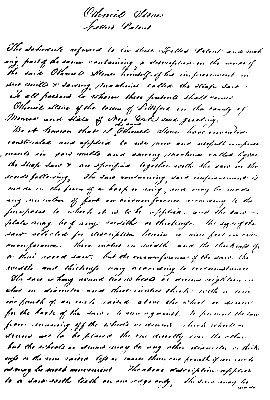
The schedule referred to in these Spelled Patent and making part of the same containing a description in the words of the said Othniel Stone himself, of his improvement in saw mills & sawing machines called the Sharp Saw.
To all persons to whom these presents shall come:
Othniel Stone of the town of Pittsford in the county of Monroe and State of New York, and greeting.
Be it known that I Othniel Stone have invented, constructed and applied to use new and useful improvements in saw mills and sawing machines called by me the Sharp Saw & are specified together with the same in the words following. The saw containing said improvement is made in the form of a hoop or ring, and may be made any number of feet in circumference according to the purposes to which it is to be applied, and the saw plate may be of any width or thickness. The size of the saw selected for description herein is nine feet in circumference. These inches in width and the thickness of a thin wood saw; but the circumference of the saw, the width and thickness may according to circumstances. The saw is hung around two wheels or drums eight feet in diameter and three inches thick with a rim one fourth of an inch raised above the wheel or drum for the back of the saw, to run against, to prevent the saw from running off the wheels or drums which wheels or drums are to be placed the one directly over the other but the wheels or drums may be any other diameter or thickness or the rim raised less or more than one fourth of an inch, as may be most convenient. The above description applies to a saw with teeth on one edge only. The saw may be made
Page 3.
United States Patent
Patent No.: X8434
made with teeth on both edges so as to saw both ways, in which case the wheels or drums will be made with cogs in the center of the wheels or drums two inches apart and one fourth of an inch square at the surface and tapering towards the outer edge with square holes in the saw two inches apart and one fourth of an inch square to keep the saw within its motion from slipping either way on the wheels or drums, but the cogs may be put any distance apart and any size provided they secure the saw when in motion from slipping on the wheels or drums, and the wheels or drums may be any thickness, but if they are thicker than the width of the saw, it will be necessary that the part of the wheels or drums directly under the teeth of the saw be made less than the rest of the part of the wheels or drums so as to prevent the saw from cutting the set out of the saw. The wheels may be made of wood or iron or any kind of metal or part wood and part iron or metal. If the wheels or drums be made of iron or any kind of metal the same may be covered with leather so that the outer edge or cogs may be filed or cut down as the saw grows worn, by use. The saw is to be kept steady by means of two pairs of rollers, the lower pair stationary, and the upper pair movable. The lower pair of rollers will be placed directly under and as near as may be to the timber or wood to be sawed, and the upper rollers will be placed directly over the timber or wood to be sawed with a slide to raise it up or down as the thickness of the timber or wood to be sawed may require which rollers may be made of wood or iron or part wood & part iron & to be as long as the saw is wide and the rollers of each pair to be far enough apart to let the saw pass between them and make a little space where the saw teeth can so as not to take the set out, which rollers may be an inch or more in diameter. If it should be necessary one
Page 4.
United States Patent
Patent No.: X8434
or more set of rollers may be stationed to keep the saw steady & from trembling. The saw may be driven by the application of hand, horse, steam, or water power and applied to the sawing of small logs of any dimensions. Slicing sawing, veneering, sawing wood, or any kind of sawing whatever. When the saw is stationed upon the wheels or around the sides will be flattened. The specific new and useful improvements herein before described and claimed by me as the inventor are the following. First the shape of the saw. Second the manner of hanging the saw. Third the manner of keeping the saw steady when in motion by means of rollers. Fourth the manner of making the saw with teeth on one or both edges
Witnesses
Shen Bellows
Solomon Stone
Oliver Stone
Drawing
Toyo.
11/96.
5471081
Published accounts: journal notice
Notice in the monthly list of patents, with remarks
Journal of the Franklin Institute, new ser., vol. 15 (1835), p. 315 · View the page
The heart has a circular horizontal motion between two prongs of a tube, which gives the tube a vibrating motion that distributes the roving on the bobbin; this tube is hung on pivots at the top, where the prongs are connected; the bearings of the pivots are attached to the box, which turns with the flyer. The regulating circular motion of the heart, and the vibrating motion of the tube, are taken from a circular perpendicular motion of a bobbin, which has a circular horizontal one at the same time," &c. 9. For improvements in Saw Mills; Othniel Stone, Pittsford, Monroe county, New York, October 6.
Remarks. A saw is to be so made as to form a band, or hoop, of any convenient diameter and width; this band is to be passed, like a strap, over two circular drums, one above the other, and the sawing is to be effected by the straight part between the drums; these latter are to have projecting rims, to bear against the back of the saw. To prevent the saw from trembling, it is to pass between friction rollers, stationed just below and above the timber to be sawed. "The specific new and useful improvements hereinbefore described, and claimed by me as the inventor, are the following. "First. The shape of the saw. Second. 'The manner of hanging the saw. Third. The manner of keeping the saw steady, when in motion, by means of rollers. Fourth. The manner of making the saw with teeth on one or both edges." We have, on more than one occasion, had to refer to the article SAWING, in Rees' Cyclopedia, in which this saw is mentioned as having been patented in England, long ago; how frequently it has sought the same sanction with us, we shall not stop to inquire; but we know that it was patented in 1817, by Adam Stewart, of Baltimore, Maryland; the practical difficulties, however, attending its construction and use, soon convinced its reinventors that it was best to abandon it.
DATAMP: illustration
Illustrations from DATAMP
DATAMP (Directory of American Tool and Machinery Patents), via the Internet Archive · Archived DATAMP page
About this record
- Patentee
- DATAMP
- Date
- the Name and Date index of patents, DATAMP, USPTO records
- Invention
- DATAMP
- Listed in
- the Name and Date index of patents, DATAMP, USPTO records, Jim Shaw's X-patent list, the Journal of the Franklin Institute, Burke's List of Patents (1847)
- Burke's 1847 Patent Office list gives the same patent.