

Drawings and documents
National Archives restored drawings: drawing
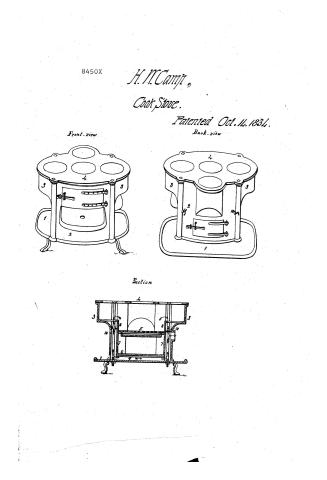
Henry W. Camp's Patent Drawing for a Cooking Stove

National Archives, Restored Patent Drawings (Record Group 241) · Full-size scan at the National Archives · Catalog record
Show the text on the drawing Hide (95 words)
Words on the drawing as machine-read by the National Archives; not checked. Useful mainly for searching.
$2- / 126. STOVES & FURNACES / [154] Cooking Stoves. / CLASSIFICATION / 8450+ / DIVISION. / Heenry W Camp d / booking Stove. / Patented: Oct. 14: 1834. / Back- view. / Front view / Section / 4. / 3. / 3, / 3. / 11 / 10.7 / TA / 1. / allo / 2639 / Patent office 15th Sept 1838, / References. / / Bottom- plate / Made under the direction of the b ammipiour / 2. Side- plates / 3. End- plates / of Patents in conformity with Out 3d March 1854 / 4. Top- plate / 5. Fire- plate / b. over plate / % End plates of the over / M.LSWorth / 8. Perpendicular plates for forming the flued, ye. / 9 Flues / 10. Dampers / Commisioner of Patiely, / F. Benne del:
USPTO scan
The patent as scanned by the USPTO
-
 Page 1
-
 Page 2
-
 Page 3
-
 Page 4
-
 Page 5
-
 Page 6
-
 Page 7
-
 Page 8


U.S. Patent and Trademark Office · Google Patents
Show the transcription Hide (2,570 words)
Machine transcription (LightOnOCR) of the pages as scanned by the USPTO, most of them the handwritten copies made when the records were restored after the 1836 fire. Not checked; it can misread handwriting, so compare it with the scan.
Page 1.
8450X
H. M. Camp,
Cook Stove.
Patented Oct. 11, 1834.
Front-view
Back-view
Section
Page 2.
Oct 14, 1834
Henry William Camp
Letters Patent
The schedule referred to in these Letters Patent and making part of the same containing a description in the words of the said Henry William Camp himself of his improvement in the common Iron Cooking Stove
To all to whom these presents shall come: Be it known that I Henry W. Camp of Oswego in the County of Tioga and State of New York have invented a new and useful improvement in the construction and operation of the common Iron Cooking Stove; and that the following is a full and exact description of the construction and operation of the said stove as invented or improved by me; that is to say. The size and form of the stove is not so material and in these it may be varied. The following is a description of one of an ordinary size and shape with the proportions. The body of the stove being oblong has swelled sides and ends. The swelled or curved ends extend but part of the way from the top down, leaving the base or bottom part of the stove of much less dimensions than the upper part and has but two doors, one the fire door on the front side of the stove for putting in fuel, and the other the oven door on the back side of the stove. The body of the stove is twenty-two inches and a half high and three feet in length across the top and about 22 inches wide including the projection for the reception of a boiler on the back side. The base or lower part being about 28 inches long and 14 inches wide through the centre and 9 through the ends; and has two hearths one on the front and one on the back side of the stove. The upper or fire hearth on the front side is sunk for holding ashes and coals, and the lower or oven hearth on the back side for the convenience of the oven which is in the lower part of the stove. The whole stove being an irregular figure of which a more perfect idea may be formed from the following description of the several plates and parts. 1st The bottom plate is a slong
Page 3.
114
8450X
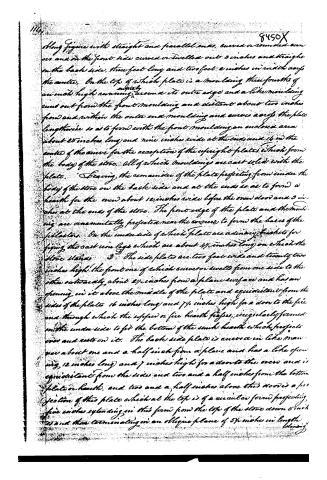
Along figure with straight and parallel ends, curved or rounded corners and on the front side curved or swelled out 3 inches and straight on the back side, three feet long and two feet 2 inches in width across the centre. On the top of which plate is a moulding three fourths of an inch high running around its outer edge and a like moulding runs out from the front moulding and distant about two inches from and within the outer end moulding and curves across the plate lengthwise so as to form with the front moulding an enclosed area about 25 inches long and nine inches wide at the ends and 14 in the centre of the curve for the reception of the upright plates which form the body of the stove, all of which mouldings are cast solid with the plate. Leaving the remainder of the plate projecting from under the body of the stove on the back side and at the ends so as to form a hearth for the oven about 12 inches wide before the oven door and 3 inches at the ends of the stove. The front edge of the plate and the moulding are ornamentally projected near the corners to form the bases of the pilasters. On the inside side of which plate are ordinary brackets for fixing the cast iron legs which are about 4½ inches long on which the stove stands.
3. The side plates are two feet wide and twenty two inches high, the front one of which curves or swells from one side to the other outwardly about 2½ inches from a plane surface and has an opening in it above the middle of the plate and equidistant from the sides of the plate 16 inches long and 7½ inches high for a door to the fire and through which the upper or fire hearth passes, irregularly formed on the under side to fit the bottom of the such hearth which projects over and rests on it. The back side plate is curved in like manner about one and a half inch from a plane and has a like opening, 12 inches long and 7 inches high for a door to the oven and is equidistant from the sides and two and a half inches from the bottom plate or hearth, and two and a half inches above that door is a projection of this plate which at the top is of a circular form projecting five inches extending in this form from the top of the stove down 6 inches and then terminating in an oblique plane of 5½ inches in length.
Hendry
Page 4.
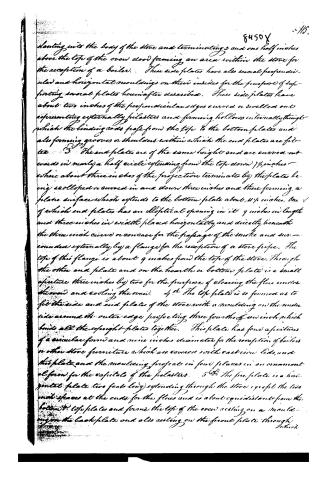
slanting into the body of the stone and terminating 2 and one half inches above the top of the oven door forming an area within the stone for the reception of a boiler. These side plates have also several perpendicular and horizontal mouldings on their insides for the purpose of supporting several plates hereinafter described. These side plates have about two inches of the perpendicular edges curved or swelled out representing externally pilasters and forming hollows internally through which the binding rods pass from the top to the bottom plates and also forming grooves or shoulders within which the end plates are fitted.
3. The end plates are of the same height and are curved outwards in nearly a half circle extending from the top down 7 1/4 inches where about three inches of the projection terminates by the plates being collapsed or curved in and down three inches and there forming a plane surface which extends to the bottom plate about 11 1/4 inches. One of which end plates has an elliptical opening in it 9 inches in length and three inches in width placed horizontally and directly beneath the three inch curve or concave for the passage of the smoke and surrounded externally by a flange for the reception of a stove pipe. The top of this flange is about 9 inches from the top of the stone. Through the other end plate and on the hearth or bottom plate is a small aperture three inches by two for the purpose of clearing the flue under the oven and cooling the oven.
4. The top plate is so formed as to fit the side and end plates of the stone with a moulding on the under side around its outer edge projecting three fourths of an inch which binds all the upright plates together. This plate has four apertures of a circular form and nine inches diameter for the reception of boilers or other stove furniture which are covered with cast iron lids, and this plate and the moulding project in four places in an ornamental form for the capitals of the pilasters.
5. The fire plate is a horizontal plate two feet long extending through the stone except the two inch spaces at the ends for the flues and is about equidistant from the bottom top plate and forms the top of the oven resting on a moulding on the back plate and also resting on the front plate through which
Page 5.
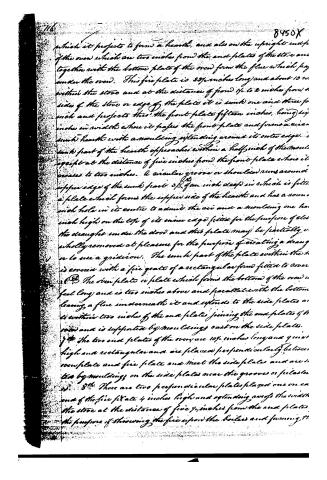
which it projects to form a hearth, and also on the upright ends of the oven which are two inches from the end plates of the stove and together with the bottom plate of the oven form the flue which passes under the oven. This fire plate is 23½ inches long and about 10 inches within the stove and at the distance of from 1½ to 2 inches from the side of the stove or edge of the plate it is sunk one and three-fourths inch and projects three inches the front plate fifteen inches, being six inches in width where it passes the front plate and forms a circular sunk hearth with a moulding extending around its outer edge. The sunk part of the hearth approaches within a half inch of the moulding except at the distance of five inches from the front plate where it comes to two inches. A circular groove or shoulder runs around the upper edge of the sunk part 2½ inches deep in which is fitted a plate which forms the upper side of the hearth and has a round inch hole in its centre to admit the air and a moulding one inch high on the top of its inner edge fitted for the purpose of closing the draught under the door and this plate may be partially or wholly removed at pleasure for the purpose of creating a draught or to use a gridiron. The sunk part of the plate within the stove is covered with a fire grate of a rectangular form fitted to cover the oven plate or plate which forms the bottom of the oven 10 feet long and is two inches above and parallel with the bottom leaving a flue underneath it and extends to the side plates or to within two inches of the end plates joining the end plates of the stove and is supported by mouldings cast on the side plates. The two end plates of the oven are 10½ inches long and 9 inches high and rectangular and are placed perpendicularly between the oven plate and fire plate and meet the side plates and are supported by mouldings on the side plates near the grooves or pilasters. 8th. There are two perpendicular plates placed one on each end of the fire plate 4 inches high and extending across the width of the stove at the distance of five inches from the end plates the purpose of throwing the fire upon the boilers and forming a
Page 6.
and protecting them from ashes, each plate having on its upper edge a horizontal grate cast solid on and forming with it a right angle, each of which grates extends towards the end plate in a circular form so as to cover the flues and protect the dampers from coals or fuel unless these are held firmly in their places by moulding cast on the side plates for that purpose. 9th. There are two flues or what is called a double flue. One is the long flue and extends over one of the plates last mentioned, passing through the grate and down between the end plate and this grate-plate and still down between the end plate of the stove and that of the oven to the bottom plate, and passes under the oven and up on the other end of the stove between plates like those at the end where it passes down to the aperture where it passes off 8½ inches from the bottom plate. And the other flue passes over the other upright plate and through its grate and down 4½ inches directly to the aperture where it meets the long flue and both are discharged through the same into the pipe or chimney. 10th. There are two dampers formed of flat pieces of cast iron 9 inches by three extending at each end to form pivots and rounded at the corners and beveled on one edge to fit and close the flue and rounded on the pivot edge for turning placed horizontally in the flues and resting on the ends of the fire plates with one pivot of each resting in countersinks in the front plate, and the other passing through the back side plate and made square so as to be turned on the outside with a small crank fitted to them for the purpose of closing either of the flues and regulating the draughts and for partially or wholly turning the fire under the oven or passing it off through the short flue and thus regulating the heat of the oven. The whole stove being bound together by four wrought iron rods passing through perpendicularly with heads in countersunk holes in the top plates and nuts on the rods beneath the bottom plate—the whole stove being of cast iron except the rods and turnings. The improvements claimed are principally as follows:
1. In the form and construction of the flues & dampers for the fire
Page 7.
118 8450X
piece of directing and regulating the fire, being so constructed as to cause a draught of heat from the fire both ways and equalize them (to one way or the other by simply moving one or both dampers so as to apply the heat where it may be needed and turn under the oven or not or partially so for baking with greater safety and better, the heat being by this process distributed equally and better through the whole stove and applied so directly to the bodies and cooking utensils or oven as to acquire less fuel and other differently constructed stove or fireplace whatever, furnish the same facilities—all of which is further described.
2. On the form and construction of the fire hearth which is also described above, comprising an ordinary hearth on the top plate, ordinary use and convenience and a sunk hearth under it as can (with the sunk plate within the stove) contain convenient quantities of coals and ashes for cooking and forms a receptacle for ashes from the burning fuel which is upheld by the grate as described and by means of this and the draught made to burn fire and advantageously. This draught being varied and increased or diminished by means of a hole in the centre of the upper plate, the hearth and the partial or entire removal of this plate, is removed entirely to admit of the use of a gridiron or other cooking utensil.
3. On the oven and the application of the heat to it & its location. It being so situated that it may have only gentle heat all around it or a heat on the upper side only, intense heat all around it or otherwise, and which heat may shut off at once and cool air allowed to pass into the bottom.
4. On the situation of the main flue and flange for conducting the smoke in such a manner and place as to ensure a draught and admit of a beneficial use of the two flues and the dampers above mentioned.
5. On the formation and construction of the proper plates which form the flues with the grates attached, to the whole of each being one piece cast solid and forming an enclosure over the flues against the admission of fuel or other things.
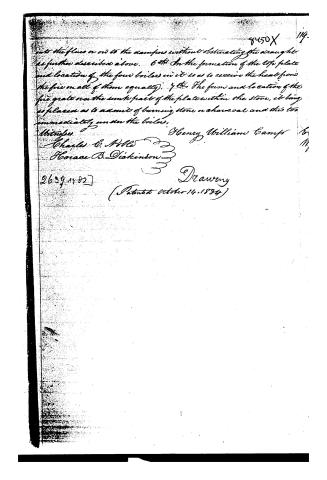
Page 8.
into the flues or ovens to the dampers without obstructing the air draught as further described above. 6th In the formation of the top plate and location of the four boilers in it is so as to receive the heat from the fire on all of them equally. 7th The form and location of the fire grate over the sunken part of the plate within the stove, it being so placed as to admit of burning stone or charcoal and this too immediately under the boilers.
Witness
Henry William Camps
Charles E. Noble
Horace B. Dickinson
2637.11.82
Drawing
(Patented October 14, 1834)
Published accounts: journal notice
Notice in the monthly list of patents, with remarks
Journal of the Franklin Institute, new ser., vol. 15 (1835), p. 319 · View the page
21. For an improvement in the common Cooking Stove; Henry W. Camp, Owego, Tioga county, New York, October 14.
Remarks. What are called improvements in this stove, consist in the particular manner of arranging the respective parts, and more especially the flues. "The improvements claimed are principally as follows. "1st. In the form and construction of the flues and dampers, for the purpose of directing and regulating the fire; being so constructed as to cause a draught of heat both ways, and equalize or turn it one way or the other, by simply moving one or both dampers, so as to apply the heat where it may be needed, and turn it under the oven, or not, or partially so, for baking with greater safety, and better. The heat being by this process distributed equally, if necessary, through the whole stove, and applied so directly on the boilers, or cooking utensils, or oven, as to require less fuel than any other differently constructed stove, or fireplace, whatever, to furnish the same facilities. "2d. In the form and construction of the fire hearth, comprising an ordinary hearth on the top plate, for ordinary use and convenience, and a sunk hearth under it, which can, with the sunk plate within the stove, contain convenient quantities of coals and ashes for cooking, and forms a receptacle for ashes from the burning fuel, which is upheld by the grate above described; by means of this and the draught, made to burn freely and advantageously. This draught being caused and increased or diminished by means of a hole in the centre of the upper plate of the hearth, and the partial or entire removal of the plate, which is removed entirely to admit of a gridiron, or other cooking utensil." We have not yet passed half way through the claims, and will, therefore, to save space, give a mere outline of the remainder. 4th. The situation of the main flue, and the dampers by which it is governed. 5th. The formation of the perpendicular plates, which form the flues, &c. 6th. The formation of the top plate, and the location of the four boilers. 7th. The form and location of the fire grate, &c. We have found the claim too long for insertion, and are very apprehensive that, if tested in court, the patentee will learn that he has made it too broad also. The basis upon which a patent must be sustained, is the invention, and not the claim, of the applicant; but, as in the case before us, patentees are very apt to mistake the one for the other.
About this record
- Patentee
- the Journal of the Franklin Institute, Journal
- Date
- the Name and Date index of patents, USPTO records, Jim Shaw's X-patent list
- Invention
- the Name and Date index of patents
- Listed in
- the Name and Date index of patents, USPTO records, Jim Shaw's X-patent list, the Journal of the Franklin Institute, Burke's List of Patents (1847)
- The patentee's full name comes from the Franklin Institute's journal.
- Burke's 1847 Patent Office list gives the same patent.