

Drawings and documents
National Archives restored drawings: drawing
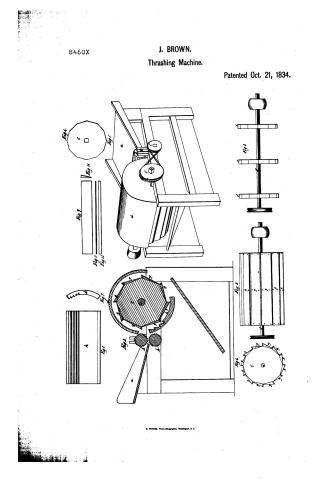
John Brown's Patent Drawing for a Thrashing Machine

National Archives, Restored Patent Drawings (Record Group 241) · Full-size scan at the National Archives · Catalog record
Show the text on the drawing Hide (146 words)
Words on the drawing as machine-read by the National Archives; not checked. Useful mainly for searching.
130. THRASHING. / [] / Thrashing Machines. / Einiered / A. Cylinder Machines. / CLASSIFICATION / 8460-x 84 / DIVISION. / John Brown / Vol.18.pg. 575 / Thrashing Machine. / Patented Get2i.1834. / 243 / h. / figg. / Preferences. / a feed trough. / Dig.8 / Jig.7. / b. b feeding rollers. / Aig.R / C.C whires. / a cover / Sig.1. / occylinders head. see Sig. 3. / Jig.2. / f shaft. / g.g.g.g.g.g.le. beaters. / h. concave. / Fig. / Perspective view. / Tig.2 Lection. / Fig. 3 head andshaft, seen in Front / Sig. a head, side view. / Jig.5 . the cylinder / Aig. 6 side view of cylinder fig / Jig fide view of / ia concave Jig.8 Topviewof / Fig. 10 side view of / concaveh. Fig Topricurofe beater / Top peing / Fig. 12 fide view of dtto. / Patent offile Teptember 1841 / made under the direction of the Commits / of Patents in conformity with act of 3' march 1857. / Sig.6. / Commitions of Patents / Jigs / Sigh / Fig.3 / filt.
USPTO scan
The patent as scanned by the USPTO
-
 Page 1
-
 Page 2
-
 Page 3


U.S. Patent and Trademark Office · Google Patents
Show the transcription Hide (658 words)
Machine transcription (LightOnOCR) of the pages as scanned by the USPTO, most of them the handwritten copies made when the records were restored after the 1836 fire. Not checked; it can misread handwriting, so compare it with the scan.
Page 1.
8460X
J. BROWN.
Thrashing Machine.
Patented Oct. 21, 1834.

N. PETER, Photo-Lithographer, Washington, D.C.
Page 2.
John Brown, of Jackson, Tenn.
Letter Patent
The Schedule referred to in these Letters Patent and making part of the same, containing a description in the words of the said John Brown himself, of his improvement in a machine for threshing grain —
To all to whom these presents shall come: Be it known that I John Brown of Jackson, in the County of Madison and State of Tennessee, have invented a new and useful improvement in a machine for threshing grain, and that the following is a full and exact description of the construction and operation of the said machine as invented or improved by me.
The machine like those in ordinary use consists of a supporting frame, feed trough feeding rollers, bands, whirli coneave, cylinder cap or cover and cylinder. The latter alone being peculiar in its construction and is made as follows. Three or more polygonal wooden heads equal in diameter to that of the intended cylinder with any number of sides, say 12 are firmly secured to an iron shaft of proper dimensions, passing through their centres, so as to stand at equal distances apart the distance between the two outside ones being equal to the length of the intended cylinder — Twelve or more strikers or beaters are secured to the heads, formed of strips or bars of hard wood, say, of ash equal in length to the cylinder, their breadth corresponding to the side of the polygon, and their thickness at one edge being one third their breadth, whilst at the other it may be of a thickness only sufficient to form a close joint with the adjoining beater, or in other words their external surfaces being in a profile resembling the appearance of saw teeth and the internal the sides of the polygonal heads. — Each bar may be secured by two screws to each head, so as to be firm and solid — The front or highest edges of the bars or beaters are faced with strap iron or such as is used for looping cakes, the outer edge of each strap coinciding neatly with the outer or acute corners of the beater which may be best effected by filing the iron down to it, after it is secured thereto by a sufficient number of screws — —
Page 3.
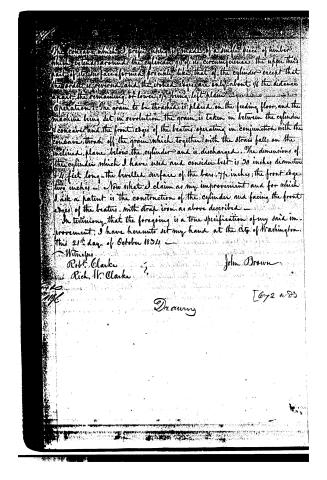
The concave which I prefer, being made of a single piece of timber which extends around the cylinder 1/2 of its circumference, the upper third part of its surface formed precisely like that of the cylinder except that the order is reversed and the toothed edges are only about 1/6 the distance apart, the remaining or lower 2/3 being left plain.
Operation: The grain to be threshed is placed on the feeding floor, and the machine being set in revolution, the grain is taken in between the cylinder and concave and the front edges of the beaters operating in conjunction with the concave, thrash off the grain which together with the straw falls on the inclined plane below the cylinder and is discharged. The dimensions of the cylinder which I have used and consider best is 30 inches diameter 4 feet long—the bevelled surface of the bars 7 1/2 inches; the front edge two inches. Now what I claim as my improvement and for which I ask a patent is the construction of the cylinder and facing the front edges of the beaters with strap iron as above described.
In testimony that the foregoing is a true specification of my said improvement, I have hereunto set my hand at the City of Washington this 21st day of October 1854.
Witnesses
Robt. Clarke
Rich. W. Clarke
John Brown
Drawing
[672 wds]
Published accounts: journal notice
Notice in the monthly list of patents, with remarks
Journal of the Franklin Institute, new ser., vol. 15 (1835), p. 326 · View the page
33. For a Thrashing Machine; John Brown, Jackson, Madison county, Tennessee, October 21.
Remarks. We need not describe this machine, except in one particular point of its formation, this being the only thing claimed. The cylinder is grooved from end to end, in such a manner as to give to its section the form of saw teeth, and the vertical part of these teeth, which constitute the beaters, are faced with iron.
About this record
- Patentee
- Jim Shaw's X-patent list
- Date
- the Name and Date index of patents, USPTO records, Jim Shaw's X-patent list
- Invention
- the Name and Date index of patents
- Listed in
- the Name and Date index of patents, USPTO records, Jim Shaw's X-patent list, the Journal of the Franklin Institute, Burke's List of Patents (1847)
- The residence comes from the Franklin Institute's journal.
- Burke's 1847 Patent Office list gives the same patent.