

Drawings and documents
National Archives restored drawings: drawing
T.B. Stillman's Patent Drawing for a Steam Valve

National Archives, Restored Patent Drawings (Record Group 241) · Full-size scan at the National Archives · Catalog record
Show the text on the drawing Hide (50 words)
Words on the drawing as machine-read by the National Archives; not checked. Useful mainly for searching.
191. STEAM / 1. / ENGINES. / [W2] / Out Offs. / 75 / Steam Engines- Valves / T B STILLMAN'S. / Transcribed from a / CLASSIFICATION / Certified Copy of the Original / 8480.+ / DIVISION / STEAM VALVE. / Potented 30ᵗʰ Oct, 1834. / v18p255 V / Fig 2. / Fig 1. / Frg 3. / Fig 4. / ET
USPTO scan
The patent as scanned by the USPTO
-
 Page 1
-
 Page 2
-
 Page 3
-
 Page 4


U.S. Patent and Trademark Office · Google Patents
Show the transcription Hide (882 words)
Machine transcription (LightOnOCR) of the pages as scanned by the USPTO, most of them the handwritten copies made when the records were restored after the 1836 fire. Not checked; it can misread handwriting, so compare it with the scan.
Page 1.
8480X
T. B. Stillman,
Steam Cut-Off.
Patented Oct. 30, 1884.
Fig. 2.
Fig. 3.
Fig. 4.
Fig. 1.
AM. PHOTO-LITHO. CO. N. Y. (OSSORNE'S PROCESS)
Page 2.
Thomas B. Stillman
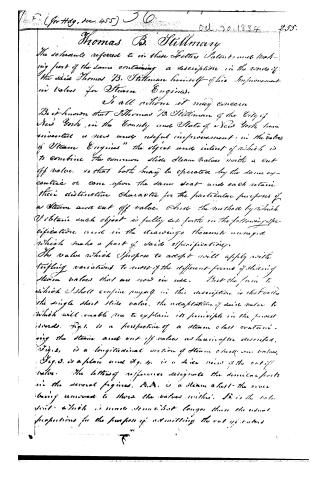
The scheme referred to in these Letters Patent and making part of the same containing a description in the words of the said Thomas B. Stillman himself of his Improvement in Valves for Steam Engines.
To all whom it may concern
Be it known that Thomas B. Stillman of the City of New York, in the County and State of New York have invented a new and useful improvement in the valves of Steam Engines, the object and intent of which is to combine the common slide steam valves with a cut off valve, so that both may be operated by the same eccentric or cone upon the same seat and each retain their distinctive character for the particular purposes of a steam and cut off valve. And the method by which I obtain such object is fully set forth in the following specification and in the drawings thereunto annexed which make a part of said specification.
The valve which I propose to adopt will apply with trifling variations to most of the different forms of sliding steam valves that are now in use. But the form to which I shall confine myself in this description is that called the single short slide valve, the adaptation of said valve to which will enable me to explain its principle in the fewest words. Fig. 1 is a perspective of a steam chest containing the steam and cut off valves as herein after described. Fig. 2 is a longitudinal section of steam chest and valves. Fig. 3 is a plan and Fig. 4 is a side view of the cut off valve. The letters of reference designate the similar parts in the several figures. A.A. is a steam chest—the cover being removed to show the valves within. B is the valve seat which is made somewhat longer than the usual proportions for the purpose of admitting the cut off steam.
Page 3.
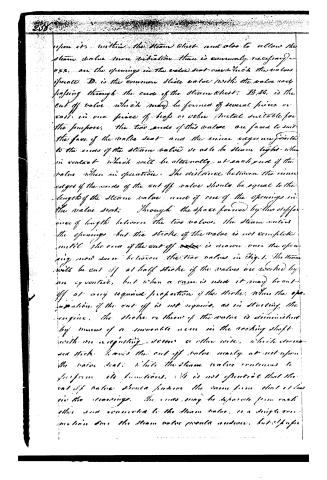
upon it, within the steam chest and also to allow the steam valve more vibration than is commonly necessary. See the openings in the valve seat over which the valves operate. D is the common slide valve with the valve port passing through the end of the steam chest; E, E, is the cut off valve which may be formed of several pieces or cast in one piece of brass or other metal suitable for the purpose. The two ends of this valve are faced to suit the face of the valve seat and the inner edges are fitted to the ends of the steam valve so as to be steam tight when in contact which will be alternately at each end of the valve when in operation. The distance between the inner edges of the ends of the cut off valve should be equal to the length of the steam valve and of one of the openings in the valve seat. Through the space formed by the difference of length between the two valves, the steam enters the opening but the stroke of the valve is not complete until the end of the cut off valve is drawn over the opening now seen between the two valves in Fig. 1. The steam will be cut off at half stroke if the valves are worked by an eccentric, but when a cam is used it may be cut off at any required proportion of the stroke. When the operation of the cut off is not required, as in starting the engine, the stroke or throw of the valve is diminished by means of a movable arm in the rocking shaft with an adjusting screw or other wise, which draws the cut off valve nearly at rest upon the valve seat while the steam valve continues to perform its functions. It is not essential that the cut off valve should have the same form that is now in the drawings. The ends may be separate from each other and connected to the steam valve, or a single arm may be used. The steam valve would condense, but if pro-
Page 4.
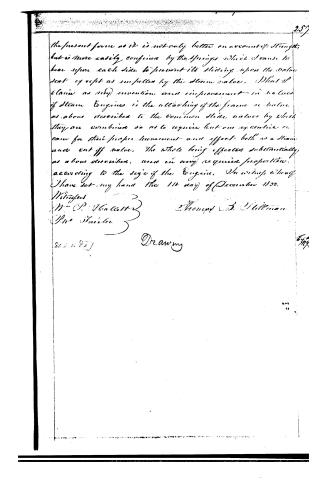
The present form as it is not only better on account of strength, but is more easily confined by the springs which I cause to bear upon each side to prevent its sliding upon the valve seat except as impelled by the steam valves. What I claim as my invention and improvement in valves of steam engines is the attaching of the frame or valve as above described to the common slide valves by which they are combined so as to require but one eccentric or cam for their proper movement and effects both as a steam and cut off valve, the whole being effected substantially as above described, and in any required proportion, according to the size of the engine. In witness whereof I have set my hand the 11th day of December 1833.
Witness
Wm. P. Hackett
Pro. Stairler
Thomas B. Stillman
Drawing
Published accounts: journal notice
Notice in the monthly list of patents, with remarks
Journal of the Franklin Institute, new ser., vol. 15 (1835), p. 332 · View the page
A wisp, tangle, or irregular coil, of small wire, is to be placed in the steam chamber, or rather, we presume, in the steam pipe, so as to occupy six or eight inches of its lower part; or layers of woven wire, or other similar substance, may be substituted for the wisp of wire, although the latter is deemed the best. The doing this is the thing claimed, 48. For an improvement in Valves for Steam Engines; Thos. B. Stillman, city of New York, October 30.
Remarks. The object proposed to be attained by this invention, "is to combine the common slide steam valve, with a cut off valve, so that both may be operated by the same eccentric, or cam, upon the same seat, and each retain its distinctive character, for the particular purposes of a steam and cut off valve." Without a drawing we shall not attempt to explain the particular arrangement of this combined valve, the purpose of which is shown in the above quotation.
About this record
- Patentee
- Jim Shaw's X-patent list
- Date
- the Name and Date index of patents, USPTO records, Jim Shaw's X-patent list
- Invention
- the Name and Date index of patents
- Listed in
- the Name and Date index of patents, USPTO records, Jim Shaw's X-patent list, the Journal of the Franklin Institute, Burke's List of Patents (1847)
- Burke's 1847 Patent Office list gives the same patent.