

Drawings and documents
USPTO scan
The patent as scanned by the USPTO
-
 Page 1
-
 Page 2
-
 Page 3


U.S. Patent and Trademark Office · Google Patents
Show the transcription Hide (535 words)
Machine transcription (LightOnOCR) of the pages as scanned by the USPTO, most of them the handwritten copies made when the records were restored after the 1836 fire. Not checked; it can misread handwriting, so compare it with the scan.
Page 1.
TEMPORARY NOTICE of BEST AVAILABLE IMAGE
U. S. PATENT AND TRADEMARK OFFICE
THE SCANNED IMAGES OF PATENT NUMBER
8488 ½ X
FOR THE ISSUE DATE OF
11/6/1834. ARE NOT THE COMPLETE ORIGINAL
DOCUMENT, BUT CONTAIN A COPY OF THE BEST
AVAILABLE TEXT AND IMAGE DATA FROM VARIOUS
SOURCES.
WHEN THE MISSING INFORMATION BECOMES AVAILABLE,
THE DOCUMENT WILL BE RESCANNED AND REPLACED.
ANY QUESTIONS SHOULD BE DIRECTED TO THE DATA
MAINTENANCE BRANCH BY TELEPHONE AT (703) 306-3116.
TEMPORARY NOTICE of BEST AVAILABLE IMAGE
Page 2.
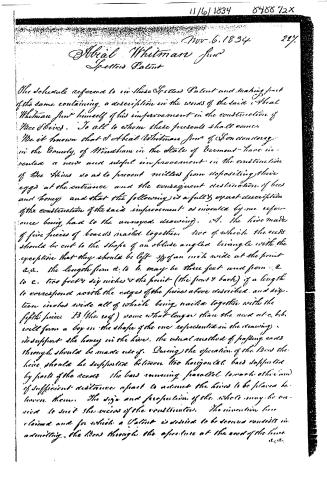
11/6/1834 8488 12X
Nov. 6, 1834 227.
Abial Whitman Junr
Spettias Patent
The schedule referred to in these Spettias Patent and making part of the same containing a description in the words of the said Abial Whitman Junr himself of his improvement in the construction of Bee Hives. To all to whom these presents shall come.
Be it known that I Abial Whitman Junr of Bennington in the County of Windham in the State of Vermont have invented a new and useful improvement in the construction of Bee Hives so as to prevent moles from depositing their eggs at the entrance and the consequent destruction of bees and honey and that the following is a fully exact description of the construction of the said improvement as invented by me reference being had to the annexed drawing. 1. The hive made of five pieces of boards nailed together, two of which the ends should be cut to the shape of an obtuse angled triangle with the exception that they should be left open an inch wide at the point a.e. the length from a. to b. may be three feet and from a to c. two feet & six inches & the point (the front & back) if a length to correspond not to the edges of the pieces above described, and sixteen inches wide all of which being nailed together with the fifth piece 13 (the roof) some what longer than the need at c. b. will form a box in the shape of the one represented in the drawing. To support the honey in the hive, the usual method of passing bars through should be made use of. During the operation of the bees the hive should be supported between two horizontal bars supported by parts of the ends the bars running parallel to each other and of sufficient distance apart to admit the hives to be placed between them. The size and proportion of the whole may be varied to suit the wishes of the constructor. The invention here claimed and for which a Patent is desired to be secured consists in admitting the bees through the aperture at the end of the hive.
12. 12.
Page 3.
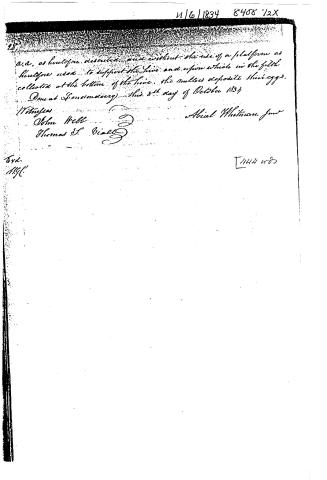
28
a.a. as heretofore described, and without the use of a platform as heretofore used to support the hive and upon which in the fifth collected at the bottom of the hive, the mules deposit their eggs.
Done at Spencermere this 8th day of October 1834
Witnesses
John Webb
Thomas T. Viall
Abiel Whitman Jr.
[444 w-8]
Tvd.
1196.
Published accounts: journal notice
Notice in the monthly list of patents, with remarks
Journal of the Franklin Institute, new ser., vol. 15 (1835), p. 391 · View the page
5. For Bee Hives; Abial Whitman, Londonderry, Windham county, Vermont, November 6.
Remarks. The object aimed at in this hive, is so to construct it that millers may not deposit their eggs at its entrance, and thus to prevent the destruction of the bees and honey by those insects. The hive is to be made of five pieces of board, two of which, forming the ends, are triangular. Two pieces of board, sixteen inches wide, one of them three feet, and the other two feet six inches long, are nailed on to two sides of the triangular ends, but so as to leave an open space of about three-eighths of an inch at the angle, through which the bees are to enter. This angle is to be placed downwards, the sides resting against parallel bars. A piece of board nailed on the top forms the roof, which, in consequence of the unequal length of the two sides of the triangle, has the requisite slope. There being "no platform, as heretofore used, to support the hive, upon which, in the filth collected at the bottom of the hive, the millers deposit their #eggs."
About this record
- Patentee
- the Journal of the Franklin Institute, Journal
- Date
- the Name and Date index of patents, USPTO records, Jim Shaw's X-patent list
- Invention
- the Name and Date index of patents
- Listed in
- the Name and Date index of patents, USPTO records, Jim Shaw's X-patent list, the Journal of the Franklin Institute, Burke's List of Patents (1847)
- The Name and Date index has a note on this number.
- The patentee's full name comes from the Franklin Institute's journal.
- Burke's 1847 Patent Office list gives the same patent.