

Drawings and documents
USPTO scan
The patent as scanned by the USPTO
-
 Page 1
-
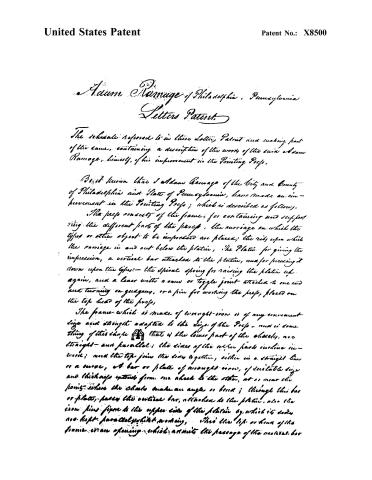 Page 2
-
 Page 3
-
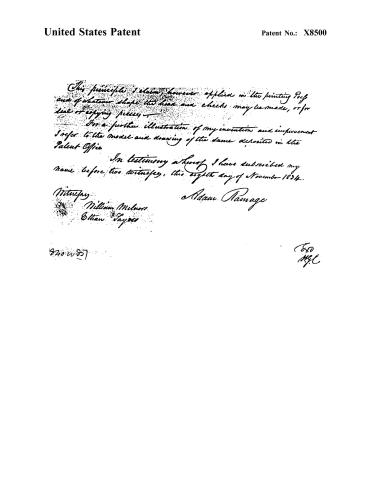 Page 4


U.S. Patent and Trademark Office · Google Patents
Show the transcription Hide (827 words)
Machine transcription (LightOnOCR) of the pages as scanned by the USPTO, most of them the handwritten copies made when the records were restored after the 1836 fire. Not checked; it can misread handwriting, so compare it with the scan.
Page 2.
United States Patent
Patent No.: X8500
Adam Parnage of Philadelphia, Pennsylvania
Letters Patent.
The schedule referred to in these Letters Patent and making part of the same, containing a description of the work of the said Adam Parnage, himself, of his improvement in the Printing Press.
Be it known that I Adam Parnage of the City and County of Philadelphia and State of Pennsylvania, have made an improvement in the Printing Press; which is described as follows.
The press consists of the frame, for containing and supporting the different parts of the press, the carriage on which the types or other object to be impressed are placed; the ribs upon which the carriage in and out below the platen, the Platen for giving the impression, a vertical bar attached to the platen, and for pressing it down upon the types;—the spiral spring for raising the platen up again, and a lever with a cam or toggle joint attached to one end and turning on a fulcrum, or a pin for working the press, placed on the top head of the press.
The frame which is made of wrought-iron or of any convenient size and strength adapted to the size of the Press—and is something of this shape (A) that is the lower part of the sheets, are straight—and parallel; the sides of the upper parts incline inward; and the top joins the sides together, either in a straight bar or a curve, or bar or plate of wrought-iron, of suitable size and thickness extending from one sheet to the other, at or near the point where the sheets make an angle or bend; through this bar or plate, passes the vertical bar, attached to the platen, also the iron pins figure to the upper side of the platen by which it does not keep parallel whilst moving. This the top or head of the frame is an opening which admits the passage of the movable bar
Page 3.
United States Patent
Patent No.: X8500
upon the upper one of which the force is applied, —
The vertical bar attached to the plate is also made of wrought iron & steel, is of size and strength adapted to the force; passing the horizontal plate, connecting the cheeks, and the head or top of the frame, — around this upright bar is a spiral screw, for raising the plate, one end of which rests upon the horizontal plate and the other is attached to a female screw, which turns on a screw cut on the vertical bar, and by which the spiral spring can be regulated, — — — 3. the end of the lever which works on guide quons pr. Journals, is attached a segment of an elliptical or eccentric roller, on a toggle joint working on the top of the vertical bar, and gives the pressure upon the plate and types &c.
Upon the top of the vertical bar, a small piece of steel is placed between the pressing lever and top of the vertical bar, working in a channel. A regulating screw is so placed as to regulate the force to be given by the lever &c.
All the other parts of the press are too well known to need a farther description.
Operation
The form or thing to be pressed, having been placed upon the carriage, is inked, and the white paper put upon the typepan and the frosted turned down. The carriage is then run in by the runner under the plate. The pressman or operator then lays hold of the bar, and forces the eccentric roller or toggle joint down upon the head of the vertical bar; which forces the plate down upon the type &c and gives the impression required.
The invention here claimed and desired to be secured by Letters Patent, consists in the general construction of the before described press, with the arrangement of its several parts, so as to do away with many of the expensive parts of the common printing Press; and to produce one, which at the same time combines cheapness, power, and convenience, but what I particularly claim as my improvement is the wrought iron frame, which has the strength of a wrought iron bar, drawn longitudinally.
Page 4.
United States Patent
Patent No.: X8500
This principle I claim, however applied in the printing Press and of whatever shape the lines and checks may be made, or for use or copying pieces.
For a further illustration of my invention and improvement I refer to the model and drawing of the same deposited in the Patent Office.
In testimony whereof I have subscribed my name before two witnesses, this eighth day of November 1834.
Adam Plamage
Witnesses:
William Milnor
Ethan Jayce
870.2287
Published accounts: journal notice
Notice in the monthly list of patents, with remarks
Journal of the Franklin Institute, new ser., vol. 15 (1835), p. 397 · View the page
There is not any claim made, nor do we think the machine new, although it is probable that it has never been applied to the splitting of palm leaf. Will not a machine of this description destroy the texture of the strips, by cutting them across the grain? 21. For a Printing Press; Adam Ramage, city of Philadelphia, November 19.
Remarks. This is a press intended for small work, and a main object in its construction has been to render it simple, and consequently cheap, whilst it should be efficient for the purposes to which it is to be applied. A bed, or platform, may be made of wood, to which are bolted the two ends of a wrought iron frame, that rises from it something in the form of a gothic arch. The carriage to support the form, frisket, &c., runs upon ways, and has a handle attached to it, by which it can readily be passed back and forth, under the platten. A vertical bar rises from the centre of the platten, through the top of the arch, its lower end being governed by a guide bar extending from one side of the arch to the other. The platten is raised by a spiral spring, surrounding the vertical bar, and is forced down by a lever, working like a pump handle, at the top of the arch, and connected with the bar by a toggle joint. The claim is to "the general construction of the before described press; but particularly the wrought iron frame, which has the strength of a wrought iron bar drawn lengthwise; this principle is claimed however applied in the printing press, and of whatever shape the head and cheeks may be made, for seal or other presses."
About this record
- Patentee
- the Journal of the Franklin Institute, Journal
- Date
- the Name and Date index of patents, USPTO records, Jim Shaw's X-patent list
- Invention
- Burke's List of Patents (1847)
- Listed in
- the Name and Date index of patents, USPTO records, Jim Shaw's X-patent list, the Journal of the Franklin Institute, Burke's List of Patents (1847)
- The patentee's full name comes from the Franklin Institute's journal.
- Burke's 1847 Patent Office list gives the same patent.