

Drawings and documents
USPTO scan
The patent as scanned by the USPTO
-
 Page 1
-
 Page 2
-
 Page 3


U.S. Patent and Trademark Office · Google Patents
Show the transcription Hide (697 words)
Machine transcription (LightOnOCR) of the pages as scanned by the USPTO, most of them the handwritten copies made when the records were restored after the 1836 fire. Not checked; it can misread handwriting, so compare it with the scan.
Page 1.
8511X
S. Lamson,
Bending Wood.
Patented Nov. 25, 1834.

A.M. PHOTO-LITHO. CO. N.Y. (OSBORNE'S PROCESS)
Page 2.
for wood work Pat. for Page 5. Nov 25. 1835
Nov 25. 1834 43/
Silas Lamson of Sterling State of Massachusetts,
Letters Patent
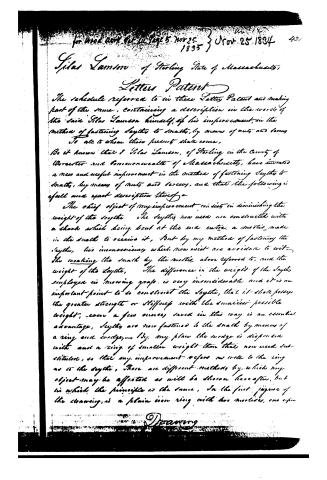
The schedule referred to in these Letters Patent and making part of the same, containing a description in the words of the said Silas Lamson himself, of his improvement, in the method of fastening scythes to smalls, by means of nuts and screws.
To all to whom these presents shall come,
Be it known that I Silas Lamson, of Sterling in the County of Worcester and Commonwealth of Massachusetts, have invented a new and useful improvement in the method of fastening scythes to smalls, by means of nuts and screws, and that the following is a full and exact description thereof.
The chief object of my improvement consists in diminishing the weight of the scythe. The scythes now used are constructed with a shank which being bent at the end enters a mortise made in the small to receive it, but by my method of fastening the scythe, two inconveniences which now exist are avoided to wit, the breaking the small by the mortise above referred to, and the weight of the scythe. The difference in the weight of the scythe employed in mowing grass is very inconsiderable and it is an important point to so construct the scythe, that it shall possess the greater strength or stiffness with the smallest possible weight, even a few ounces saved in this way is an essential advantage, scythes are now fastened to the small by means of a ring and wedge, by my plan the wedge is dispensed with and a ring of smaller weight than that now used substituted, so that any improvement refers as well to the ring as to the scythe. There are different methods by which my object may be effected as will be shown hereafter, but in which the principle is the same. In the first figure of the drawing, is a plain iron ring with two mortises, one of
Drawing
Page 3.
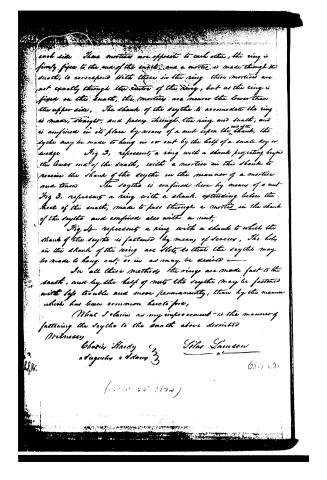
each side. These mortices are opposite to each other, the ring is firmly fixed to the end of the snath, and a mortice is made through the snath, to correspond with those in the ring. These mortices are not exactly through the centre of the ring, but as the ring is fixed on the snath, the mortices are nearer the lower than the upper side. The shank of the scythe to accommodate the ring is made straight, and passes through the ring and snath, and is confined in its place by means of a nut upon the shank, the scythe may be made to hang in or out by the help of a small key or wedge.
Fig. 2, represents a ring with a shank projecting beyond the lower end of the snath, with a mortice in this shank to receive the shank of the scythe in the manner of a mortice and tenon. The scythe is confined here by means of a nut.
Fig. 3, represents a ring with a shank extending below the heel of the snath, made to pass through a mortice in the shank of the scythe and confined also with a nut.
Fig. 4, represents a ring with a shank to which the shank of the scythe is fastened by means of screws. The holes in the shank of the ring are slots, so that the scythe may be made to hang out, or in as may be desired.
In all these methods the rings are made fast to the snath, and by the help of nuts the scythe may be fastened with less trouble and more permanently, than by the manner which has been common heretofore.
What I claim as my improvement is the manner of fastening the scythe to the snath above described.
Witness:
Chas. Hardy
adjudgts & Surveyor
Silas Lawson
657 n 31
(1855)
Published accounts: journal notice
Notice in the monthly list of patents, with remarks
Journal of the Franklin Institute, new ser., vol. 15 (1835), p. 402 · View the page
32. For an improved mode of Fastening Scythes to Sneaths; Silas Lamson, Sterling, Worcester county, Massachusetts, November 25.
Remarks. A ferule is to be driven on to the end of the sneath, and fixed in its place by means of a key driven through a mortise in the ferule, and sneath; different modes of forming these ferules are pointed out in the specification, but in all cases the ferules, or "rings, are made fast to the sneath, and by the help of nuts, [and screws,] the scythe may be fastened with less trouble, and more permanently, than by the manner which has been common heretofore." Perhaps Mr. Naramore, (No. 27,) who has suggested that scythes may be fastened to sneaths by means of screws, may think his plan interfered with; screws, however, are common property, and the manner of using them in the two cases is essentially different. [SUPPLEMENT.] Notice of two Patents issued in July, 1832, which were accidentally omitted in their proper place, as were ten also in August, 1833.
About this record
- Patentee
- the Journal of the Franklin Institute, Journal
- Date
- the Name and Date index of patents, USPTO records, Jim Shaw's X-patent list
- Invention
- the Name and Date index of patents
- Listed in
- the Name and Date index of patents, USPTO records, Jim Shaw's X-patent list, the Journal of the Franklin Institute, Burke's List of Patents (1847)
- The patentee's full name comes from the Franklin Institute's journal.
- Burke's 1847 Patent Office list gives the same patent.