

Drawings and documents
USPTO scan
The patent as scanned by the USPTO
-
 Page 1
-
 Page 2
-
 Page 3
-
 Page 4
-
 Page 5
-
 Page 6


U.S. Patent and Trademark Office · Google Patents
Show the transcription Hide (1,110 words)
Machine transcription (LightOnOCR) of the pages as scanned by the USPTO, most of them the handwritten copies made when the records were restored after the 1836 fire. Not checked; it can misread handwriting, so compare it with the scan.
Page 1.
No Printed Specification Available
B. BLANEY. 2 Sheets—Sheet 1.
8,527 X Bake Oven. Patented Dec. 17, 1834.

Page 2.
8,527X
B. BLANEY.
Bake Oven.
2 Sheets—Sheet 2.
Patented Dec. 17, 1834.

Page 3.
Dec. 17, 1834
Benjamin Blaney, a Citizen of the U. S.
Letters Patent.
The Schedule referred to in these Letters Patent and making part of the same, containing a description in the words of the said Benjamin Blaney himself of his Improvement in the mode of making & erecting ovens for domestic and other purposes, called Blaney's Oven.
"Blaney's Oven" may be placed wherever other ovens may be conveniently, and is constructed of Brick and iron, as follows, & is exhibited in the drawings herewith.
First. The space for the oven is of a square form, and is inclosed on three sides with Brick walls, and a double door on the fourth or front, and is covered over the top with soapstone, brick or iron. The bottom to be of cast iron, with a row of oblong perforations on each side near the edge about two inches wide, by six inches long, & with a rim on each, projecting upwards, upon which short or cast iron funnels are to be placed for the passage of the smoke and heat from the furnace as herein after described.
Second. On the bottom of the furnace room, under the oven, is a cast iron plate, with grooves in which the furnace is to slide, having a perforation or nearly of the size and directly beneath the bottom of the furnace to admit the air which passes through the ash-pit into the furnace for the support of combustion. The ash-pit is furnished with a door nicely fitted, which when closed will stop the circulation of the air through the furnace and places of the oven.
Third. An oblong square box of cast iron, with grated bottom
Page 4.
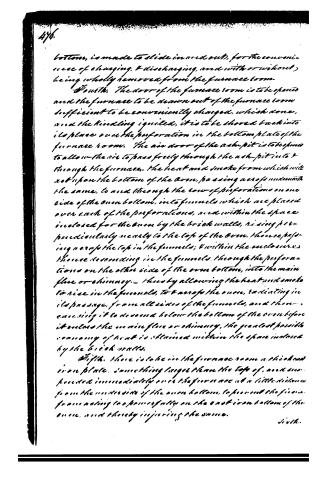
bottom, is made to slide in and out, for the convenience of charging, & discharging, and with or without, being wholly removed from the furnace room.
Fourth. The door of the furnace room is to be opened and the furnace to be drawn out of the furnace room sufficient to be conveniently charged, which done, and the kindling ignited, it is to be shoved back into its place over the perforation in the bottom plate of the furnace room. The air door of the ash-pit is to be open to allow the air to pass freely through the ash-pit into & through the furnace, the heat and smoke from which will not upon the bottom of the oven, passing across underneath the same, to and through the row of perforations on one side of the oven bottom, into funnels which are placed over each of the perforations, and within the space enclosed for the oven by the brick walls, rising perpendicularly nearly to the top of the oven, thence passing across the top in the funnels; & within the enclosure, thence descending in the funnels, through the perforations on the other side of the oven bottom, into the main flue or chimney. Thus by allowing the heat and smoke to rise in the funnels, to & across the oven, radiating in its passage, from all sides of the funnels, and then, crossing it to descend below the bottom of the oven before it enters the main flue or chimney, the greatest possible economy of heat is obtained within the space enclosed by the brick walls.
Fifth. There is to be in the furnace room a thick and iron plate, something larger than the top of, and supported immediately over the furnace at a little distance from the underside of the oven bottom, to prevent the fire from acting too powerfully on the cast iron bottom of the oven, and thereby injuring the same.
Sixth.
Page 5.
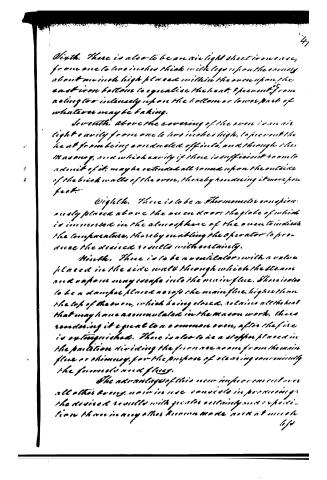
Ninth. There is also to be an air tight sheet iron case, from one to two inches thick with legs upon the corners about one inch high placed within the oven upon the cast iron bottom to equalise the heat, & prevent from acting too intensely upon the bottom or lower part of whatever may be baking.
Tenth. Above the covering of the oven is an air tight cavity from one to two inches high, to prevent the heat from being conducted off into, and through the Masonry, and which cavity if there is sufficient room to admit of it, may be extended all round upon the outside of the brick walls of the oven, thereby rendering it more perfect.
Eleventh. There is to be a Thermometer conspicuously placed above the oven door, the globe of which is immersed in the atmosphere of the oven to indicate the temperature, thereby enabling the operator to produce the desired results with certainty.
Twelfth. There is to be a ventilator with a valve placed in the side wall through which the steam and vapors may escape into the main flue. There is also to be a damper placed above the main flue, higher than the top of the oven, which being closed, retains all the heat that may have accumulated in the mason work, thus rendering it equal to a common oven, after the fire is extinguished. There is also to be a stopper placed in the partition dividing the furnace room from the main flue or chimney, for the purpose of closing conveniently the furnace and flues.
The advantage of this new improvement over all other ovens, now in use consists in producing the desired results with greater certainty and expedition than in any other known mode, now at work.
Page 6.
478.
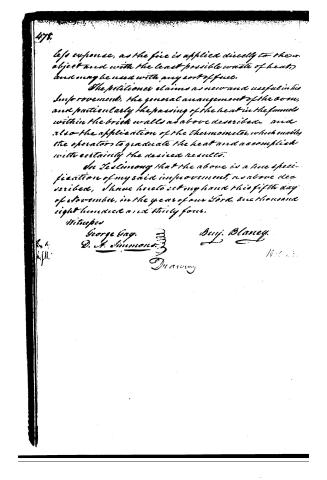
less expense, as the fire is applied directly to the object and with the least possible waste of heat, and may be used with any sort of fuel.
The petitioner claims as new and useful in his improvement, the general arrangement of the oven, and particularly the passing of the heat in the furnace within the brick walls as above described, and also the application of the thermometer, which enables the operator to graduate the heat and accomplish with certainty the desired results.
In Testimony that the above is a true specification of my said improvement, as above described, I have hereunto set my hand this fifth day of November, in the year of our Lord, one thousand eight hundred and thirty four.
Witnesses
George Gay.
D. A. Simmons.
Benj. Blaney.
Drawing
10.11.3.
Published accounts: journal notice
Notice in the monthly list of patents
Journal of the Franklin Institute, new ser., vol. 15 (1835), p. 144 · View the page
606. Ovens. Benjamin Blaney, Boston, Massachusetts,
Published accounts: journal notice
Notice in the monthly list of patents, with remarks
Journal of the Franklin Institute, new ser., vol. 16 (1835), p. 28 · View the page
36. For an Oven; Benjamin Blaney, Boston, Massachusetts, December 17.
Remarks. The oven which forms the subject of this patent is to consist of a rectangular metallic box, with a furnace below, also of metal, and capable of being drawn out, to ignite the fire. The heated air is to pass up, beside, and over, the oven, and is to descend again before it enters the flue. The whole is to be enclosed in brickwork, and particular devices are pointed out to prevent the escape of heat, in which, however, there is nothing new in principle; the particular arrangements spoken of are distinctly represented in appropriate drawings. A thermometer is to be so fixed as to have its bulb within the oven. "The petitioner claims the general arrangement of the oven; and particularly the passing of the heat in the funnels within the brick walls, as above described; and also the application of a thermometer, which enables the operator to graduate the heat, and acccomplish with certainty the desired results."
About this record
- Patentee
- the Journal of the Franklin Institute, Journal
- Date
- the Name and Date index of patents, USPTO records, Jim Shaw's X-patent list
- Invention
- the Name and Date index of patents
- Listed in
- the Name and Date index of patents, USPTO records, Jim Shaw's X-patent list, the Journal of the Franklin Institute, Burke's List of Patents (1847)
- The patentee's full name comes from the Franklin Institute's journal.
- Burke's 1847 Patent Office list gives the same patent.