

Drawings and documents
National Archives restored drawings: drawing
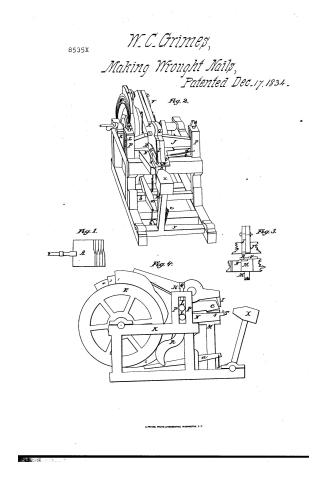
W.C. Grimes' Patent Drawing for a Machine for Making Wrought Nails

National Archives, Restored Patent Drawings (Record Group 241) · Full-size scan at the National Archives · Catalog record
Show the text on the drawing Hide (75 words)
Words on the drawing as machine-read by the National Archives; not checked. Useful mainly for searching.
85. METAL WORKING, / Cut Nail M'k'g. / ag. / WA C GRIMES / $250 P / CLASSIFICATION / Machine for making wrought nails. / 8535-X / DIVISION / Patented Dec. 77th 1834 / Fig. 3. / Fig. 4. / El / Fig: 2. / LA / References. / II / :/: / Fig 1. Shews form in which the narls / fy / out from the plate. / Fig2. Perspective. / Figs. End men of jane. / Fig 4. Geometriea projection or side / vrew of the machine. / Fig. 1. / .4
USPTO scan
The patent as scanned by the USPTO
-
 Page 1
-
 Page 2
-
 Page 3
-
 Page 4
-
 Page 5
-
 Page 6
-
 Page 7
-
 Page 8
-
 Page 9


U.S. Patent and Trademark Office · Google Patents
Show the transcription Hide (3,209 words)
Machine transcription (LightOnOCR) of the pages as scanned by the USPTO, most of them the handwritten copies made when the records were restored after the 1836 fire. Not checked; it can misread handwriting, so compare it with the scan.
Page 1.
8535X
W.C. Grimes,
Making Wrought Nails,
Patented Dec. 17, 1834.
Fig. 1.
Fig. 2.
Fig. 3.
Fig. 4.
H. PETERS, PHOTO-LITHOGRAPHER, WASHINGTON, D.C.
Page 2.
William C. Grimes, York Pennsylvania
Letters Patent.
The schedule referred to in these Letters Patent, and making part of the same, containing a description in the words of the said William C. Grimes, himself, of his improvement in the mode and machine for making wrought nails, tacks, or spikes.
To all to whom these presents shall come.
Be it known that William C. Grimes, of York, in the county of York and state of Pennsylvania, have invented a new and useful mode and machine for making wrought nails, tacks, or spikes, and that the following is a full and exact description thereof, reference being had to the drawing which accompanies and makes part of this specification. To make wrought nails by machinery is an object that has been sought by numerous individuals, hence it may be useful in order to point out more clearly the novelty in the present plan, to refer to the general principles upon which preceding machines or process for that purpose, have been founded.
One of the first, and it is believed an almost universal principle, that has been observed in previous attempts to make wrought nails, has been to make them from rods that were rolled or slit to the size of the larger part of the body of the nail. To take or to give to the nail its requisite form, from such rods, various modes have been invented—banging, forging, and rolling have been tried, but the latter by far the most generally. Modifications of these principles to effect the object proposed, have been too numerous to be here detailed. But whatever has been the modification of the machine, it has generally embraced or been constructed to operate upon only one of these principles. The novelty of the present machine consists in its being constructed so as to combine several of these principles at the same time, viz: butting, swinging or pressing, and forging, or percussion, and to make the novelty
Page 3.
novelty more apparent, the nails &c are not to be made from rods of the iron of the body of the nail, but from broad plates, and these at a high red heat. These plates are to be prepared by rolling after the manner of plates for cut nails, but with this difference, they must be of perfectly sound iron, and two or three times as broad as the length of the intended nail, but of about the same thickness. These plates are to be cut off transversely into pieces about two thirds of the length of two nails. From the sides of these pieces or plates the the nails are to be formed and cut, the length of the nail running with the grain of the iron, or parallel with the length of the original plate. These plates are held, turned over, and the nails cut from the sides or ends of them, in the same manner as is practised in making cut nails but with this difference, in making cut nails the plate is either cold, or at what is called a black heat, whilst in my process the plate are to be at a high red heat.) In making cut nails they are cut off with a regular taper from end to end, in this process they are to be not more than half their length (see drawing marked A). In making cut nails the width of the plate is the length of the nail. In this process the plate is cut into lengths transversely, which length forms two nails by their points overlapping each other &c. In making cut nails the first action upon the nail is to sever it from the plate; in this process the nail is nearly formed before it is severed from the plate.
As the plates are cut at a high red heat, they would soon destroy the temper of the steel cutters or dies if continually applied as in making cut nails, therefore to prevent such injury, I cut a few nails in rapid succession, and then allow a short intermission, when the plate is withdrawn, and a jet of water is applied for an instant to the dies which at the time in motion, the plate and the jet of water being applied alternately to the dies. Two or more of these plates should be in the fire at a time, as only a part of one plate can be cut or formed into nails without reheating. The plates may be changed in the furnace, during the time that the jet of water is let on to the dies. The water in the pipe that conducts it to the dies should be under considerable head or pressure, and starting and stopping the jet may
Page 4.
maybe done in various ways, the valves or cocks may be opened at regular intervals by the machinery, or a tickler may be applied for that purpose. When the nail is to be formed and cut from the plate, a portion of the latter as shall be necessary, is placed between the jaws or dies B and C, constructed for the purpose, and which are parallel with the end or edge of the plate for about half or two thirds of the length of the nail. The remainder of the dies are turned off at a slight angle, running out to the edge of the plate, thus forming the taper or point of the nail; the plate is then turned over, and its opposite side brought into the same position between the jaws, and another nail is cut, the point of which commences at the same point in the plate that the taper began in the preceding nail.
The jaws or dies B and C are to clamp, keep, and form the nail, one of them B is stationary, while the other C, has a vertical movement, this die is attached to the underside of a jaw or the short end of a lever D, the other or long end has upon its extremity a projecting arm, which rests upon the periphery of a heavy flywheel E, which is about two or three feet in diameter. The periphery of the flywheel approaches to within a few inches of the fulcrum of the lever, while its axis is but a little below the horizontal plane of the said fulcrum, hence the long end of the lever D must be elevated to an angle of about thirty or forty degrees from the horizon, while the short end is in a horizontal position. The vertical breadth of this lever D, is much greater than its thickness in a horizontal direction, and in a part C, of its short end nearly over the fulcrum, it rises into a much greater width; through the centre of this part, passes a pin, which is the fulcrum of another lever F, of nearly the same dimension as the one to which it is joined by the aforesaid pin. The short end of the first named lever D, is so formed that a part of it lies directly beneath the short end of the second, the latter projecting about half an inch over or beyond the end of the first. To the underside of this projecting part is attached a piece of steel I, of such size and form as in effect to lengthen the aforesaid die C, about three eighths of an inch (more or less). In fact the said die may be considered as consisting of two parts, each susceptible of a motion independent of the other. The length of these levers
Page 5.
levers D and H, for a machine of ordinary size, maybe about two feet. The fulcrum of the first lever D, is a strong shaft J, that rises at right angles a few inches back of the die C. This shaft lies across the frame K of the machine, it has round iron or wooden upon its ends, which work in suitable boxes E fixed in the frame. The lower jaw or die B rests upon permanent fixtures M M M, to which it is made fast with keys or screws. The contiguous faces of the dies B and C are parallel, or nearly so for about half or two thirds of their length, the remainder of their faces being inclined towards each other till they meet at their inner ends, or in other words, their faces are so bent or curved, and lie in that relative position, the one to the other, as to give the proper taper, or requisite form to the nail, the latter lying with its point towards the fulcrum of the lever D. The side or edges of the jaws or dies next the nail plate, are in the same vertical plane, the one above the other. The nail or edge of the plate being clamped or gripped between the dies B and C, as in a vice, and with such a degree of pressure as to give to that portion of the plate the required form or taper of the nail, the jaws or dies biting into, and forcing down a portion of the metal for the taper and point of the nail. The taper of the nail in the other or vertical direction, being formed as aforesaid, by the edges of the dies being curved or bent so as to run out to the edge of the plate. A portion of the side of the plate A, when gripped as aforesaid, projects out beyond the ends of the dies B and C, far enough to allow of the formation of the head of the nail. By the side of the stationary jaw B, there is fixed a strong movable jaw H, which is the short end of a lever the fulcrum of which is a strong horizontal shaft O, lying directly beneath the fulcrum shaft J, and with similar journals and boxes, which last are in the same vertical oblong openings with the before named boxes E E. These oblong openings are formed by vertical posts P P, which make a part of the frame K, of the machine. The tops of each pair of these posts are united by a cross piece, through which descends a screw Q of a suitable size, down upon the upper boxes E E, by which means the fulcrum shafts J and O may be set at the requisite
Page 6.
80
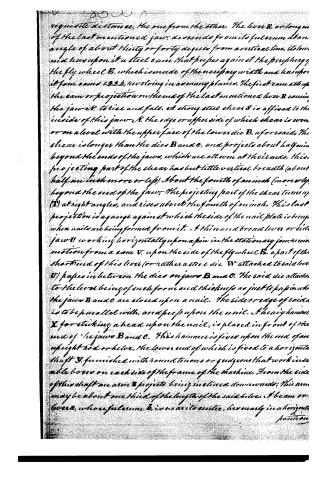
requisite distance, the one from the other. The lever B, or tongue of the last mentioned jaw, descends from its fulcrum at an angle of about thirty or forty degrees from a vertical line, its lower end has upon it a steel cam that presses against the periphery of the fly wheel E, which is made of the necessary width and has upon it four cams 1, 2, 3, 4, revolving in as many planes. The first cam acts upon the cam or projection on the end of the last mentioned lever B causing the jaw C, to rise and fall. A strong steel shear S is affixed to the inside of this jaw C, the edge or upper side of which shear is even or on a level with the upper face of the lower die B, aforesaid. The shear is longer than the dies B and C, and projects about half an inch beyond the ends of the jaws, which are all even at their ends. This projecting part of the shear has but little vertical breadth (about half an inch more or less) about the fourth of an inch (more or less) beyond the end of the jaw. The projecting part of the shear turns up (T) at right angles, and rises about the fourth of an inch. This last projection is a gage against which the side of the nail plate is brought when nails are being formed from it. A thin curved broad lever or die jaw D working horizontally upon a pin in the stationary jaw receives motion from a cam V, upon the side of the fly wheel E, a part of the short end of this lever (or rather a steel die W attached to said lever D) passes in between the dies on jaws B and C. The said die attached to the lever being of such form and thickness as just to pass in when the jaws B and C are closed upon a nail. The side or edge of said is to be parallel with, and press upon the nail. A heavy hammer X for striking a head upon the nail, is placed in front of the end of the jaws B and C. This hammer is fixed upon the end of an upright rod or helve, the lower end of which is fixed to a horizontal shaft Y, furnished with curved tenons or gudgeons that work in suitable boxes on each side of the frame of the machine. From the side of this shaft an arm Z projects being inclined downwards; this arm may be about one third of the length of the said helve. A beam or lever a, whose fulcrum b, is near its centre, lies nearly in a horizontal position.
Page 7.
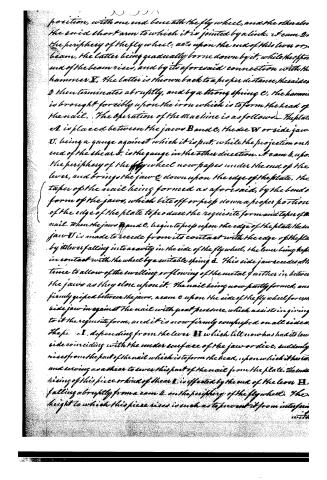
position, with one end beneath the fly wheel, and the other above the said short arm to which it is joined by a link. It can D, the periphery of the fly wheel, acts upon the end of this lever or beam, the latter being gradually borne down by it, while the opposite end of the beam rises, and by its aforesaid connection with the hammer E, the latter is thrown back to a proper distance, the said D then terminates abruptly, and by a strong spring C, the hammer is brought forcibly upon the iron which is to form the head of the nail. The operation of the machine is as follows: The plate A is placed between the jaws B and C, the die W or side jaw D, being a gauge against which it is put, while the projection on the end of the shear S, is the gauge in the other direction. It can L, upon the periphery of the fly wheel now passes under the end of the lever, and brings the jaw C down upon the edge of the plate, the taper of the nail being formed as aforesaid, by the bends form of the jaws, which bite off or pick down a proper portion of the edge of the plate to produce the requisite form and taper of a nail. When the jaws B and C, begin to pick upon the edge of the plate the side jaw D is made to recede from its contact with the edge of the plate by its lever falling into a notch in the side of the fly wheel, the lever being kept in contact with the wheel by a suitable spring d. This side jaw recedes at the time to allow of the swelling or flowing of the metal further in between the jaws as they close upon it. The nail being now partly formed, and firmly gripped between the jaws, a cam E upon the side of the fly wheel forces side jaw in against the nail with great pressure, which assists in giving to it the requisite form, and it is now firmly compressed on all sides. The piece I, depending from the lever H which till now has had its lower side coinciding with the under surface of the jaw or die C, suddenly rises from the part of the nail which is to form the head, upon which it has been serving as a shear to sever this part of the nail from the plate. The under rising of this piece or kind of shear I is effected by the end of the lever H, falling abruptly from a cam L, on the periphery of the fly wheel. The height to which this piece rises is such as to prevent it from interfering with
Page 8.
with the heading of the nail, the projecting part of the shear has previously risen to the same height, leaving an even surface, the projecting end of the nail, against which the hammer now comes with a force that instantly forms the head of the nail; the hammer immediately recedes a little, the jaws A and B, and the shear S, rise till they are above the nail, then the jaws B, and C, release their grip upon it, the side jaw or die N is swung by the cam V, quite through between the jaws B and C, the nail is thus forced out sideways beneath the shear jaw S, and falls finished from the machine. The jaws now instantly resume their former position, the plate is again applied, when as before another nail is formed in like manner. I intend sometimes to form the head upon the nail by pressure, instead of percussion.
Any competent power may be employed to inspect the machine. Machines greatly differing in form and in the particular arrangement of the respective parts, may be constructed upon the preceding principle to produce similar results, or effect the same end by similar means. I therefore, do not intend to limit myself to the particular arrangement herein specified, but to change such form and arrangement as I may think proper, where the principle remains unchanged.
What I claim as new, and as my invention and for which I ask letters patent, is, 1st, the making or forming wrought nails, tacks, or spikes, from or upon the edges or sides of metal plates, by pressure and cutting, after the manner or upon the principle herein specified. 2nd, the manner of severing the plate from the so that a part of the latter is left standing out beyond the end of the jaws, as hereinbefore described. 3rd, the side jaw by which the plate is gauged, and the nail compressed and removed from the jaws. 4th, I also claim the general construction and combination of the respective parts of the above described machine, by which general combination of the respective parts of the above described machine, by general combination it derives that character by which my complete
Page 9.
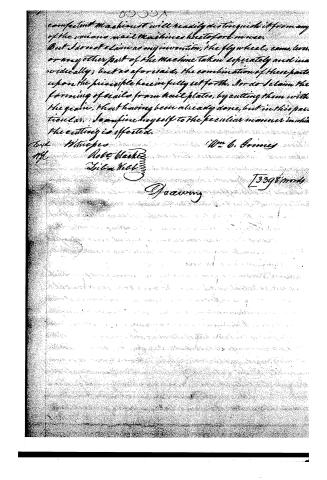
competent Machinist will readily distinguish it from any of the various nail Machines heretofore in use. But I do not claim as my invention, the flywheel, cams, lever, or any other part of the Machine taken separately and individually; but as aforesaid, the combination of these parts upon the principle herein fully set forth. Nor do I claim the forming of nails from nail plates, by cutting them with the gear, that having been already done, but in this particular. I confine myself to the peculiar manner in which the cutting is effected.
Wm. C. Grimes
[3398/mmd]
Published accounts: journal notice
Notice in the monthly list of patents
Journal of the Franklin Institute, new ser., vol. 15 (1835), p. 143 · View the page
576. Pressing bricks.-Wm. C. Grimes, York, do.
Published accounts: journal notice
Notice in the monthly list of patents
Journal of the Franklin Institute, new ser., vol. 15 (1835), p. 144 · View the page
608. Wrought iron nails, &c.-Wm. C. Grimes, York, Penn.
Published accounts: journal notice
Notice in the monthly list of patents, with remarks
Journal of the Franklin Institute, new ser., vol. 16 (1835), p. 28 · View the page
39. For a mode of Manufacturing Wrought Nails, Tacks, or Spikes, by first preparing the material, rods, or pieces, in such a manner as greatly to tacilitate the process. William C. Grimes, York, York county, Pennsylvania, December 17.
Remarks. (See the specification.)
Published accounts: journal notice
Notice in the monthly list of patents, with remarks
Journal of the Franklin Institute, new ser., vol. 16 (1835), p. 42 · View the page
We are aware that machines very similar to that which we have described, have been used for hulling clover and other seeds, and for rubbing and smutting wheat, and other grain; but we have adapted it more perfectly to the hulling and breaking cotton seed, by the form which we have given to the teeth, which adaptation will be clearly understood by an examination of the drawing deposited in the Patent Office; and it is this adaptation which we particularly claim as our invention. CHARLES BECK, WILLIAM JENKS. Abstract of the Specification of a Patent for a mode or machine for making Wrought Nails, Tacks, or Spikes. Granted to WILLIAM C. GRIMES, York, York county, Pennsylvania, December 17th, 1834.
Remarks. To make wrought nails by machinery, is an object that has been sought by numerous individuals; hence it may be useful, in order to point out more clearly the novelty in the present plan, to refer to the general principles upon which preceding machines, or processes, for that purpose have been founded. One of the first, and, it is believed, an almost universal principle, that has been observed in previous attempts to make wrought nails, has been to make them from rods that were rolled or slit to the size of the larger part of the body of the nail. To taper, or to give to the nail its requisite form, from such rods, various modes have been essayed; swaging, forging, and rolling, have been tried, but the latter by far the most generally. Modifications of these principles, to effect the object proposed, have been too numerous to be here detailed. But, whatever has been the modification of the machine, it has generally embraced, or been constructed to operate upon, only one of these principles. The novelty of the present machine consists in its being constructed so as to combine several of these principles at the GRIMES' Mode of Making Wrought Nails, &c. same time, viz.: cutting, swaging, or pressing, and forging, or percussion, and to make the novelty more apparent, the nails, &c. are not to be made from rods of the size of the body of the nail, but from broad plates, and these at a red heat. These plates are to be prepared by rolling, after the manner of plates for cut nails, but with this difference, they must be of perfectly sound iron, and two or three times as broad as the length of the intended nail, but of about the same thickness. These plates are to be cut off transversely into pieces, about two-thirds the length of two nails. From the sides of these pieces, or plates, the nails are to be formed and cut, the length of the nail running with the grain of the iron, or parallel with the length of the original plate. These plates are held, turned over, and the nails cut from the sides or ends of them, in the same manner as is practised in making cut nails, but with this difference, in making cut nails, the plate is either cold, or at what is called a black heat, whilst in my process the plates are to be at a high red heat. In making cut nails, they are cut off with a regular taper from end to end; in this process, they are tapered not more than half their length. In making cut nails, the width of the plate is the length of the nail; in this process, the plate is cut into lengths transversely, which length forms two nails, by their points overlapping each other. In making cut nails, the first action upon the nail is to sever it from the plate; in this process, the nail is nearly formed before it is severed from the plate. As the plates are cut at a high red heat, they would soon destroy the temper of the steel cutters, or dies, if continually applied, as in making cut nails; therefore, to prevent such injury, I cut a few nails in rapid succession, and then allow a short intermission, when the plate is withdrawn, and a jet of water is applied for an instant to the dies, which continue in motion, the plate and the jet of water being applied alternately to the dies. Two or more of these plates should be in the fire at a time, as only a part of one plate can be cut or formed into nails without reheating. The plates may be changed in the furnace during the time that the jet of water is let on to the dies. The water in the pipe that conducts it to the dies, should be under considerable head, or pressure, and the starting and stopping the jet may be done in various ways; the valves, or cocks, may be opened at regular intervals by the machinery, or a treadle may be applied for that purpose. When the nail is to be formed and cut from the plate, such a portion of the latter as shall be necessary, is placed between the jaws, or dies, constructed for the purpose, and which are parallel with the end, or edge, of the plate, for about half or two-thirds of the length of the nail. The remainder of the dies are turned off at a slight angle, running out to the edge of the plate, thus forming the taper, or point, of the nail; the plate is then turned over, and its opposite side brought into the same position between the jaws, and another nail is cut, the point of which commences at the same point in the plate that the taper began in the preceding nail. GRIMES' Mode of Making Wrought Nails, &c. A heavy hammer, for striking a head upon the nail, is placed in front of the end of the jaws; this hammer is fixed upon the end of an upright rod, or helve, the lower end of which is fixed to a horizontal shaft, furnished with round tenons, or gudgeons, that work in suitable boxes on each side of the frame of the machine. From the side of this shaft an arm projects, being inclined downwards; this arm may be about one-third of the length of the said helve. A beam, or lever, whose fulcrum is near its centre, lies nearly in a horizontal position, with one end beneath the fly-wheel, and the other above the said short arm, to which it is jointed by a link. A cam on the periphery of the fly-wheel acts upon the end of this lever, or beam, the latter being gradually borne down by it, while the opposite end of the beam rises, and, by its aforesaid connection with the hammer, the latter is thrown back to a proper distance; the said cam then terminates abruptly, and, by a strong spring, the hammer is brought forcibly upon the iron which is to form the head of the nail. I intend sometimes to form the head upon the nail by pressure, instead of percussion. Any competent power may be employed to impel the machine. Machines greatly differing in form, and in the particular arrangement of the respective parts, may be constructed upon the preceding principle, to produce similar results, or effect the same end by similar means. I, therefore, do not intend to limit myself to the particular arrangement herein specified, but to change such form and arrangement as I may think proper, while the principle remains unchanged. What I claim as new, and as my invention, and for which I ask letters patent, is, 1st. The making or forming wrought nails, tacks, or spikes, from, or upon, the edges, or sides, of metallic plates, by pressure and cutting, after the manner, or upon the principle, herein specified. 2d. The manner of severing the plate from the nail, so that a part of the latter is left standing out beyond the end of the jaws, as herein before described. 3d. The side jaw by which the plate is gauged, and the nail compressed, and removed from the jaws. 4th. I also claim the general construction and combination of the respective parts of the above described machine, by which general combination it derives that character by which any competent machinist will readily distinguish it from any of the various nail machines heretofore in use.
Published accounts: journal notice
Notice in the monthly list of patents
Journal of the Franklin Institute, new ser., vol. 16 (1835), p. 44 · View the page
But I do not claim as my invention, the fly-wheel, cams, levers, or any other part of the machine, taken separately and individually; but, as aforesaid, the combination of these parts upon the principle herein fully set forth. Nor do I claim the forming of nails from nail plates, by cutting them with the grain, that having been already done; but in this particular I confine myself to the peculiar manner in which the cutting is effected.* WILLIAM C. GRIMES. * See note p. 38.-Editor. Abstract of the Specification of a Patent for a mode of manufacturing Wrought Nails, Tacks, or Spikes, by first preparing the material, rod, or pieces, from which they are to be made, in such a manner as greatly to facilitate the process of making them, and then operating upon the pieces so prepared by means of a machine particularly adapted to that purpose. Granted to WILLIAM C. GRIMES, York, York county, Pennsylvania, December 17th, 1834.
Published accounts: specification
Specification printed in the Journal of the Franklin Institute
Journal of the Franklin Institute, new ser., vol. 16 (1835), p. 42 · View the page
Text of the specification as printed in the Journal, from OCR; not proofread.
Specification of a Patent for a mode or machine for making Wrought Nails, Tacks, or Spikes. Granted to WILLIAM C. GRIMES, York, York county, Pennsylvania, December 17th, 1834. To make wrought nails by machinery, is an object that has been sought by numerous individuals; hence it may be useful, in order to point out more clearly the novelty in the present plan, to refer to the general principles upon which preceding machines, or processes, for that purpose have been founded. One of the first, and, it is believed, an almost universal principle, that has been observed in previous attempts to make wrought nails, has been to make them from rods that were rolled or slit to the size of the larger part of the body of the nail. To taper, or to give to the nail its requisite form, from such rods, various modes have been essayed; swaging, forging, and rolling, have been tried, but the latter by far the most generally. Modifications of these principles, to effect the object proposed, have been too numerous to be here detailed. But, whatever has been the modification of the machine, it has generally embraced, or been constructed to operate upon, only one of these principles. The novelty of the present machine consists in its being constructed so as to combine several of these principles at the GRIMES' Mode of Making Wrought Nails, &c. same time, viz.: cutting, swaging, or pressing, and forging, or percussion, and to make the novelty more apparent, the nails, &c. are not to be made from rods of the size of the body of the nail, but from broad plates, and these at a red heat. These plates are to be prepared by rolling, after the manner of plates for cut nails, but with this difference, they must be of perfectly sound iron, and two or three times as broad as the length of the intended nail, but of about the same thickness. These plates are to be cut off transversely into pieces, about two-thirds the length of two nails. From the sides of these pieces, or plates, the nails are to be formed and cut, the length of the nail running with the grain of the iron, or parallel with the length of the original plate. These plates are held, turned over, and the nails cut from the sides or ends of them, in the same manner as is practised in making cut nails, but with this difference, in making cut nails, the plate is either cold, or at what is called a black heat, whilst in my process the plates are to be at a high red heat. In making cut nails, they are cut off with a regular taper from end to end; in this process, they are tapered not more than half their length. In making cut nails, the width of the plate is the length of the nail; in this process, the plate is cut into lengths transversely, which length forms two nails, by their points overlapping each other. In making cut nails, the first action upon the nail is to sever it from the plate; in this process, the nail is nearly formed before it is severed from the plate. As the plates are cut at a high red heat, they would soon destroy the temper of the steel cutters, or dies, if continually applied, as in making cut nails; therefore, to prevent such injury, I cut a few nails in rapid succession, and then allow a short intermission, when the plate is withdrawn, and a jet of water is applied for an instant to the dies, which continue in motion, the plate and the jet of water being applied alternately to the dies. Two or more of these plates should be in the fire at a time, as only a part of one plate can be cut or formed into nails without reheating. The plates may be changed in the furnace during the time that the jet of water is let on to the dies. The water in the pipe that conducts it to the dies, should be under considerable head, or pressure, and the starting and stopping the jet may be done in various ways; the valves, or cocks, may be opened at regular intervals by the machinery, or a treadle may be applied for that purpose. When the nail is to be formed and cut from the plate, such a portion of the latter as shall be necessary, is placed between the jaws, or dies, constructed for the purpose, and which are parallel with the end, or edge, of the plate, for about half or two-thirds of the length of the nail. The remainder of the dies are turned off at a slight angle, running out to the edge of the plate, thus forming the taper, or point, of the nail; the plate is then turned over, and its opposite side brought into the same position between the jaws, and another nail is cut, the point of which commences at the same point in the plate that the taper began in the preceding nail. GRIMES' Mode of Making Wrought Nails, &c. A heavy hammer, for striking a head upon the nail, is placed in front of the end of the jaws; this hammer is fixed upon the end of an upright rod, or helve, the lower end of which is fixed to a horizontal shaft, furnished with round tenons, or gudgeons, that work in suitable boxes on each side of the frame of the machine. From the side of this shaft an arm projects, being inclined downwards; this arm may be about one-third of the length of the said helve. A beam, or lever, whose fulcrum is near its centre, lies nearly in a horizontal position, with one end beneath the fly-wheel, and the other above the said short arm, to which it is jointed by a link. A cam on the periphery of the fly-wheel acts upon the end of this lever, or beam, the latter being gradually borne down by it, while the opposite end of the beam rises, and, by its aforesaid connection with the hammer, the latter is thrown back to a proper distance; the said cam then terminates abruptly, and, by a strong spring, the hammer is brought forcibly upon the iron which is to form the head of the nail. I intend sometimes to form the head upon the nail by pressure, instead of percussion. Any competent power may be employed to impel the machine. Machines greatly differing in form, and in the particular arrangement of the respective parts, may be constructed upon the preceding principle, to produce similar results, or effect the same end by similar means. I, therefore, do not intend to limit myself to the particular arrangement herein specified, but to change such form and arrangement as I may think proper, while the principle remains unchanged. What I claim as new, and as my invention, and for which I ask letters patent, is, 1st. The making or forming wrought nails, tacks, or spikes, from, or upon, the edges, or sides, of metallic plates, by pressure and cutting, after the manner, or upon the principle, herein specified. 2d. The manner of severing the plate from the nail, so that a part of the latter is left standing out beyond the end of the jaws, as herein before described. 3d. The side jaw by which the plate is gauged, and the nail compressed, and removed from the jaws. 4th. I also claim the general construction and combination of the respective parts of the above described machine, by which general combination it derives that character by which any competent machinist will readily distinguish it from any of the various nail machines heretofore in use. But I do not claim as my invention, the fly-wheel, cams, levers, or any other part of the machine, taken separately and individually; but, as aforesaid, the combination of these parts upon the principle herein fully set forth. Nor do I claim the forming of nails from nail plates, by cutting them with the grain, that having been already done; but in this particular I confine myself to the peculiar manner in which the cutting is effected.* WILLIAM C. GRIMES. * See note p. 38.-Editor. Abstract of the
About this record
- Patentee
- the Journal of the Franklin Institute, Journal
- Date
- the Name and Date index of patents, USPTO records, Jim Shaw's X-patent list
- Invention
- the Name and Date index of patents
- Listed in
- the Name and Date index of patents, USPTO records, Jim Shaw's X-patent list, the Journal of the Franklin Institute, Burke's List of Patents (1847), the Journal of the Franklin Institute, Journal
- The patentee's full name comes from the Franklin Institute's journal.
- The residence comes from the Franklin Institute's journal.
- Burke's 1847 Patent Office list gives the same patent.