

Drawings and documents
National Archives restored drawings: drawing
Seba and Caleb Howard's Patent Drawing for a Lath Machine

National Archives, Restored Patent Drawings (Record Group 241) · Full-size scan at the National Archives · Catalog record
Show the text on the drawing Hide (85 words)
Words on the drawing as machine-read by the National Archives; not checked. Useful mainly for searching.
143. WOOD SAWING 143. SAWING, / Rath Mashines- Lumber / CIRCUL ACHINES / Circular Sawing,Angular. / 50 $ 143. WOOD SAWING / Circular Saw Machines / Angular, / CLASSI FICATION / I'm S / 8539-+ / DIVISION. / Lath-machine. / Patented Dec 17:1834 / References / a. Upright circular slaw. / b. Horizontal circular saws. / d. Followers. / c. Pulley which propels the horizontal saws. / F.B.del. / Patent offin 10 Nov 1838 / Made under the direction of the Commisioner / of Patients in conformity with act 3 March 1834 / Hung / Commissioner of Patents
USPTO scan
The patent as scanned by the USPTO
-
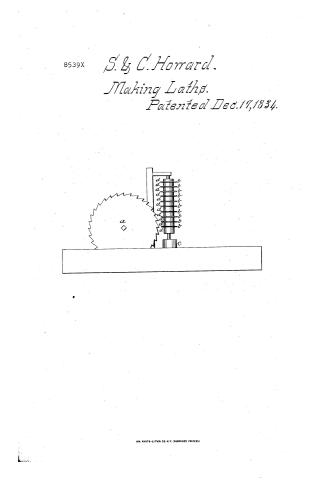 Page 1
-
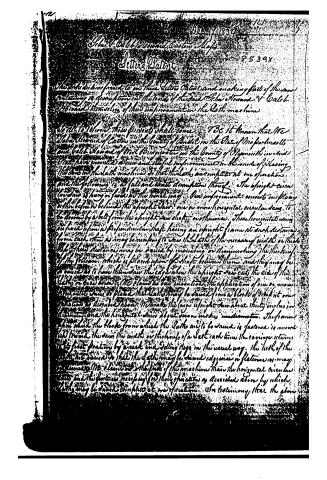 Page 2
-
 Page 3


U.S. Patent and Trademark Office · Google Patents
Show the transcription Hide (472 words)
Machine transcription (LightOnOCR) of the pages as scanned by the USPTO, most of them the handwritten copies made when the records were restored after the 1836 fire. Not checked; it can misread handwriting, so compare it with the scan.
Page 1.
8539X
S. & C. Horward.
Making Laths.
Patented Dec. 17, 1834.

A.M. PHOTO-LITHO. CO. N.Y. (OSBORNE'S PROCESS)
Page 2.
Dec. 17, 1834
S. H. & Caleb Howard, Easton, Mass.
Setting Patent 8539X
The undersigned have filed to us these Letters Patent and enclosing parts of the same containing a description in the words of the said S. H. Howard & Caleb Howard themselves of their improvement in the Lath machine.
We all to whom these presents shall come, To be it known that We S. H. Howard of Easton in the County of Bristol in the State of Massachusetts and Caleb Howard of West Bridgewater in the County of Plymouth in said State have invented a new and useful improvement in the mode of placing the saws in the Lath machine so that the Laths are completed at one operation. And the following is a full and exact description thereof. The upright saw carriage is hung or fixed to the usual way. Our improvement consists in placing either before or behind the upright saw, one or more horizontal circular saws to be driven by a belt from the upright saw shaft, or otherwise. These horizontal saws are fixed upon a perpendicular shaft having an upright frame at such distance from each other as may be necessary to saw the Laths of the necessary width or thickness. Their distance may be varied by increasing or diminishing the thickness of the follower, which is placed upon the shaft between them, and they may be so raised as to have them saw the edge when the upright saw cuts the side of the Laths or their ends. We claim as our invention, the application of one or more horizontal saws so placed that Laths may be sawed from a block of wood at one operation as described above. We make the large upright saw about thirty inches in diameter, and the horizontal saws about seven inches in diameter. The frame upon which the blocks from which the Laths are to be sawed is fastened is moved up toward the saw the width or thickness of a Lath each time the carriage returns to its first position by a rack and idling dogs in the usual way. The teeth of the saws are raised so that the Laths may be sawed edgewise or flatwise as may be desired. We claim as the parts of the machine, the horizontal circular saws and the fasteners necessary for their operation as described above by which the Laths may be sawed complete at one operation. In testimony that the above
Published accounts: journal notice
Notice in the monthly list of patents
Journal of the Franklin Institute, new ser., vol. 15 (1835), p. 144 · View the page
597. Lath machine.-S. and C. Howard, Bristol, Mass.
Published accounts: journal notice
Notice in the monthly list of patents, with remarks
Journal of the Franklin Institute, new ser., vol. 16 (1835), p. 25 · View the page
27. For a Lath Machine; Siba and Caleb Howard, Plymouth county, Massachusetts, December 17.
Remarks. "We claim as our invention, the application of one or more horizontal [circular] saws, so placed that laths may be sawed from a block of wood at one operation, as described above. We make the large upright saw about thirty inches in diameter, and the horizontal saws about seven inches. "The frame upon which the block from which the laths are to be sawed is fastened, is moved up toward the saw the width or thickness of a lath each time the carriage returns to its first position, by a rack and setting dogs in the usual way. The teeth of the rack are varied, so that the laths may be sawed edgewise or flatwise, as may be desired. We claim no other parts of the machine than the horizontal circular saws, and the fixtures necessary to their operation, as described above, by which laths may be sawed completely at one operation." In vol. xi., p. 319, there is the specification of a patent for cutting laths by means of circular saws, operating simultaneously on the edges and sides. In the only point claimed, therefore, the patentees have been anticipated. VOL. XVI. No. 1.-JULY, 1835. 4 side of the scythe. Two sets of dies, models of those I use in the manufacture of scythes, as above described, together with two scythes manufactured by the use of them, I have transmitted."
About this record
- Patentee
- Jim Shaw's X-patent list
- Date
- the Name and Date index of patents, USPTO records, Jim Shaw's X-patent list
- Invention
- the Name and Date index of patents
- Listed in
- the Name and Date index of patents, USPTO records, Jim Shaw's X-patent list, the Journal of the Franklin Institute, Burke's List of Patents (1847)
- Burke's 1847 Patent Office list gives the same patent.