

Drawings and documents
USPTO scan
The patent as scanned by the USPTO
-
 Page 1
-
 Page 2
-
 Page 3
-
 Page 4


U.S. Patent and Trademark Office · Google Patents
Show the transcription Hide (843 words)
Machine transcription (LightOnOCR) of the pages as scanned by the USPTO, most of them the handwritten copies made when the records were restored after the 1836 fire. Not checked; it can misread handwriting, so compare it with the scan.
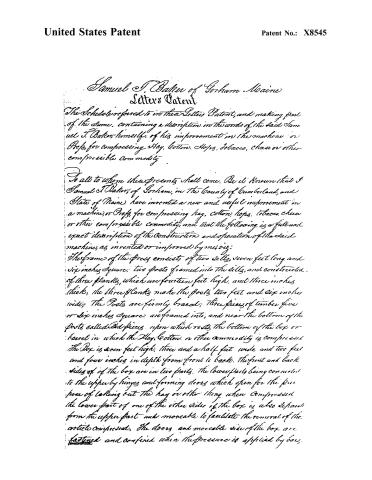
Page 2.
United States Patent
Patent No.: X8545
Samuel T. Baker of Gorham, Maine
Letters Patent
The Schedule referred to in the Letters Patent, and making part of the same, containing a description in the words of the said Samuel T. Baker himself, of his improvement in the machine or Press, for compressing Hay, Cotton, Hops, Tobacco, Cheese or other compressible commodity.
To all to whom these presents shall come, Be it known that I Samuel T. Baker, of Gorham, in the County of Cumberland, and State of Maine, have invented a new and useful improvement in a machine, or Press, for compressing hay, cotton, hops, tobacco, cheese or other compressible commodity, and that the following is a full and exact description of the construction and operation of the said machine, as invented or improved by me, viz:
The frame of the press consists of two sills, seven feet long and six inches square; two posts, framed into the sills, and constructed of three planks, which are fourteen feet high, and three inches thick, the three planks make the posts two feet and six inches wide; The Posts are firmly braced; Three pieces of timber five or six inches square, are framed into, and near the bottom of the posts, called Bed pieces, upon which rests the bottom of the box or barrel in which the Hay, Cotton, or other commodity is compressed. The Box is seven feet high, three and a half feet wide and two feet and four inches in depth from front to back. The front and back sides of the box are in two parts, the lower part being connected to the upper by hinges and forming doors which open for the purpose of taking out the hay or other thing when compressed. The lower part of one of the other sides of the box is also separated from the upper part and moveable to facilitate the removal of the article compressed. The doors and moveable side of the box are fastened and confined when the pressure is applied by bolts.
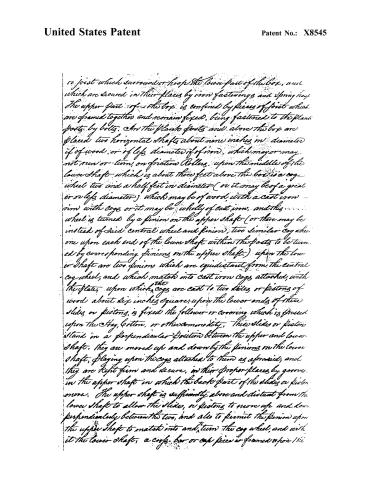
Page 3.
United States Patent
Patent No.: X8545
a joist which surround or hoop the lower part of the box, and which are secured in their places by iron fastenings and spring keys. The upper part of the box is confined by pieces of joist which are framed together and remain fixed, being fastened to the plank posts by bolts. On the plank posts and above the box are placed two horizontal shafts about nine inches in diameter if of wood, or of less diameter if of iron, which may or may not run or turn, on friction rollers, upon the middle of the lower shaft which is about three feet above the box is a cog wheel two and a half feet in diameter (or it may be of a greater or less diameter), which may be of wood, with a cast iron rim with cogs or it may be wholly of cast iron, and this wheel is turned by a pinion on the upper shaft (or there may be instead of said central wheel and pinion, two similar cog wheels one upon each end of the lower shaft within the posts to be turned by corresponding pinions on the upper shaft.) upon the lower shaft are two pinions which are equidistant from the central cog wheel, and which match into cast iron cogs attached, with the plates, upon which cogs are cast to two slides or pistons of wood about six inches square; upon the lower ends of these slides or pistons is fixed the follower or covering which is pressed upon the Hay, Cotton, or other commodity. These slides or pistons stand in a perpendicular position between the upper and lower shaft. They are moved up and down by the pinions on the lower shaft, playing upon the cogs attached to them as aforesaid, and they are kept firm and secure, in their proper places by grooves in the upper shaft in which the back part of the slides or pistons move. The upper shaft is sufficiently above and distant from the lower shaft to allow the slides, or pistons to move up and down perpendicularly between the two, and also to permit the pinion upon the upper shaft to match into and turn the cog wheel, and with it the lower shaft, a cross bar or cap piece is framed upon the
Page 4.
United States Patent
Patent No.: X8545
UNITED STATES PATENT OFFICE
PTO – BOYERS, PA DUTY STATION
PAGE NOT AVAILABLE
PATENT NUMBER X8545 FOR THE ISSUE DATE
12/17/1834 HAS BEEN SCANNED/LOADED, BUT WITH MISSING PAGE(S). UPON RECEIPT OF THE MISSING PAGE(S), THE ENTIRE DOCUMENT WILL BE RESCANNED. THIS NOTICE IS FOR THE MISSING PAGE CONTAINING:
Missing Text Pg 3 To END
DATA CONVERSION OPERATION
BOYERS, PA
Published accounts: journal notice
Notice in the monthly list of patents
Journal of the Franklin Institute, new ser., vol. 15 (1835), p. 143 · View the page
586. Press for cotton, hay, &c. I. Robinson, Portland, Maine,
Published accounts: journal notice
Notice in the monthly list of patents, with remarks
Journal of the Franklin Institute, new ser., vol. 16 (1835), p. 21 · View the page
16. For a Press for Cotton, Hay, &c.; Isaac Robinson, assignee of William T. Baker; the former of Portland, in the county of Cumberland, Maine, December 17.
Remarks. This is the well known rack and pinion press. Upon a shaft passing through the cheeks of the press, there is to be a pinion taking into a cog wheel on the middle of a second shaft, parallel to, but in advance of, and below it, and upon this second shaft are two pinions, one near each end, taking into two racks, the lower ends of which are attached to the follower of the press. The first shaft is to be turned by means of a large wheel, having hand pins on its periphery. Such is the whole arrangement of this press, but neither to the parts, or to the whole, of it, is there any claim made.
About this record
- Patentee
- Jim Shaw's X-patent list
- Date
- the Name and Date index of patents, USPTO records, Jim Shaw's X-patent list
- Invention
- the Name and Date index of patents
- Listed in
- the Name and Date index of patents, USPTO records, Jim Shaw's X-patent list, the Journal of the Franklin Institute, Burke's List of Patents (1847)
- The residence comes from the Franklin Institute's journal.
- Burke's 1847 Patent Office list gives the same patent.