

Drawings and documents
National Archives restored drawings: drawing
A. D. Spoor's Patent Drawing for a Salamander Cooking Stove

National Archives, Restored Patent Drawings (Record Group 241) · Full-size scan at the National Archives · Catalog record
Show the text on the drawing Hide (85 words)
Words on the drawing as machine-read by the National Archives; not checked. Useful mainly for searching.
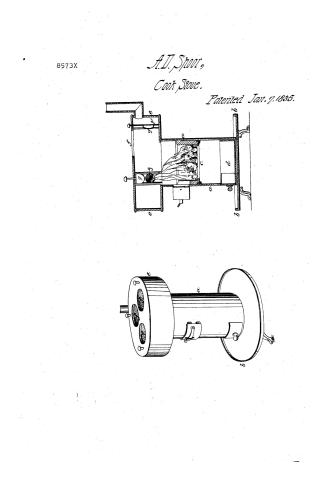
$2 - 126. STOVES & FURNACES / [154] Cooking Stoves. / CLASSIFICATION / 8573-X - / AD.SPOOR / DIVISION. / Patented J"Jan" 1835 / Salamander Cookingstove / a. Cast Iron cylouder / b. Hearth / C. grate / d. ash chawen / l. Upper cylender / f. Boiler holes F The in go / I. Openings of dawfers / section / do / COP / Patent office Decmb 31ᵗʰ18112 / Made under the derection of the Commignour / Strichland Del / of Patents in conformity with act, 3. Manch 1537 / Commynous of Par
USPTO scan
The patent as scanned by the USPTO
-
 Page 1
-
 Page 2
-
 Page 3


U.S. Patent and Trademark Office · Google Patents
Show the transcription Hide (835 words)
Machine transcription (LightOnOCR) of the pages as scanned by the USPTO, most of them the handwritten copies made when the records were restored after the 1836 fire. Not checked; it can misread handwriting, so compare it with the scan.
Page 1.
8573X
A. H. Shorr,
Cook Stove.
Patented Jan. 7, 1835.


Page 2.
8573X Jan. 4, 1835
Abraham D. Whor of Seneca County New York
Letters Patent
The Whor is found to be the better patent and making part of the same is being a description in the words of the said Abraham Whor himself of his improvement in Stoves for cooking with anthracite coal called the “mandar Cooking Stove.”
To all to whom these presents shall come: Know the want of sufficient flame and the limited extent of the horizontal surface of the fire in Stoves, cooking with anthracite coal, hitherto in use, have made it difficult if not impossible to expose more than one or two Roasts at once to the degree of heat necessary to carry on ordinary operations to advantage; and whereas also it has been found difficult in such Stoves, to increase or diminish the fire suddenly for different purposes, therefore—
Be it known that I Abraham D. Whor of the Town of Coropachic County of Seneca and State of New York have invented a new and useful improvement in Stoves for cooking with anthracite Coal called the “Mandar Cooking Stove,” by which it is intended to obviate the above difficulties, and of which the following is a true and exact Specification.
The circular form (the not essential) being the best adapted to the arrangement that is to be made of the boilers and other appliances for cooking in one that will now be described. This Stove consists of a hollow cast iron cylinder of from twelve to fifteen inches height, placed vertically on a circular hearth of about double its diameter, both having a common center. The grate is suspended within this cylinder about midway between the base and top, and it may be adjusted for rest or motion, and the grate above the grate may be lined with brick, stone, or other non-conductors of heat. The ash-trough may be above or below the hearth and should entirely close the entrance for air at the base of the cylinder. On the top of this cylinder is placed another hollow and conical cylinder of double the diameter of the lower one, or some larger if required. This may be above the grate in height and the lower plate of this upper cylinder has an opening in its centre equal in extent to the top of the lower cylinder and
Page 3.
at the margin of this opening, the two cylinders are joined together and united into one common chamber. The upper plate of the upper cylinder, or the top of the stove, has several openings for boilers and kettles, or other cooking utensils, the openings for them being in such order and arrangement that all of them to the number of three or more, stand partly over and are directly exposed to the fire, and may consequently be kept boiling at the same time. Thus avoiding the necessity of removing one after another successively to the fire, or of giving a rotary motion to the plate in which they are contained to attain the necessary degree of heat. For increasing the heat under either of the boilers, a further provision is made by means of a flue within the periphery of the upper cylinder to extend from the opening for the pipe both ways, so as nearly to meet in front and encircle the stove. Lateral outlets are made into this flue opposite to each boiler, which outlets or openings are provided with dampers, to shut or open them as occasion requires. The opening with the collar for the attachment of pipe may be on the outside of the periphery of the upper cylinder and there should always be a damper in the pipe to regulate the fire. The baking, roasting and other similar operations, are performed in separate boilers and roasters of suitable construction placed at proper distance around the lower cylinder or furnace.
I claim as my invention and improvement the stove or upper cylinder with the openings for boilers in the top so placed in relation to the lower cylinder or furnace that all the boilers to the number of three or more shall be partly over and directly exposed to the fire and so as to be kept at the required temperature at the same time and also the circular flue with lateral openings and dampers for directing the draft under either of the boilers when required whether said flue be constructed within or on the outside of the upper cylinder, and the general arrangement and combination of the respective parts, so as to constitute a cooking stove operating upon the principle or in the manner described.
Witnesses
Robt Clarke
Rich W. Clarke
A. G. Spoor
Patented January 7, 1855
Published accounts: journal notice
Notice in the monthly list of patents
Journal of the Franklin Institute, new ser., vol. 15 (1835), p. 222 · View the page
1. Cooking Stove.-Abraham Spoor, Coxsackie, New York, do. do.
Published accounts: journal notice
Notice in the monthly list of patents, with remarks
Journal of the Franklin Institute, new ser., vol. 16 (1835), p. 81 · View the page
1. For a Stove for Cooking with Anthracite Coal; Abraham D. Spoor, Coxsackie, Greene county, New York, January 7.
Remarks. (See the specification.)
Published accounts: journal notice
Notice in the monthly list of patents, with remarks
Journal of the Franklin Institute, new ser., vol. 16 (1835), p. 103 · View the page
SPECIFICATIONS OF AMERICAN PATENTS. Specification of a Patent for a Stove for Cooking with Anthracite Coal, called the Salamander Cooking Stove. Granted to ABRAHAM D. SPOOR, Coxsackie, Greene county, New York, January 7th, 1835.
Remarks. Whereas, the want of sufficient flame, and the limited extent of the horizontal surface of the fire, in stoves for cooking with anthracite coal, hitherto in use, have made it difficult, if not impossible, to expose more than one or two boilers at once to the degree of heat necessary to carry on culinary operations to advantage; and whereas, it has been found difficult, also, in such stoves, to increase or diminish the fire suddenly for culinary processes: Therefore, be it known, that I, Abraham D. Spoor, have invented a new and useful improvement in stoves for cooking with anthracite coal, called the SALAMANDER COOKING STOVE, by which it is intended to obviate the above difficulties, and of which the following is a true and exact description. The circular form, though not essential, being the best adapted to the arrangement that is to be made of the boilers, and other utensils for cooking, is the one that will now be described. This stove consists of a hollow cast-iron cylinder, of from twelve to fifteen inches in height, placed vertically on a circular hearth of about double its diameter, both having a common centre. The grate is suspended within this cylinder, about midway between the base and top, and it may be adjusted for rest or motion; and the part SPOOR'S Cooking Stove. above the grate may be lined with brick, stone, or other non-conductor of heat. The ash drawer may be above or below the hearth, and should entirely close the entrance for air at the base of the cylinder. On the top of this cylinder is placed another hollow and concentric cylinder, of double the diameter of the lower one, or larger if required; this may be about six inches in height, and the lower plate of the upper cylinder has an opening in its centre, equal in extent to the top of the lower cylinder; and at the margin of this opening the two cylinders are joined together, and united into one common chamber. The upper plate of the upper cylinder, or the top plate of the stove, has several openings for boilers and kettles, and other cooking utensils, the openings for them being in such order and arrangement, that all of them, to the number of three or more, stand partly over, and are directly exposed to, the fire, and may, consequently, be kept boiling at the same time, thus avoiding the necessity of removing one after the other successively to the fire, or of giving a rotary motion to the plate in which they are contained, to attain the necessary degree of heat. For increasing the heat under either of the boilers, a further provision is made, by means of a flue within the periphery of the upper cylinder, to extend from the opening for the pipe both ways, so as nearly to meet in front, and encircle the stove; lateral outlets are made into this flue, opposite to each boiler, which outlets, or openings, are provided with dampers, to shut or open them as occasion requires. The opening, with a collar for the attachment of the pipe, may be on the outside of the periphery of the upper cylinder, and there should always be a damper in the pipe to regulate the fire. The baking, roasting, and other similar operations, are performed in separate bakers and roasters, of suitable construction, placed at proper distances around the lower cylinder of the furnace.
Published accounts: specification
Specification printed in the Journal of the Franklin Institute
Journal of the Franklin Institute, new ser., vol. 16 (1835), p. 103 · View the page
Text of the specification as printed in the Journal, from OCR; not proofread.
Specification of a Patent for a Stove for Cooking with Anthracite Coal, called the Salamander Cooking Stove. Granted to ABRAHAM D. SPOOR, Coxsackie, Greene county, New York, January 7th, 1835. Whereas, the want of sufficient flame, and the limited extent of the horizontal surface of the fire, in stoves for cooking with anthracite coal, hitherto in use, have made it difficult, if not impossible, to expose more than one or two boilers at once to the degree of heat necessary to carry on culinary operations to advantage; and whereas, it has been found difficult, also, in such stoves, to increase or diminish the fire suddenly for culinary processes: Therefore, be it known, that I, Abraham D. Spoor, have invented a new and useful improvement in stoves for cooking with anthracite coal, called the SALAMANDER COOKING STOVE, by which it is intended to obviate the above difficulties, and of which the following is a true and exact description. The circular form, though not essential, being the best adapted to the arrangement that is to be made of the boilers, and other utensils for cooking, is the one that will now be described. This stove consists of a hollow cast-iron cylinder, of from twelve to fifteen inches in height, placed vertically on a circular hearth of about double its diameter, both having a common centre. The grate is suspended within this cylinder, about midway between the base and top, and it may be adjusted for rest or motion; and the part SPOOR'S Cooking Stove. above the grate may be lined with brick, stone, or other non-conductor of heat. The ash drawer may be above or below the hearth, and should entirely close the entrance for air at the base of the cylinder. On the top of this cylinder is placed another hollow and concentric cylinder, of double the diameter of the lower one, or larger if required; this may be about six inches in height, and the lower plate of the upper cylinder has an opening in its centre, equal in extent to the top of the lower cylinder; and at the margin of this opening the two cylinders are joined together, and united into one common chamber. The upper plate of the upper cylinder, or the top plate of the stove, has several openings for boilers and kettles, and other cooking utensils, the openings for them being in such order and arrangement, that all of them, to the number of three or more, stand partly over, and are directly exposed to, the fire, and may, consequently, be kept boiling at the same time, thus avoiding the necessity of removing one after the other successively to the fire, or of giving a rotary motion to the plate in which they are contained, to attain the necessary degree of heat. For increasing the heat under either of the boilers, a further provision is made, by means of a flue within the periphery of the upper cylinder, to extend from the opening for the pipe both ways, so as nearly to meet in front, and encircle the stove; lateral outlets are made into this flue, opposite to each boiler, which outlets, or openings, are provided with dampers, to shut or open them as occasion requires. The opening, with a collar for the attachment of the pipe, may be on the outside of the periphery of the upper cylinder, and there should always be a damper in the pipe to regulate the fire. The baking, roasting, and other similar operations, are performed in separate bakers and roasters, of suitable construction, placed at proper distances around the lower cylinder of the furnace. I claim as my invention and improvement, the drum, or upper cylinder, with the openings for boilers in the top, so placed in relation to the lower cylinder, or furnace, that all the boilers, to the number of three or more, shall be partly over, and directly exposed to, the fire, and so as to be kept at the required temperature at the same time; and also the circular flue, with lateral openings and dampers for directing the draught under either of the boilers when required, whether said flue be constructed within, or on the outside of, the upper cylinder; and the general arrangement and combination of the respective parts, so as to constitute a cooking stove, operating upon the principle, and in the manner, described. A. D. SPOOR. Spoor's Salamander Cooking Stove. A, Circular hearth. B, Furnace cylinder. C, Upper cylinder, or drum. D, Top plate, with openings. E, Pipe. The dotted lines show the place of the partition, with dampers, forming the curved flue within the upper cylinder. D C B A E Specification of improvements made for equalizing the heat in, and correcting the smell from, Cook Stoves, and for improving the quality and flavor of articles cooked therein, especially where anthracite coal is the fuel in use. Granted to ELIPHALET NOTT, Schenectady, New York, January 7th, 1835. Whereas, in cook stoves, having ovens constructed of iron plates, through which the heat is transmitted from the flame in passing along and around the same, the heat is variable, the smell offensive, and the quality and flavour of the articles cooked, injured: therefore, an improvement has been introduced, which consistsIn substituting ovens, the crust of which, so far as the same is exposed to the action of the interior furnace, or flue, but especially the furnace, is constructed, in whole or in part, of brick, stone, or other material, that is a poor conductor; and so far as the same is exposed to the action of the exterior air, is constructed of tin, polished brass, or other material, that is a good reflector; and also in opening an aperture for the escape of steam to the flue in ovens heated laterally. The form and relative positions of which furnace, flue, and ovens, may be varied at pleasure, provided only the whole be so combined, that the heat from the furnace and flue be transmitted to the oven, through brick, or stone, &c., on the inside, and reflected from tin, polished brass, &c., on the outside. For further information, reference may be had to the explanations and drawings connected herewith. SUMMARY.-The invention and improvement herein contemplated, consist in equalizing the heat, correcting the smell, and improving the quality and flavor of articles cooked in stoves, by so constructing and combining the furnace, flue, and ovens, that the heat shall be transmitted from the former to the latter through brick, or stone, &c. on the inner side, and reflected from tin, polished brass, or other reflector, on the outer side, in place of being, as heretofore, transmitted through, and reflected from, iron. I, therefore, claim as my invention and improvement, the construcVOL. XVI. No, 2.-AUGUST, 1835. 14 BUCKLEY'S Mode of Heating Puddling Furnaces tion and combination of the furnace, flue, and oven, whether fixed or movable, in a cook stove, especially where anthracite coal is the fuel in use, in the manner, and for the purposes, above set forth, together with the uses to which the same has been, or may hereafter be, applied. d f e f a ELIPHALET Nотт. a, chamber of combustion. b, flue for flame. ccc, kettles in places. d, smoke pipe. e e, ovens. ff, exterior tin crust of ovens. gg, exterior brick crust. hh, interior iron crust. o, inlet for fuel.
About this record
- Patentee
- DATAMP
- Date
- the Name and Date index of patents, DATAMP, USPTO records
- Invention
- DATAMP
- Listed in
- the Name and Date index of patents, DATAMP, USPTO records, Jim Shaw's X-patent list, the Journal of the Franklin Institute, the Journal of the Franklin Institute, Journal
- The sources give the patentee's name differently; the name shown follows DATAMP and Shaw.