

Drawings and documents
USPTO scan
The patent as scanned by the USPTO
-
 Page 1
-
 Page 2
-
 Page 3
-
 Page 4
-
 Page 5


U.S. Patent and Trademark Office · Google Patents
Show the transcription Hide (2,008 words)
Machine transcription (LightOnOCR) of the pages as scanned by the USPTO, most of them the handwritten copies made when the records were restored after the 1836 fire. Not checked; it can misread handwriting, so compare it with the scan.
Page 2.
United States Patent
Patent No.: X8575
Allen Ward, of Philadelphia, Penna.
Letter Patent
The schedule referred to in these Letters Patent, and making part of the same, containing a description in the words of the said Allen Ward, himself, of his improvement in the art of measuring and marking out Coats.
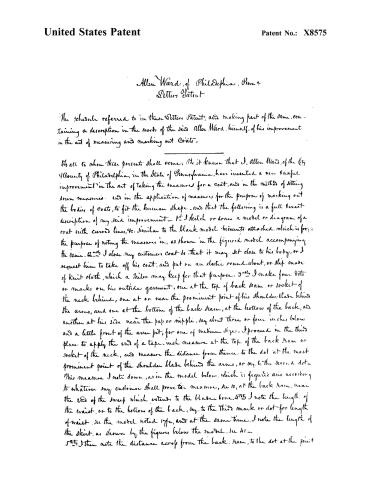
To all to whom these presents shall come: Be it known that I, Allen Ward, of the City and County of Philadelphia, in the State of Pennsylvania, have invented a new and useful improvement in the art of taking the measures for a coat, and in the method of setting down measures, and in the application of measures for the purpose of marking out the bodies of coats, to fit the human shape, and that the following is a full and exact description of my said improvement — 1st I sketch or draw a model or diagram of a coat with curved lines, &c. similar to the blank model herewith attached, which is for the purpose of noting the measures in, as shown in the figured model accompanying the same. 2nd I close my customer’s coat so that it may set close to his body, or I request him to take off his coat, and put on an elastic round about, or slip made of knit cloth, which a tailor may keep for that purpose. 3rd I make four dots or marks on his outside garment, one at the top of back seam or socket of the neck behind, one at or near the prominent point of his shoulder blade behind the arms, and one at the bottom of the back seam, at the hollow of the back, and another at his side near the pop or nipple, say about three or four inches below and a little front of the arm pit, for one of medium size. I proceed in the third place to apply the end of a tape-inch measure at the top of the back seam or socket of the neck, and measure the distance from thence to the dot at the most prominent point of the shoulder blade behind the arms, or any to the second dot. This measure I note down, as in the model below, which is figured and according to whatever my customer shall prove to measure, see 10, at the back seam, near the end of the sweep which extends to the blade bone. 4th I note the length of the waist, or to the hollow of the back, say, to the third mark or dot for length of waist. See the model noted 17½, and at the same time, I note the length of the skirt, as shown by the figures below the model, see 41 — 5th I then note the distance across from the back seam, to the dot at the point
Page 3.
United States Patent
Patent No.: X8575
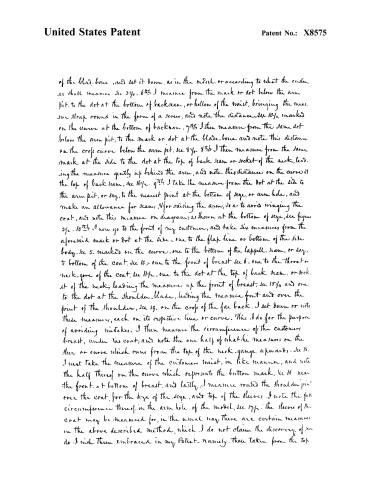
of the blade bone, and set it down, as in the model, or according to what the customer shall measure see 3½. 6th.) measure from the mark or dot below the arm pit, to the dot at the bottom of back seam, or hollow of the waist, bringing the measure strap round in the form of a screw, and note the distance, see 10½ marked on the curve at the bottom of back seam. 7th.) I then measure from the same dot below the arm pit, to the mark or dot at the blade bone and note this distance on the cross curve below the arm pit, see 8½. 8th.) I then measure from the same mark at the side to the dot at the top of back seam or socket of the neck, leading the measure quite up behind the arm, and note this distance on the curve at the top of back seam, see 11½. 9th.) I take the measure from the dot at the side to the arm pit, or say, to the nearest point at the bottom of scye, or arm hole, and make an allowance for seam, ¼ for raising the arm, so as to avoid ringing the coat, and note this measure on diagram 2 shown at the bottom of scye, see figure 3½. 10th.) I now go to the front of my customer, and take six measures from the aforesaid mark or dot at the side—one to the flap line or bottom of the side body, see 5, marked on the curve—one to the bottom of the lappell seam, or say, to bottom of the coat, see 16, one to the front of breast see 6, one to the throat or neck gore of the coat, see 11½, one to the dot at the top of back seam, or socket of the neck, leading the measure up the front of breast, see 15¼, and one to the dot at the shoulder blade, leading the measure front and over the point of the shoulder, see 19, on the cross of the far back. I set down or note these measures, each on its respective line or curve. This I do for the purpose of avoiding mistakes. I then measure the circumference of the customer’s breast, under his coat, and note the one half of what he measures on the line or curve which runs from the top of the neck gauge upwards, see 18. I next take the measure of the customer’s waist, in like manner, and note the half thereof on the curve which represents the button mark, see 16 near the front at bottom of breast. And lastly, I measure round the shoulder joint over the coat, for the size of the scye, and top of the sleeves. I note the full circumference thereof, in the arm hole of the model, see 17½. The sleeves of the coat may be measured for, in the usual way. There are certain measures in the above described method, which I do not claim the discovery of, nor do I wish them embraced in my Patent—namely, those taken from the top
Page 4.
United States Patent
Patent No.: X8575
of back seam to the length of the waist and skirt. Also that taken from top of back seam to the point of blade bone, and each of the circumference measures. I claim only the method of setting down these to avoid mistakes, by means of diagrams or models. But all the measures taken from the dot or point below the bottom of eye, I claim as my discovery, as well as the application of them —
The application is as follows — after I cut out the back of a coat, as fashion or fancy may dictate, I make three dots on the back, one at the top of the back seam, one at the point of the blade bone which I find by measure, and one at the length of the waist or hollow of the back, say at 17½ or what the measure may call for, and then I place the back on the cloth, and mark the shape of the side seam of the back, or only a part of it will do, opposite the blade bone. And while the back lies in this position I look to my measure as taken from the blade bone to the dot or crop below the arm pit, and with this length of measure I cast a curve toward the front, the pivot being at the dot at the blade bone. I then look to my measure as taken from the side dot to the hip or hollow of the waist, and with it cast another sweep pivoted at the mark for hollow of the waist across the sweep last made, and the cropping of which will give the point at the side below the arm pit. I then make the crop below the arm pit my pivot and cast nine sweeps or slurs, 1st by the length of measure as taken from the dot at the side, so as to crop the top of the right back seam. 2nd so as to crop the bottom of the right back seam. 3rd toward the arm pit. 4th toward the flap. 5th toward the bottom of breast. 6th toward the front of chest. 7th toward the chin or neck gorge. 8th toward the far top of back seam across the cloth. 9th toward the blade bone on the cloth under the far back above the eye: in this last I confine the measure at front of eye for a pivot, and shorten the sweep a fraction left to allow for the stretching of the eye: each of these sweeps to be governed according to their respective measures, as taken from the aforesaid dot at the side of the customer. I generally prefer measuring the left side but in some instances I measure the right side also, and then divide the difference between the two measures, or cut each back and fore part to suit their respective measures; this last method is only necessary in case of deformity. But to complete the application of the measure while the back lies in the first position, and
Page 5.
United States Patent
Patent No.: X8575
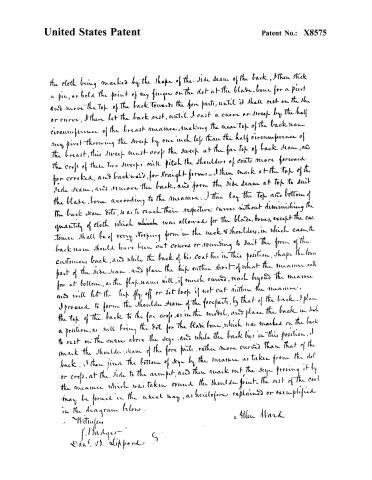
the cloth being marked by the shape of the side seam of the back, I then stick a pin, or hold the point of my finger on the dot at the blade-bone for a pivot and move the top of the back towards the fore parts, until it shall rest on the skin or curve; I then let the back rest, until I cast a curve or sweep by the half circumference of the breast measure, making the near top of the back seam my pivot throwing the sweep by one inch less than the half circumference of the breast, this sweep must crop the sweep at the far top of back seam, and the crops of these two sweeps will pitch the shoulders of coats more forward for crooked, and backward, for straight forms—I then mark at the top of the side seam, and remove the back, and form the side seam at top to suit the blade-bone according to the measure. I then lay the top and bottom of the back seam dots, so as to reach their respective curves without diminishing the quantity of cloth which was allowed for the blade-bones, except the extension shall be of very sloping form in the neck & shoulder, in which case, the back seam should have been cut convex or rounding to suit the form of the customer’s back, and while the back of his coat lies in this position, shape the lower part of the side seam, and place the hip on the short of what the measure calls for at bottom, as the flap seams will, if much curved, reach beyond the measure and will let the hip fly off or set loose if not cut within the measure.
I proceed to form the shoulder seam of the fore parts, by that of the back—I place the top of the back to the far crop, as in the model, and place the back in such a position, as will bring the dot for the blade bone, which was marked on the back to rest on the curve above the scye, and while the back lies in this position, I mark the shoulder seam of the fore parts, rather more curved than that of the back. I then find the bottom of scye by the measure as taken from the dot or crops, at the side to the armpit, and then mark out the scye proving it by the measure which was taken round the shoulder joint—the rest of the coat may be formed in the usual way, as heretofore explained or exemplified in the diagram below.
Witnesses
J. B. Dugan
Dan. J. Lippard
e Allen Ward
Published accounts: journal notice
Notice in the monthly list of patents
Journal of the Franklin Institute, new ser., vol. 15 (1835), p. 222 · View the page
8. Cutting clothes.-Allen Ward, Philadelphia, List of American Patents for January, 1835.
Published accounts: journal notice
Notice in the monthly list of patents, with remarks
Journal of the Franklin Institute, new ser., vol. 16 (1835), p. 84 · View the page
8. For Taking Measure for Coats, &c.; Allen Ward, city of Philadelphia, January 7.
Remarks. The specification of this patent enters too deeply for us into the science of coat cutting, and it is accompanied by nearly as many diagrams as are to be found in the first five books of Euclid; and after all the description given, there is not any claim made, and we are, therefore, left to the conclusion that this great work is, in all its parts, perfectly original.
About this record
- Patentee
- DATAMP
- Date
- the Name and Date index of patents, DATAMP, USPTO records
- Invention
- DATAMP
- Listed in
- the Name and Date index of patents, DATAMP, USPTO records, Jim Shaw's X-patent list, the Journal of the Franklin Institute, Burke's List of Patents (1847)
- Burke's 1847 Patent Office list gives the same patent.