

Drawings and documents
National Archives restored drawings: drawing
A. J. Murray's Patent Drawing for a Tobacco, Cotton, and Hay Press

National Archives, Restored Patent Drawings (Record Group 241) · Full-size scan at the National Archives · Catalog record
Show the text on the drawing Hide (116 words)
Words on the drawing as machine-read by the National Archives; not checked. Useful mainly for searching.
100.-2 / CLASSIFICATION Prisses / Baling, / AJJ O .MURRRY / Scrow. / 8581-X 8581 / DIVISION / Waling Plunce Plunger / Tobacco Cotton &. Hay Press / period / Patented) 9th Inn 1835 / lins / Flungert Staw: / A Frame / B. Side nieces / Plan / c. Cradle / D. Hogshead to befilled / E. Cylinder or false Hogshend-, / F. Bands orhoons / G. Pins crossing each other for handpacking / H. Iron-band, / I. Screw i crofspreces / A. / K. Circularpeice to fil Cylinder will / rejecting neices / L. Wheel / Section / of / Side view / Patent Office / ahril 19 "1" / rtand Del / Made under the direction of the Couniferater 1812 of / in Conformity with the act of 3 March 1837 / Ho M.Sumorth / of Patenty
USPTO scan
The patent as scanned by the USPTO
-
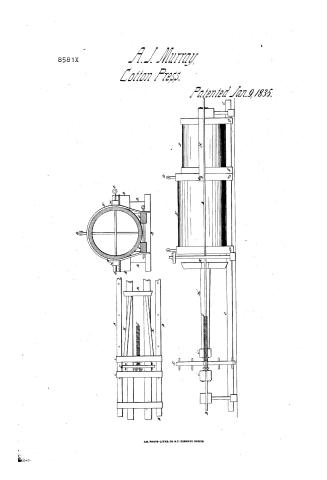 Page 1
-
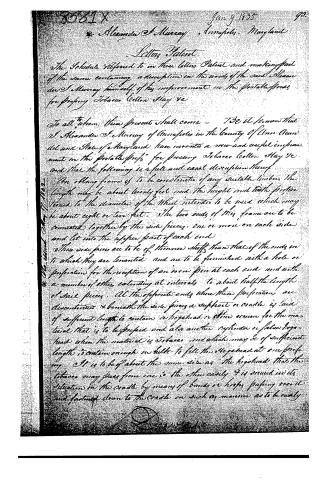 Page 2
-
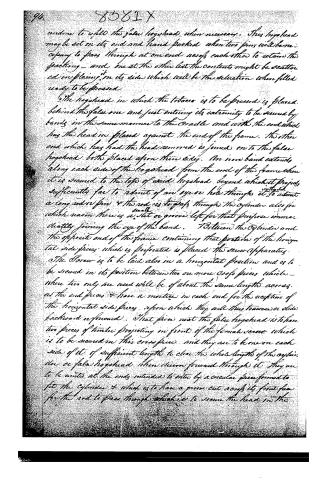 Page 3
-
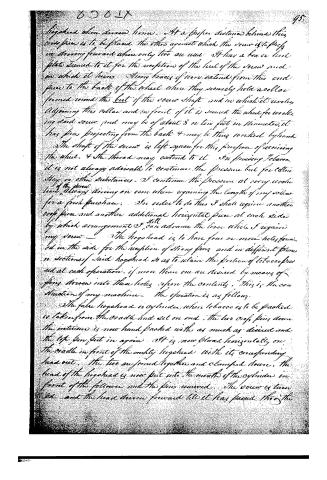 Page 4
-
 Page 5


U.S. Patent and Trademark Office · Google Patents
Show the transcription Hide (1,359 words)
Machine transcription (LightOnOCR) of the pages as scanned by the USPTO, most of them the handwritten copies made when the records were restored after the 1836 fire. Not checked; it can misread handwriting, so compare it with the scan.
Page 1.
8581X
A. J. Murray,
Cotton Press.
Patented Jan. 9, 1835.
AM. PHOTO-LITHO. CO. N.Y. (OSBORNE'S PROCESS)
Page 2.
8561X
Jan 9, 1835
90.
Alexander S. Murray, Annapolis, Maryland
Letters Patent.
The Schedule referred to in these Letters Patent and making part of the same containing a description in the words of the said Alexander S. Murray himself of his improvement in the portable press for pressing Tobacco Cotton Hay &c
To all whom these presents shall come — Be it known that Alexander S. Murray of Annapolis in the County of Anne Arundel and State of Maryland have invented a new and useful improvement in the portable press for pressing Tobacco Cotton Hay &c and that the following is a full and exact description thereof.
An oblong frame is to be constructed of any suitable timber. The length may be about twenty feet and the height and width proportioned to the diameter of the Wheel intended to be used which may be about eight or ten feet. The two ends of this frame are to be connected together by the side pieces, one or more on each side and let into the upper part of each end.
These side pieces are to be of thinner stuff than that of the ends in to which they are tenanted and are to be furnished with a hole or perforation for the reception of an iron pin at each end and with a number of other extending at intervals to about half the length of said pieces. At the opposite ends where these perforations are discontinued & beneath the side pieces a support or cradle is laid of sufficient length to contain a hoghead or other vessel for the material that is to be pressed and also another cylinder or false hoghead when the material is Tobacco and which may be of sufficient length to contain enough in bulk to fill the hoghead at one pressing. It is to be of about the same size as the hoghead that the tobacco may pass from one to the other easily & is secured in its situation in the cradle by means of bands or hoops passing over it and fastened down to the cradle in such a manner as to be easily
[Signature]
Page 3.
94. 85817
and one to yield the false hoghead, when necessary. This hoghead may be set on its end and hand packed when two pins will be necessary to pass through at one end across each other to retain the packing—and one at the other lest the contents might be scattered in placing it on its side which will be the situation when filled ready to be pressed.
The hoghead in which the tobacco is to be pressed is placed behind the false one and just entering its extremity to be secured by bands in the same manner to the cradle and with the end which has the head in placed against the end of the frame. The other end which has had the head removed is joined on to the false hoghead both placed upon their sides. An iron band extends along each side of the hoghead from the end of the frame when it is secured to the top of said hoghead beyond which it projects sufficiently far to admit of an eye or hole through it to admit a long rod or pin & the rod is to pass through the cylinder also for which reason there is a slot or groove left for that purpose immediately joining the eye of the band. Between the cylinder and the opposite end of the frame containing that portion of the horizontal side pieces which is perforated is placed the screw apparatus.
The Screw is to be laid also in a horizontal position and is to be secured in its position between two or more cross pieces which—where two only are used will be of about the same length across as the end pieces & have a mortice in each end for the reception of the horizontal side pieces upon which they will thus traverse or slide backward or forward. That piece next the false hoghead is to have two pieces of timber projecting in front of the female screw which is to be secured in this cross piece and they are to be one on each side of it of sufficient length to clear the whole length of the cylinder or false hoghead when driven forward through it. They are to be united at the ends intended to enter by a circular piece formed to fit the cylinder & which is to have a groove cut across its front face for the rod to pass through which is to secure the head in the
Page 4.
hogshead when driven home. At a proper distance behind this cross piece is to be placed the other against which the screw is to press in driving forward when only two are used. It has a box or heel plate secured to it for the reception of the heel of the screw and in which it turns. Strong braces of iron extend from this end piece to the back of the wheel where they securely hold a collar formed round the butt of the screw shaft and in which it revolves. Adjoining this collar and in front of it is secured the wheel for working said screw and may be of about 8 or ten feet in diameter. It has pins projecting from the back and may be thus worked by hand.
The shaft of the screw is left square for this purpose of receiving the wheel, and the thread may extend to it. In pressing tobacco it is not always advisable to continue the pressure but for cotton, flax or other substances. I continue the pressure at every revolution of the screw. Always driving on even when regaining the length of my screw for a fresh purchase. In order to do this I shall require another cross piece and another additional horizontal piece at each side by which arrangement I can advance the lever while I regain my screw.
The hogshead is to have four or more holes formed in the side for the reception of strong pins and in different places in sections of said hogshead so as to retain the portion of tobacco pressed at each operation, if more than one are desired by means of pins driven into these holes upon the contents. This is the construction of my machine. The operation is as follows:
The false hogshead is cylindrical when tobacco is to be packed is taken from the cradle and set on end, the two cross pins down the interior is now hand packed with as much as desired and the top pin put in again. It is now placed horizontally on the cradle in front of the empty hogshead with its corresponding head out. The two are joined together and clamped down. The head of the hogshead is now put into the mouth of the cylinder in front of the follower and the pins removed. The screw is turned and the head driven forward till it has passed through the
Page 5.
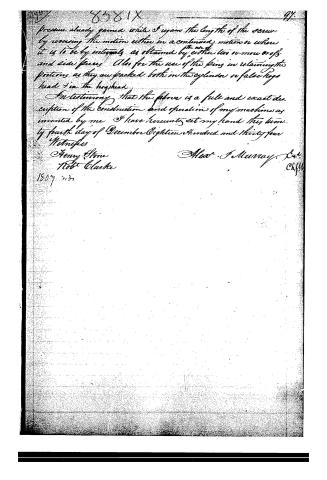
pressure already gained while I regain the length of the screw by varying the motion either in a continued motion or where it is to be by intervals as obtained by the use of either two or more cranks and side pieces. Also for the use of the pins in retaining the portions as they are packed both in the cylinder or false hogs head & in the hoghead.
In testimony that the above is a full and exact description of the construction and operation of my machine as invented by me I have hereunto set my hand this twenty fourth day of December Eighteen Hundred and thirty four
Witnesses
Henry Stone
Robt Clarke
1834
Alasd. J. Murray, Esq.
Ck. M.
Published accounts: journal notice
Notice in the monthly list of patents, with remarks
Journal of the Franklin Institute, new ser., vol. 16 (1835), p. 86 · View the page
13. For a portable Press for Tobacco, Cotton, Hay, &c.; Alexander J. Murray, Annapolis, Anne Arundel county, Maryland, January 9.
Remarks. This press is intended to act horizontally, and the power employed is that of the screw. A frame is made, consisting of two parallel side timbers, framed into stout head blocks at each end. Between these side timbers, the hogshead to be filled with tobacco, or other receptacle, is placed upon a suitable cradle. A cylinder, called a false hogshead, of about the same diameter with the hogshead, is also placed upon the cradle; this false hogshead is to hold a sufficient quantity to fill the hogshead, when pressed. A follower is to be forced into the false hogshead by means of the screw, and this screw works in a frame which crosses from side to side, sliding upon the parallel side pieces, and capable of being fixed on any part of them by means of pins passing through holes, adapted to the purpose. When the screw has forced the follower down its whole length, the sliding frame, or block, which advances with it, is confined by means of the pins; the screw is then turned back, and a block, against which it bears, is advanced so as to make a new start, and this is repeated until the pressing is accomplished. The claim is to the general arrangement, as described. We think that this press will be found to be inferior to several others already in use, and, indeed, that it will not answer the purpose for which it appears to be principally intended, the pressing of tobacco. This article requires to be laid in the hogshead with much care, and to be packed in successive portions, and very uniformly; how it is to be so laid in a horizontal cylinder, we do not perceive, nor do we believe that the power applied will suffice to pack the whole contents of a hogshead uniformly and firmly, throughout, at one operation.
About this record
- Patentee
- DATAMP
- Date
- the Name and Date index of patents, DATAMP, USPTO records
- Invention
- DATAMP
- Listed in
- the Name and Date index of patents, DATAMP, USPTO records, Jim Shaw's X-patent list, the Journal of the Franklin Institute, Burke's List of Patents (1847)
- Burke's 1847 Patent Office list gives the same patent.
Shaw: lists Murray, A. J. here as 8581½