

Drawings and documents
National Archives restored drawings: drawing
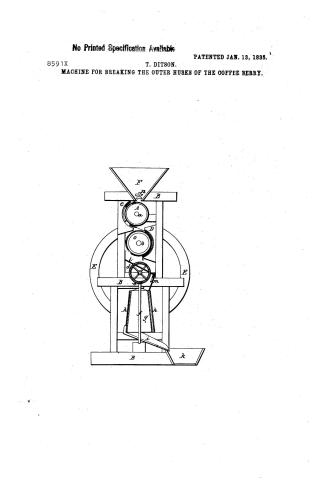
Thomas Ditson's Patent Drawing for a Machine for Breaking the Outer Husks of the Coffee Berry

National Archives, Restored Patent Drawings (Record Group 241) · Full-size scan at the National Archives · Catalog record
Show the text on the drawing Hide (87 words)
Words on the drawing as machine-read by the National Archives; not checked. Useful mainly for searching.
83. MILLS. / Scourens: 5 Conical / Grain Scourers. / Conical. / Voe / 21 / pl- / CLASSIFICATION / THO: DITSON'S / 8591 X Machine for breaking the outer husks of the Coffee- berry. / DIVISION. / Patented 13" Jany 1835. / in been suller the regulate borrgies the ad. / muprow of the / A cylmeter of would or atter an States you / Oa / material nal arening x of short vien perform / ten with Roles E/muches on / itler under shiface / concere @ of like construction / ling Agricult
USPTO scan
The patent as scanned by the USPTO
-
 Page 1
-
 Page 2
-
 Page 3
-
 Page 4


U.S. Patent and Trademark Office · Google Patents
Show the transcription Hide (1,184 words)
Machine transcription (LightOnOCR) of the pages as scanned by the USPTO, most of them the handwritten copies made when the records were restored after the 1836 fire. Not checked; it can misread handwriting, so compare it with the scan.
Page 1.
No Printed Specification Available
8591X
T. DITSON.
PATENTED JAN. 13, 1835.
MACHINE FOR BREAKING THE OUTER HUSKS OF THE COFFEE BERRY.

Page 2.
Thomas Ditson
Machine for breaking or cracking in pieces the outer husks of the Coffee berry
The schedule referred to in these Letters Patent and making part of the same, containing a description in the words of the said Thomas Ditson himself, of his improvement in a Machine for breaking or cracking in pieces, the outer husks of the Coffee berry.
To all persons, to whom these Presents shall come, Thomas Ditson of Boston in the county of Suffolk & state of Massachusetts, since groeling
Be it known, that I the said Thomas Ditson, have invented, made and applied to use, new and useful improvements of Machinery for the purpose of separating the external coats or husks of the Coffee berry, from the kernels or seed, which improvements, the principles thereof, and mode of in which I have contemplated the application of the same, together with the manner of using the same, I have hereunto set forth and described in the following words and drawings, which, taken in connection form my specification—
On examination of the Coffee berry, we find it composed of three external coats or husks, forming two compartments surrounding the seeds. The object of the invention here described, is to crack or break open these husks when in a dry state, that by another process of winnowing they may be blown away or scattered from the seeds. The outer covering is a stouter and stronger nature than the second both being quite brittle and easily broken in pieces. The third, or covering immediately contiguous to the seed is of a more delicate nature than the others and adheres more closely to the Coffee. The first operation of the machine here described is to crack or crush the outer husks, the second also tearing asunder the second covering, while the third and last operation is to rub off, or separate from the seeds, the covering immediately in contact with them.
The machinery for the first purpose, consists of a Cylinder A of wood or other suitable material, surrounded by an external covering X of sheet iron perforated with holes by punches on the under surface
Page 3.
so that jagged edges are raised on the outer surface, similar to a common grater. The shaft of the cylinder A revolves in proper boxes attached to the sides of the frame BB, which boxes admit of being moved laterally so as to carry the cylinder further from, or nearer to a concave surface C, covered with sheet iron similar to the cylinder A—on the end of the shaft a of the cylinder A is fixed a cogged wheel, whose teeth enter into, and act upon the teeth of another cogged wheel on the shaft b. The last mentioned shaft b passes through a second wooden or iron cylinder O covered with stout wires inserted in leather of the same description used for carding wool—
A concave surface D, covered like the cylinder O, passes a proper distance around the same, and with sufficient space between the rows of the cards of each to effect the purpose of tearing off the second husk of the seed as it drops from the first Cylinder A and passes between the card surfaces—
The cogged wheel on the end of the shaft b is turned round by another cogged wheel on the extremity of another horizontal shaft c. The shaft c has a bevelled wheel d on its other end, the teeth of which enter into the teeth of a bevelled pinion e, on the top of the upright shaft f. The upright shaft f passes through the conic frustum g, into which nails are thickly driven, so as to stand out from the convex surface about seven eighths of an inch. Around the whole frustum, is another hollow frustum h of sheet iron, filled with holes similar to that around the cylinder A. The rough edges of the iron thus raised by the punches together with the ends of the nails coming in contact with the seeds during the rotary motion of the conic frustum, tear off the third and last covering, thus effectually separating the husks from the seeds and leaving the whole in a proper state for the next process of winnowing—
The broken husks and seeds as they leave from between the surfaces of the inner and outer conic frustums fall into a trough I placed underneath, from whence they are conveyed to a proper receptacle K on the outer extremity of the axis of the shaft c is fixed a flywheel E to regulate the motion of the machinery. The power
Page 4.
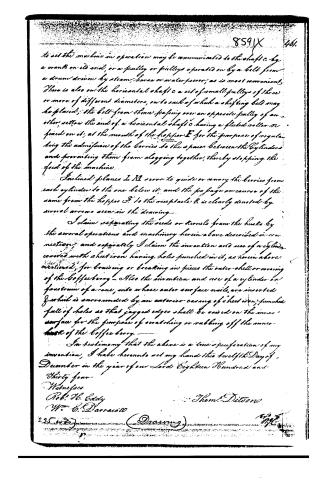
to set the machine in operation may be communicated to the shaft c by a crank on its end, or a pulley or pulleys operated on by a belt from a drum driven by steam, horse or water power; as is most convenient. There is also on the horizontal shaft c a set of small pulleys of three or more of different diameters, on to each of which a shifting belt may be placed; the belt from thence passing over an opposite pulley of an other section the end of a horizontal shaft c having a fluted roller m fixed on it, at the mouth of the hopper E for the purpose of regulating the admission of the berries to the spaces between the cylinders and preventing them from clogging together; thereby stopping the feed of the machine.
Inclined planes L M serve to guide or convey the berries from each cylinder to the one below it, and the passage or course of the same from the hopper E to the receptacle R is clearly denoted by several arrows seen in the drawing.
I claim separating the seeds or kernels from the husks by the several operations and machinery herein above described in connection; and separately I claim the invention and use of a cylinder covered with sheet iron having holes punched in it, as herein above mentioned, for bruising or breaking in pieces the outer shell or covering of the coffee berry—Also the invention and use of a cylinder or frustum of a cone, into whose outer surface nails are inserted & which is surrounded by an exterior casing of sheet iron, punched full of holes so that jagged edges shall be raised on the inner surface for the purpose of scratching or rubbing off the inner husk of the coffee berry.
In testimony that the above is a true specification of my invention, I have hereunto set my hand this twelfth Day of December in the year of our Lord Eighteen Hundred and Thirty four.
Witnesses
Robt. H. Cady
Wm. C. Darraclow
Thom. Ditson
235 wds) (Drawing)
Published accounts: journal notice
Notice in the monthly list of patents, with remarks
Journal of the Franklin Institute, new ser., vol. 16 (1835), p. 91 · View the page
25. For machinery for Breaking the Husk of the Coffee Berry; Thomas Ditson, Boston, Massachusetts, January 13.
Remarks. This apparatus resembles many of the machines for hulling clover, and other seeds. The berries are to be put into a hopper, whence they pass between a cylinder and concave, covered with punched sheet iron; thence between another cylinder and concave, covered with wire cards, and, after this, between a vertical revolving and a fixed hollow cone, the former of which is covered with projecting nails, and the latter with punched sheet iron. The patentee says, "I claim separating seeds, or kernels, from the husks, by the several operations and machinery above described, in connection. And, separately, I claim the invention and use of a cylinder covered with sheet iron, having holes punched in it, as herein above mentioned, for bruising or breaking in pieces, the outer shell or covering of the coffee berry. Also, the invention and use of a cylinder or frustrum of a cone, into whose inner surface nails are inserted, and which is surrounded by an exterior casting of sheet iron, punched full of holes, so that jogged edges shall be raised on the inner surface, for the purpose of scratching or rubbing off the inner husk of the coffee berry." Cylinders and concaves, covered with sheet iron, have been so long known and used, that we do not see how they can now be called an invention. We think the claim would have been more safe, had it left off with the general combination.
About this record
- Patentee
- DATAMP
- Date
- the Name and Date index of patents, DATAMP, USPTO records
- Invention
- DATAMP
- Listed in
- the Name and Date index of patents, DATAMP, USPTO records, Jim Shaw's X-patent list, the Journal of the Franklin Institute, Burke's List of Patents (1847)
- Burke's 1847 Patent Office list gives the same patent.