

Drawings and documents
National Archives restored drawings: drawing
James Burns and John Walter's Patent Drawing for a Machine for Mincing Meat

National Archives, Restored Patent Drawings (Record Group 241) · Full-size scan at the National Archives · Catalog record
Show the text on the drawing Hide (90 words)
Words on the drawing as machine-read by the National Archives; not checked. Useful mainly for searching.
17. BUTCHERING. / Meat Cutters. / Cylinder and Concave. / 150 / JAMES BURNS 8 JOHN WALTER / ICATION / 8594-X DIVISION. / Mincing Meat / Patented 16th Jany 1835. Voe 22/2 41 / Fig.1, / Fig. 2. / References / Fig. 1. Perspective View.Fig. 2. Section.ofBox / A. Revolving Cone. 2. Studs / B.B. Stationary Knives / C. Feeding Knives. / D. Crank & Handle. / E. Feeding Hopper / B. / F. Dischargeng Spout. / and / - a / ad / Patent office 13 / Made under direction of the the ifsioner of patents. in / with the act of 3 March 183% / M.Sumorth / Commissioner
USPTO scan
The patent as scanned by the USPTO
-
 Page 1
-
 Page 2
-
 Page 3
-
 Page 4
-
 Page 5
-
 Page 6


U.S. Patent and Trademark Office · Google Patents
Show the transcription Hide (1,650 words)
Machine transcription (LightOnOCR) of the pages as scanned by the USPTO, most of them the handwritten copies made when the records were restored after the 1836 fire. Not checked; it can misread handwriting, so compare it with the scan.
Page 1.
8594X
J. BURNS & J. WALTER.
Meat Mincer.
Patented Jan. 16, 1835
Fig. 1.
Fig. 2.
THE MORRIS PETERS CO., PHOTO-LITHO., WASHINGTON, D. C.
Page 2.
Jan 16, 1835
James Burns & John Walter, Maynesboro, Pa.
Letters Patents.
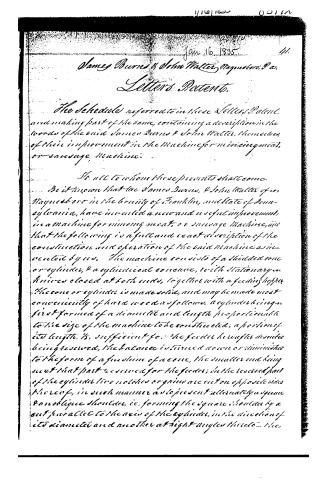
The Schedule referred to in these Letters Patent, and making part of the same, containing a description in the words of the said James Burns & John Walter, themselves, of their improvement in the Machine for mincing meat, or sausage Machine.
To all to whom these presents shall come.
Be it known that the James Burns, & John Walter of in Maynesboro in the County of Franklin, and State of Pennsylvania, have invented a new and useful improvement in a machine for mincing meat, or sausage Machine, and that the following is a full and exact description of the construction and operation of the said Machine as invented by us. The machine consists of a shelled cone or cylinder, & a cylindrical concave, with stationary knives closed at both ends, together with a feeding hopper. The cone or cylinder is made solid, and may be made most conveniently of hard wood as follows. A cylinder being first formed of a diameter and length proportionable to the size of the machine to be constructed; a portion of its length, is sufficient for the feeder hereafter described being reserved, the balance is turned down or diminished to the form of a frustum of a cone, the smaller end being next that part reserved for the feeder; in the reserved part of the cylinder two notches or groins are cut on opposite sides thereof, in such manner as to present alternately a square & an oblique shoulder, i.e. forming the square shoulder by a cut parallel to the axis of the cylinder, in the direction of its diameter and another at right angles thereto. The
Page 3.
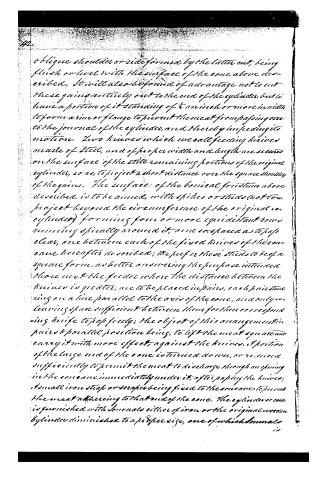
oblique shoulder or side formed by the latter cut, being flush or level with the surface of the cone above described. It will also be found of advantage not to cut these gains entirely out to the end of the cylinder, but to have a portion of it standing of a an inch or more in width to form a rim or flange to prevent the meat from passing over to the journals of the cylinder, and thereby impeding its motion. Two knives which we call feeding knives made of steel, and of proper width and length are secured on the surface of the still remaining portion of the original cylinder, so as, to project a short distance over the square shoulder of the gains. The surface of the conical frustum above described, is to be armed, with spikes or studs (not to project beyond the circumference of the original cylinder) forming from or more equidistant rows running spirally around it, and so spaced as to pass clear, one between each of the fixed knives of the cone cone hereafter described; We prefer these studs to be of a square form, as better answering the purpose intended. Those near the feeder where the distance between the knives is greater, are to be placed in pairs, each pair standing on a line parallel to the axis of the cone, and only leaving space sufficient between them for their corresponding knife to pass freely; the object of this arrangement in pairs & parallel position being, to lift the meat equally and carry it with more effect, against the knives. A portion of the large end of the cone is turned down, or reduced sufficiently to permit the meat to discharge through an opening in the cone cone immediately under it, after passing the knives; a small iron strap or scrap being fixed to the cone cone to prevent the meat adhering to that end of the cone. The cylinder or cone is furnished with Journals either of iron or the original wooden cylinder diminished to a proper size, one of which journals is
Page 4.
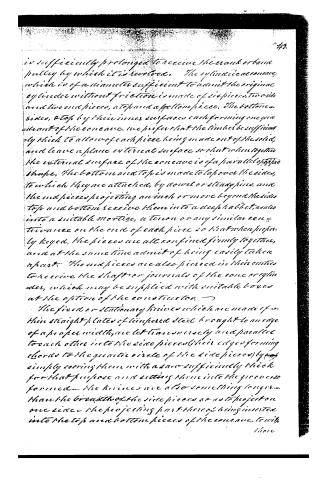
is sufficiently prolonged to receive the crank or band pulley by which it is revolved. The cylindrical concave, which is of a diameter sufficient to admit the original cylinder without friction is made of six pieces, two side and two end pieces, a top and a bottom piece. The bottom and sides, a top, by their inner surfaces each forming one quadrant of the concave. We prefer that the timbers be sufficiently thick to allow of each piece being made out of the solid, and leave a plane external surface so that when together the external surface of the concave is of a parallel or flat shape. The bottom and top is made to lap over the sides, to which they are attached, by dowel or tenon pins, and the end pieces projecting an inch or more beyond the sides top and bottom receive them into a deep rabbet, as also into a suitable mortice, a tenon or any similar connection on the end of each piece so that when properly keyed, the pieces are all confined firmly together, and at the same time admit of being easily taken apart. The end pieces are also pierced in their centers to receive the shaft or journals of the cone or cylinder, which may be supplied with suitable boxes at the option of the constructor.
The fixed or stationary knives which are made of thin straight plates of tempered steel brought to an edge of a proper width, are let transverse and parallel to each other into the side pieces (their edges forming chords to the quarter circle of the side pieces) by simply scoring them with a saw sufficiently thick for that purpose and setting them into the grooves so formed. The knives are also something longer than the breadth of the side pieces so as to project on one side. The projecting part thereof being inserted into the top and bottom pieces of the concave, to which
Page 5.
those ends which first receive the pressure of the meat above are inserted into the top, and vice versa, beginning next the feeding end of the Machine, they are in spaced gradually nearer to each other as you approach the discharging end, commencing with say 1/4 inch and ending with 1/2 inch apart. The number of knives may be varied at pleasure; we have found in a concave 17 inches long 5 inches diameter 12 knives of a side to answer sufficiently well. Immediately opposite the feeding knives and beginning at the top edge of the side piece, and wider as the length of said knives, a groove or channel is cut in the side piece, which descends obliquely towards the stationary knives, at an angle of 30° more or less extends to the bottom of the concave. Said groove being deep at the commencement, and running out at the end; its use being to receive the meat from the hopper and convey it to the bottom of the concave towards the fixed knives, where it is acted on by the studs. In the top piece over the feeding knives a square hole is cut of the width of the feeding knives or channel which receives a shallow hopper of the ordinary form except that, that edge of the foot next the groove is bevelled under & forms a continuation thereof. We find it convenient to attach three sides of the hopper permanently to the top piece of the concave and make the projection of the end piece of the concave serve as the fourth side.
Operation.—The meat to be minced being cut & freed from bones, as in the usual manner, is placed progressively in the hopper, whilst the machine is in revolution by hand, horse, or any other power. The feeding knives operate to cut or draw it into the grains from which it is pressed by the square shoulders through the feed channel under the cone or cylinder, where it is next taken up by the first pair
Page 6.
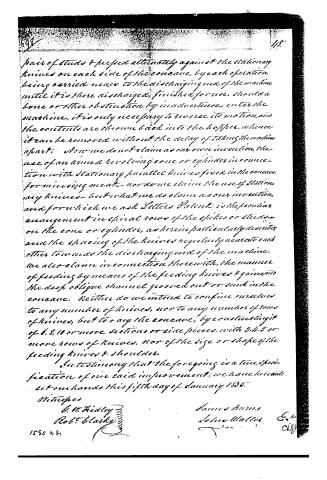
pair of studs & pressed alternately against the stationary knives on each side of the concave, by each operation being carried near to the discharging end of the machine until it is there discharged, finished for use. Should a bone or other obstruction by inadvertence, enter the machine, it is only necessary to reverse its motion, and the contents are thrown back into the hopper, whence it can be removed without the delay of taking the machine apart.
Now we do not claim as our own invention, the use of an armed revolving cone or cylinder in connection with stationary parallel knives fixed in the concave for mincing meat—nor do we claim the use of stationary knives—but what we do claim as our invention, and for which we ask Letters Patent is the peculiar arrangement in spiral rows of the spikes or studs, on the cone or cylinder, as herein particularly described, and the spacing of the knives regularly near to each other towards the discharging end of the machine.
We also claim in connection therewith, the manner of feeding by means of the feeding knives & gains, and the deep oblique channel grooved out or sunk in the concave. Neither do we intend to confine ourselves to any number of knives, nor to any number of rows of knives, but to any the concave, by constructing it of 6, 8, 10 or more sections or side pieces, with 3, 4, 5 or more rows of knives, nor of the size or shape of the feeding knives & shoulder.
In testimony that the foregoing is a true specification of the said improvement, we have hereunto set our hands this fifth day of January 1835.
Witnesses
G. W. Kidley
Robt. Clarke
James Burns
John Wallis
1550 38
Published accounts: journal notice
Notice in the monthly list of patents, with remarks
Journal of the Franklin Institute, new ser., vol. 16 (1835), p. 96 · View the page
36. For a machine for Cutting Sausage Meat; James Burns, and John Walter, Waynesboro, Franklin county, Pennsylvania, January 16.
Remarks. This bears the appearance of being a good instrument for the purpose intended, and it is certainly a very compact one. A hollow cylinder, closed at each end, has within it a revolving cylinder, or rather frustrum of a cone, extending from end to end. The meat is put into a hopper near one end of the instrument, and is discharged through an opening on the under side, near the opposite end. There is a system of fixed knives within the hollow cylinder, and upon the revolving cone are spirally placed studs, or wings, by which the meat is, in its passage, completely minced. The parts, as we have already intimated, are arranged with much skill. The claims are limited to those peculiarities in the construction, which, so far as we know, are A neighbour, who has tried the machine, was perfectly satisfied with its operation. new.
About this record
- Patentee
- DATAMP
- Date
- the Name and Date index of patents, DATAMP, USPTO records
- Invention
- DATAMP
- Listed in
- the Name and Date index of patents, DATAMP, USPTO records, Jim Shaw's X-patent list, the Journal of the Franklin Institute, Burke's List of Patents (1847)
- Burke's 1847 Patent Office list gives the same patent.