

Drawings and documents
USPTO scan
The patent as scanned by the USPTO
-
 Page 1
-
 Page 2
-
 Page 3


U.S. Patent and Trademark Office · Google Patents
Show the transcription Hide (535 words)
Machine transcription (LightOnOCR) of the pages as scanned by the USPTO, most of them the handwritten copies made when the records were restored after the 1836 fire. Not checked; it can misread handwriting, so compare it with the scan.
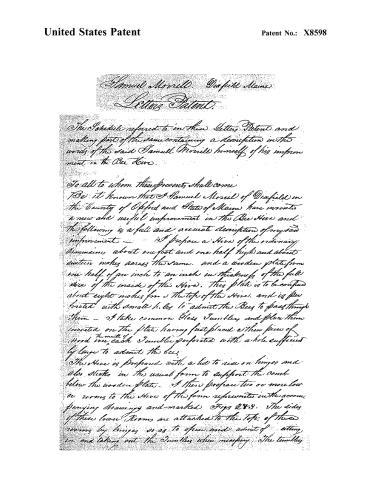
Page 2.
United States Patent
Patent No.: X8598
Samuel Morrell
Duxfield Maine
Letter Patent.
The Schedule referred to in this Letter Patent and making part of this same containing a description in the words of the said Samuel Morrell himself of his improvement in the Bee Hive.
To all to whom these presents shall come
Be it known that I Samuel Morrell of Duxfield in the County of Oxford and State of Maine have invented a new and useful improvement in the Bee Hive and the following is a full and accurate description of my said improvement —
I prepare a Hive of the ordinary dimensions, about one foot and one half high and about sixteen inches across the same, and a wooden plate from one half of an inch to an inch in thickness of the full size of the inside of the Hive. This plate is to be confined about eight inches from the top of the Hive, and is perforated with small holes to admit the Bees to pass through them — I take common Glass Tumbler, and place them inverted on the plate having first placed within pieces of wood over each Tumbler perforated with a hole sufficient by large to admit the bees.
The Hive is prepared with a lid to rise on hinges and also sticks in the usual form to support the comb below the wooden plate. If there be three or more lower rooms to the Hive of the form represented in the accompanying drawings and marked Figs 2 & 3. The sides of these lower Rooms are attached to the tops of these rooms by hinges so as to open and admit of taking in and taking out the Tumblers when necessary. The tumblers
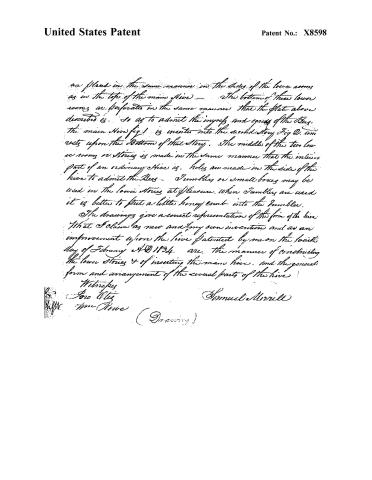
Page 3.
United States Patent
Patent No.: X8598
are placed in the same manner in the sides of the lower rooms as in the tops of the main Hive — The bottom of these lower rooms are perforated in the same manner that the plate above described is. So as to admit the ingress and egress of the Bees. The main Hive fig 1 is inserted into the second story fig 2. and rests upon the bottom of that story. The middle of the two lower rooms or stories is made in the same manner that the interior part of an ordinary Hive is. Holes are made in the side of the hive to admit the Bees. Tumblers or small boxes may be used in the lower stories at pleasure. When Tumblers are used it is better to put a little honeycomb into the Tumbler.
The drawings give a correct representation of the form of the hive. What I claim as new and my own invention and as an improvement upon the Hive patented by me on the fourth day of February 1834. are the manner of constructing the lower stories & of inserting the main hive. and the general form and arrangement of the several parts of the hive.
Witnesses
Samuel Merrill
(Drawing)
Published accounts: journal notice
Notice in the monthly list of patents, with remarks
Journal of the Franklin Institute, new ser., vol. 16 (1835), p. 97 · View the page
38. For an improvement in the Bee Hive; Samuel Morrill, Dixfield, Oxford county, Maine, January 16.
Remarks. This patent is taken for some variation of, and improvement in, the form of the hive contrived by the same gentleman, and described by us at p. 173, vol. xiv. In noticing that patent, we observed that the thing claimed was altogether old, that is, the formation of combs in vessels of glass. We do not think it necessary to detail the proposed variations in the form of the hive, as they are merely an extension of the principle upon which the hive was originally constructed.
DATAMP: illustration
Illustrations from DATAMP
DATAMP (Directory of American Tool and Machinery Patents), via the Internet Archive · Archived DATAMP page
About this record
- Patentee
- DATAMP
- Date
- the Name and Date index of patents, DATAMP, USPTO records
- Invention
- DATAMP
- Listed in
- the Name and Date index of patents, DATAMP, USPTO records, Jim Shaw's X-patent list, the Journal of the Franklin Institute, Burke's List of Patents (1847)
- Burke's 1847 Patent Office list gives the same patent.