

Drawings and documents
National Archives restored drawings: drawing
Sylvester Parker's Patent Drawing for a Cooking Stove

National Archives, Restored Patent Drawings (Record Group 241) · Full-size scan at the National Archives · Catalog record
Show the text on the drawing Hide (41 words)
Words on the drawing as machine-read by the National Archives; not checked. Useful mainly for searching.
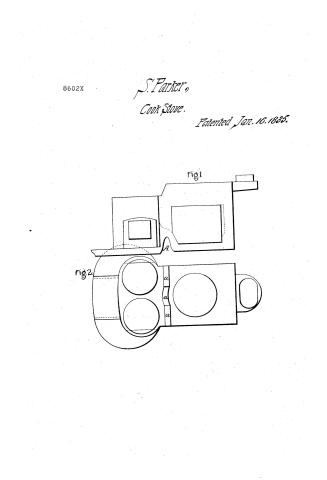
6. STOVES & FURNACE / pl / [154] Cooking Stoves / # 860 / ulvester Parker's Cooking Stove / CLA ESIFICATION / Patented Jan 16 / 8602x / 18c / ISION. / Pata Jan 16-1835 / Thg 1. Side view. / Fig:2
USPTO scan
The patent as scanned by the USPTO
-
 Page 1
-
 Page 2
-
 Page 3
-
 Page 4
-
 Page 5


U.S. Patent and Trademark Office · Google Patents
Show the transcription Hide (1,039 words)
Machine transcription (LightOnOCR) of the pages as scanned by the USPTO, most of them the handwritten copies made when the records were restored after the 1836 fire. Not checked; it can misread handwriting, so compare it with the scan.
Page 1.
8602X
S. Parker,
Cook Stove.
Patented Jan. 16, 1835.
Fig. 1.
Fig. 2.
a
a
a
Page 2.
Sylvester Parker Jan 16, 1835
The schedule referred to in the Specter Patent and Making part of the same containing a description in the words of the said Sylvester Parker himself of his improvement in the stove commonly known as the three-boiler-flat-boiling stove.
To all to whom these presents shall come greeting. Be it known that I Sylvester Parker of New York in the County of Westchester and State of New York have invented a new and useful improvement in the stove commonly known as the three-boiler-flat-boiling stove and that the following is a full and exact description of the construction and operation of said improvement as invented by me. The stove upon which I have made the improvement hereinafter described is the stove commonly known and described as the three boiler flat-boiling stove or New York stove. This stove is constructed with a flat bottom plate or foundation, running the whole length of the stove upon which is placed in front one apartment for the grate called the fire chamber, which contains the fuel (having in the top two holes for receiving boilers) and in the rear one apartment for the oven, over which is another aperture for receiving a boiler. The back of the apartment which contains the fuel is formed of an iron plate upon which (together with the grate) the fuel rests and with which it comes in contact. The flue of the furnace passes out under this plate at the bottom of the chamber for fuel, and is then continued up between the other side of this plate and the front side of the oven plate which is attached to the furnace in the rear and forms part of the main body of the stove, and
Page 3.
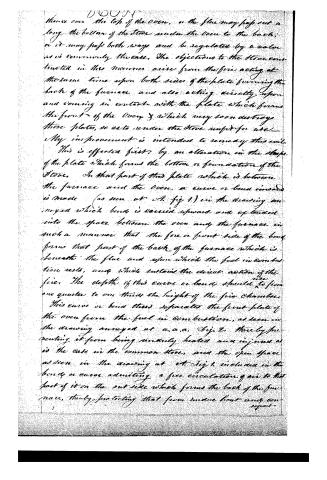
there are the top of the oven, or the flue may pass out a long the bottom of the stove under the oven to the back; or it may pass both ways and be regulated by a valve as is commonly the case. The objections to the stove constructed in this manner arise from the fire acting at the same time upon both sides of the plate forming the back of the furnace, and also acting directly upon and coming in contact with the plate which forms the front of the oven, and which very soon destroys these plates, so as to render the stove unfit for use. My improvement is intended to remedy this evil.
This is effected first, by an alteration in the shape of the plate which forms the bottom or foundation of the stove. In that part of this plate which is between the furnace and the oven, a curve or bend inward is made (as seen at A, fig 1) in the drawing annexed which bend is carried upward and extended into the space between the oven and the furnace in such a manner that the fore or front side of the bend forms that part of the back of the furnace which is beneath the flue and upon which the fuel in combustion rests, and which sustain the direct action of the fire. The depth of this curve or bend should be from one quarter to one third the height of the fire chamber.
This curve or bend thus separates the front plate of the oven from the fuel in combustion, as seen in the drawing annexed at a, a, a, fig. 2, thereby preventing it from being directly heated and injured as is the case in the common stove, and the open space as seen in the drawing at a, fig. 1, included in the bend or curve admitting a free circulation of air to that part of it on the outside which forms the back of the furnace, thereby protecting that from undue heat and consequent
Page 4.
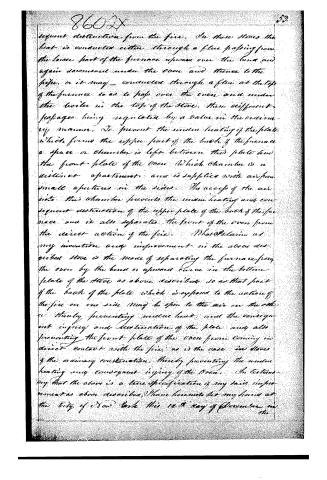
defunct destruction from the fire. In these stones the heat is conducted either through a flue passing from the lower part of the furnace upwards over the bend and again downwards under the oven and thence to the pipe, or it may be conducted through a flue at the top of the furnace so as to pass over the oven and under the boiler in the top of the stove. These different passages being regulated by a valve in the ordinary manner. To prevent the undue heating of the plate which forms the upper part of the back of the furnace a space or chamber is left between this plate and the front plate of the oven. Which chamber is a distinct apartment and is supplied with air from small apertures in the sides. The access of the air into this chamber prevents the undue heating and consequent destruction of the upper plate of the back of the furnace and it also separates the front of the oven from the direct action of the fire. What I claim as my invention and improvement in the above described stove is the mode of separating the furnace from the oven by the bend or upward curve in the bottom plate of the stove as above described so as that part of the back of the plate which is exposed to the action of the fire on one side may be open to the air on the other thereby preventing undue heat and the consequent injury and destruction of the plate and also preventing the front plate of the oven from coming in direct contact with the fire, as is the case in stoves of the ordinary construction, thereby preventing the undue heating and consequent injury of the oven. In testimony that the above is a true specification of my said improvement as above described, I have hereunto set my hand at the City of New York this 12th day of December in the
Page 5.
the year of our Lord one thousand eight hundred (and six) tyfour
Witnesse
J. H. B. W. B. Peiple
Sylvester Parker
(1100 x 11)
(Drawing)
Published accounts: journal notice
Notice in the monthly list of patents, with remarks
Journal of the Franklin Institute, new ser., vol. 16 (1835), p. 93 · View the page
30. For a Cooking Stove; Sylvester Parker, Troy, Rensselaer county, New York, January 16.
Remarks. It is said in this specification, that the direct action of the fire upon the plate which forms the back of the furnace, and the front plate of the oven in the stove commonly called the "three boiler flat cooking, or jews' harp stove, soon destroys that plate, and is productive of other inconveniences; to obviate which, the present patentee, instead of casting the lower plate flat, makes it with a bend, or rise, in the form of an inverted U, crossing the plate just at the termination of the furnace, one side of this U forming the back thereof, whilst the other forms a part of the front of the oven. The hollow of this bend is thus exposed to the action of the external air, which prevents its undue heating. For the same purpose, a similar space is left between the upper part of the division between the furnace and the oven. "What I claim as my invention and improvement in the above described stove, is the mode of separating the furnace from the oven by the bend, or upward curve, in the bottom plate of the stove, as above described, so as that part of the back of the plate which is exposed to the action of the fire on one side, may be open to the air on the other, thereby preventing undue heat, and the consequent injury and destruction of the plate. And also preventing the front plate of the oven from coming in direct contact with the fire, as is the case in stoves of the ordinary construction, thereby preventing the undue heating and consequent injury of the oven."
About this record
- Patentee
- DATAMP
- Date
- the Name and Date index of patents, DATAMP, USPTO records
- Invention
- DATAMP
- Listed in
- the Name and Date index of patents, DATAMP, USPTO records, Jim Shaw's X-patent list, the Journal of the Franklin Institute, Burke's List of Patents (1847)
- Burke's 1847 Patent Office list gives the same patent.