

Drawings and documents
USPTO scan
The patent as scanned by the USPTO
-
 Page 1
-
 Page 2
-
 Page 3
-
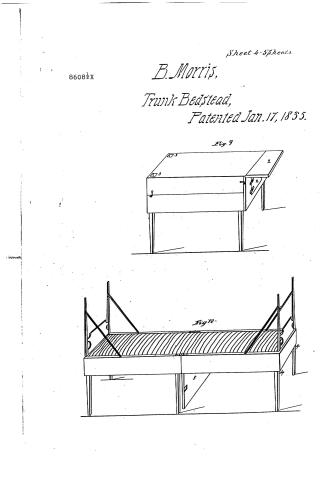 Page 4
-
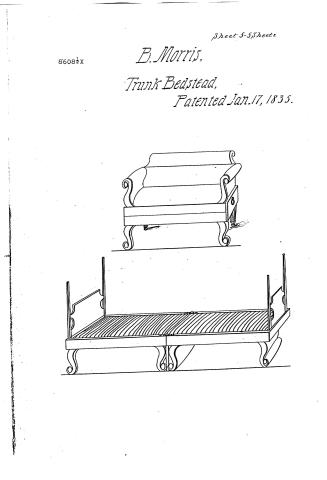 Page 5
-
 Page 6
-
 Page 7
-
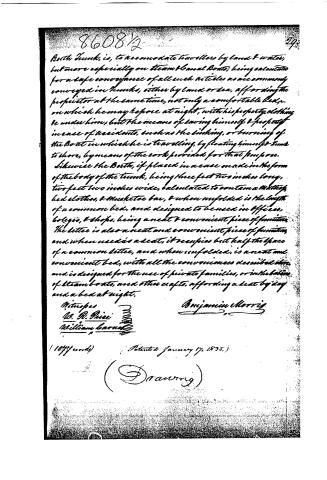 Page 8


U.S. Patent and Trademark Office · Google Patents
Show the transcription Hide (1,058 words)
Machine transcription (LightOnOCR) of the pages as scanned by the USPTO, most of them the handwritten copies made when the records were restored after the 1836 fire. Not checked; it can misread handwriting, so compare it with the scan.
Page 1.
Sheet 1 - 5 Sheets.
8608½X
B. Morris,
Trunk Bedstead,
Patented Jan. 17, 1835.
Fig. 1
Fig. 2
Fig. 3
Page 2.
8608½X
Sheet 2 of 5 Sheets.
B. Morris,
Trunk Bedstead,
Patented Jan. 17, 1835.
Fig 4
Fig 5
Page 3.
8608½X
Sheet 3-5 Sheets.
B. Morris,
Trunk Bedstead,
Patented Jan. 17, 1835.
Fig 6
Fig 7
Fig 8
Page 4.
Sheet 4-5 Sheets.
8608½X
B. Morris,
Trunk Bedstead,
Patented Jan. 17, 1835.
Fig. 9
Fig. 10
Page 5.
Sheet 5-5 Sheets.
8608½X
B. Morris,
Trunk Bedstead,
Patented Jan. 17, 1835.

Page 6.
Jan. 17, 1835
8608½x Benjamin Morris.
Letters Patent.
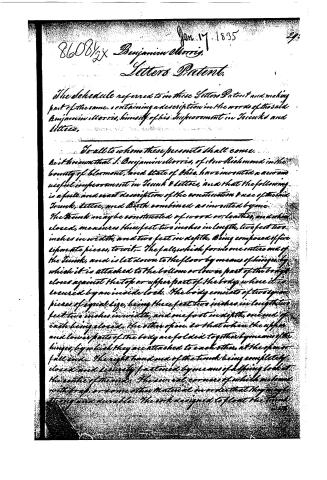
The schedule referred to in these Letters Patent and making part of the same, containing a description in the words of the said Benjamin Morris, himself of his improvement in Trunk and Letters.
To all to whom these presents shall come.
Be it known that I, Benjamin Morris, of New Richmond in the county of Belmont, and State of Ohio, have invented a new and useful improvement in Trunk & Letters, and that the following is a full and exact description of the construction & use of the said Trunk, letters, and both combined as invented by me.
The Trunk may be constructed of wood or leather, and when closed, measures three feet two inches in length, two feet two inches in width, and two feet in depth, being composed of five separate pieces, to wit:—The fall, which forms one entire one of the Trunk, and is let down to the floor by means of hinges, by which it is attached to the bottom or lower part of the body, closes against the top or upper part of the body, where it is secured by an inside lock. The body consists of two square pieces of equal size, being three feet two inches in length, two feet two inches in width, and one foot in depth, one end of each being closed, the other open, so that when the upper and lower parts of the body are folded together by means of the hinges, by which they are attached to each other, at the open or fall ends, the right hand end of the trunk being completely closed and securely fastened by means of a spring lock at the center of the end, the several corners of which are bound with brass or some other material in order that they might be very durable. The end designed to float the trunk.
Page 7.
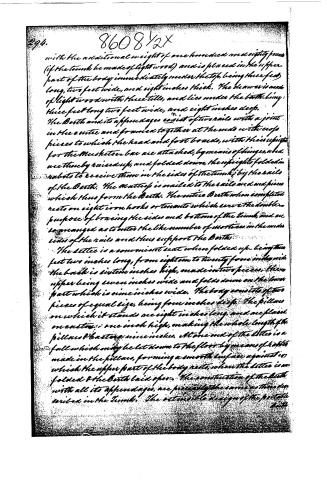
with the additional weight of one hundred and eighty pounds (if the trunk be made of light wood) and is placed in the upper part of the body immediately under the top, being three feet long, two feet wide, and eight inches thick. The drawer is made of light wood with three talls, and lies under the berth, being three feet long, two feet wide, and eight inches deep.
The Berth and its appendages consist of two rails with a joint in the centre and framed together at the ends with cross pieces to which the head and foot boards, with their uprights for the Musketoon bar are attached, by means of hinges and are thus by raised up, and folded down, the uprights folded in rabbits to receive them in the sides of the trunk, by the nails of the Berth. The Mattress is nailed to the rails and end pieces which thus form the Berth. The entire Berth when completed rests on eight iron hooks or tenants which serve the double purpose of bracing the sides and bottom of the trunk, and are so arranged as to enter the like number of mortices in the under sides of the rails and thus support the Berth.
The Letter is a convenient seat when folded up—being three feet two inches long, from eighteen to twenty four inches wide the back is sixteen inches high, made in two pieces, the upper being seven inches wide and folds down on the lower part which is nine inches wide. The body consists of two pieces of equal size, being four inches deep. The pillows on which it stands are eight inches long and one plank on each side, one inch high, making the whole length of the pillows and boards nine inches. At one end of the letter is a fall which may be let down to the floor by means of rabbits made in the pillows, forming a smooth surface against which the upper part of the body rests, when the letter is folded & the Berth laid open. The construction of the Berth with all its appendages, are precisely the same as those described in the Trunk. The admirable design of the portable
Page 8.
8608½
29
Ruth Tunk, is, to accommodate travellers by land & water, but more especially on steam & canal boats; being calculated for a safe conveyance of all such articles as are commonly conveyed in Tunks, either by land or sea, affording the proprietor at the same time, not only a comfortable bed, on which he may repose at night, with his property, clothing & under him, but the means of saving himself & property in case of accidents, such as the sinking, or burning of the boat in which he is travelling, by floating himself & Tunk to shore, by means of the cork provided for that purpose.
Likewise the Berth, if placed in a case made in the form of the body of the tunk, being three feet two inches long, two feet two inches wide, calculated to contain a mattress, bed clothes, & musket or bar, & when unfolded is the length of a common bed, and designed to be used in offices, colleges, & shops, being a neat & convenient piece of furniture.
The letter is also a neat and convenient piece of furniture, and when used as a seat, it occupies but half the space of a common letter, and when unfolded, is a neat and convenient bed, with all the conveniences described above, and is designed for the use of private families, or in the cabins of steam boats, and other crafts, affording a seat by day and a bed at night.
Witnesses
W. R. Price
William Barnes
Benjamin Morris
(1049 words) Patented January 17, 1835.
(Drawing)
Published accounts: journal notice
Notice in the monthly list of patents
Journal of the Franklin Institute, new ser., vol. 15 (1835), p. 143 · View the page
591. Bedstead.-P. Humphreville and J. King, Morristown, N. J.
Published accounts: journal notice
Notice in the monthly list of patents, with remarks
Journal of the Franklin Institute, new ser., vol. 16 (1835), p. 23 · View the page
21. For an improvement in the Construction of Bedsteads; Benjamin Humphreville, and James King, Morristown, Morris county, New Jersey, December 17.
Remarks. This improvement is said to consist of two parts, the first of which directs the making the legs of low post bedsteads in such a manner that they may turn upon a bolt, or pin, at their upper ends, so as to fold into a groove, or opening, along the head and foot rails, thus admitting of the bedstead, when not in use, being placed against a wall, so as to occupy but little more room than a wide plank. The second is in the manner of fixing the slats, which are used as a substitute for sacking bottoms. Slats are to be made to extend from one side rail to the other, but not to rest upon them, as they are to be supported entirely by the end rails. These slats are to be connected together by two ropes, in such way as to keep them at the proper distance from each other. Two iron rods, or straps, generally of hoop iron, are stretched between the head and foot rails, for these slats to lie on; in order to stretch them, screw bolts, terminating in hooks, pass through the head and foot rail, and by turning these, the required tension is given to the rods, or straps; the slats are then laid upon them, and kept in their places by fastening the cords to the hooks. The tightening screws serve as pins, upon which the legs turn. This mode of using slats, it is proposed to apply to sofas, and a number of other articles. There is no distinct claim made, but the two points mentioned are manifestly the things intended to be patented. Of the first item we do not think very favourably, as legs so constructed will necessarily make harbours for vermin; we are apprehensive, also, that it will be found of little utility, as the stowing away of the bed and bedding, as well as of the bedsteads, will be a very troublesome affair, unattended with much advantage in point of room.
Published accounts: journal notice
Notice in the monthly list of patents, with remarks
Journal of the Franklin Institute, new ser., vol. 16 (1835), p. 96 · View the page
37. For an improvement in Trunks and Settees; Benjamin Morris, New Richmond, Clermont county, Ohio, January 16.
Remarks. The trunk and settee described in the specification of this patent, are designed principally for travellers in steam and canal boats. The trunk is made to fold up in a peculiar way, and the articles placed in it have compartments adapted to the special purpose of rendering them secure. The settee, which is in general intended to accompany the trunk, is so constructed that the latter may be safely stowed below it, the whole taking but little room. The settee unfolds, so as to be readily converted into a comfortable berth, furnishing its own mattress. The upper part of the trunk encloses a thickness of cork, intended to give to it a degree of buoyancy in water which will sustain 180 lbs., thus fitting it not only to float with the property contained in it, but also to save its owner from drowning in case of accident. The whole apparatus is described without any claim being made; all the arrangements, therefore, must be considered by the patentee as new. We would suggest that, instead of a mass of cork three feet long, two feet wide, and eight inches in thickness, there might be a hollow space, lined or covered with India rubber cloth; this would be at the same time both cheaper and lighter than the cork.
About this record
- Patentee
- Jim Shaw's X-patent list
- Date
- Jim Shaw's X-patent list, Burke's List of Patents (1847)
- Listed in
- USPTO records, Jim Shaw's X-patent list, the Journal of the Franklin Institute, Burke's List of Patents (1847)
- The sources give different dates; the date shown is the one most of them agree on.
- This patent does not appear in the Name and Date index.
- The Franklin Institute's journal gives a different date.
- Burke's 1847 Patent Office list gives the same patent.
- Invention as named in Burke's 1847 Patent Office list; the standard lists give none.