

Drawings and documents
National Archives restored drawings: drawing
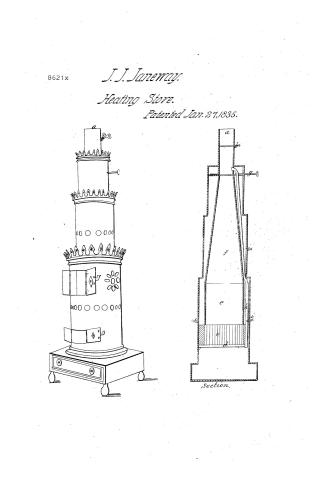
Jacob J. Janeway's Patent Drawing for an Anthracite Coal Stove

National Archives, Restored Patent Drawings (Record Group 241) · Full-size scan at the National Archives · Catalog record
Show the text on the drawing Hide (76 words)
Words on the drawing as machine-read by the National Archives; not checked. Useful mainly for searching.
$2- / 126. STOVES & FURNACES, / 196 / Heating Stoves-Hot Air. / (154) / JACOB J. JANEWAY / CLASSIFICATION / Patented 27 Sanuary 1835. / 8621-X / ANTHRACITE GOAL / DIVISION. / STOVE. / References. / The pipe. / Regulator, Fire-bricks / el / The grate / Castiron cylinder. / value segment ofa / 8h / ash / holes / for / an. / Patent office 12ed'1838 / Made under the direction of Commision / of Patents in confe omity with Ach3Mard / colo / 1837 / Section. / Humps Sunoth / Commisioner of Patents,
USPTO scan
The patent as scanned by the USPTO
-
 Page 1
-
 Page 2
-
 Page 3
-
 Page 4


U.S. Patent and Trademark Office · Google Patents
Show the transcription Hide (966 words)
Machine transcription (LightOnOCR) of the pages as scanned by the USPTO, most of them the handwritten copies made when the records were restored after the 1836 fire. Not checked; it can misread handwriting, so compare it with the scan.
Page 1.
8621x
J. J. Janeway.
Heating Stove.
Patented Jan. 27, 1835.

Section.
Page 2.
Jan. 27 1835 8621X 61
Jacob I. Saneaway of New Brunswick, New Jersey
Letters Patent.
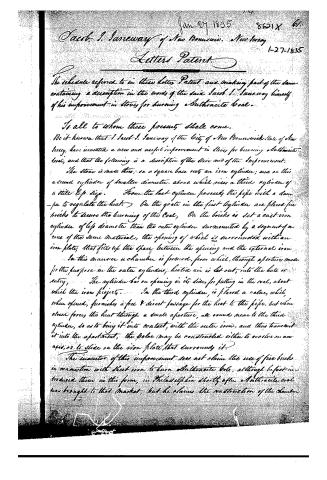
The schedule referred to in these Letters Patent and making part of the same containing a description in the words of the said Jacob I. Saneaway himself of his improvement in stoves for burning Anthracite Coal.
To all to whom these presents shall come.
Be it known that I Jacob I. Saneaway of the City of New Brunswick, State of New Jersey, have invented a new and useful improvement in stoves for burning Anthracite Coal, and that the following is a description of the stove and of the Improvement.
The stove is made thus: on a square base rests an iron cylinder; and on this a second cylinder of smaller diameter, above which rises a third cylinder of a still less size. From the last cylinder proceeds the pipe with a damper to regulate the heat. On the grate in the first cylinder are placed five bricks to secure the burning of the Coal, On the bricks is set a cast iron cylinder of less diameter than the outer cylinder, surmounted by a segment of a cone of the same material, the opening of which is surrounded with an iron plate, that fills up the space between the opening and the external iron.
In this manner a chamber is formed, from which, through apertures made for the purpose in the outer cylinder, heated air is let out, into the hall or entry.
The cylinder has an opening in its side, for putting in the coal, about which the iron projects. In the third cylinder, is placed a valve, which, when opened, furnishes a free & direct passage for the heat to the pipe, but when closed forces the heat through a small aperture, as round near to the third cylinder, so as to bring it into contact, with the outer iron, and thus transmit it into the apartment, the valve may be constructed either to oscillate on an axis, or to slide on the iron plate that surrounds it.
The inventor of this improvement does not claim the use of five bricks in connection with sheet iron to burn Anthracite Coal, although he first introduced them in this form, in Philadelphia shortly after Anthracite coal was brought to that market, but he claims the construction of the chamber
Page 3.
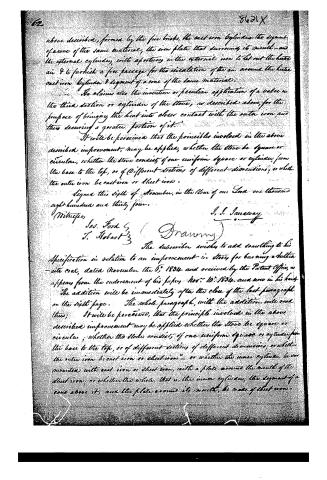
above described, formed by the five bricks, the cast iron cylinder, the segment of a cone of the same material, the iron plate that surrounds its mouth, and the external cylinder, with apertures in the external iron to let out the heated air & to furnish a free passage for the circulation of the air around the heated cast iron cylinder & segment of a cone of the same material.
He claims also the invention or peculiar application of a valve in the third section or cylinder of the stove, as described above, for the purpose of bringing the heat into closer contact with the outer iron, and thus securing a greater portion of it.
It will be perceived that the principles involved in the above described improvement, may be applied, whether the stove be square or circular, whether the stove consists of one uniform square or cylinder from the base to the top, or of different sections of different dimensions, or whether the outer iron be cast iron or sheet iron.
Signed this 9th of November, in the year of our Lord one thousand eight hundred and thirty four.
Witnesses,
Jos. Ford
T. Hobart
J. S. Saneaway
(Drawing)
The subscriber wishes to add something to his Specification in relation to an improvement in stoves for burning anthracite coal, dated November the 6th, 1834 and received by the Patent Office, as appears from the endorsement of his patent Nov. 10, 1834, and now in his hand.
The addition will be immediately after the close of the last paragraph on the 9th page. The whole paragraph, with the addition, will read thus:
It will be perceived, that the principle involved in the above described improvement may be applied whether the stove be square or circular, whether the stove consists of one uniform square or cylinder from the base to the top, or of different sections of different dimensions, or whether the outer iron be cast iron or sheet iron, or whether the inner cylinder be mounted with cast iron or sheet iron, with a plate around the mouth of the sheet iron, or whether the whole, that is, the inner cylinder, the segment of a cone above it, and the plate around its mouth, be made of sheet iron.
Page 4.
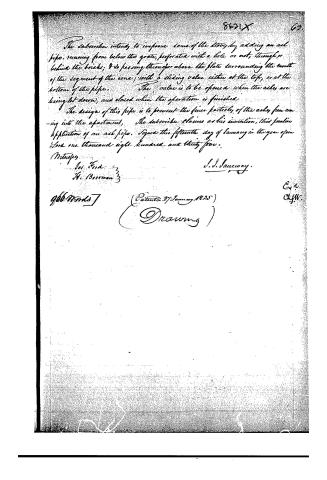
The subscriber intends to improve some of the stoves by adding an ash pipe, running from below the grate, perforated with a hole or not, through or behind the bricks, & passing through above the plate surrounding the mouth of the segment of the cone; with a sliding valve either at the top, or at the bottom of the pipe. The valve is to be opened when the ashes are being let down, and closed when the operation is finished.
The design of this pipe is to prevent the finer particles of the ashes from coming into the apartment. The subscriber claims as his invention, this peculiar application of an ash pipe. Signed this fifteenth day of January in the year of our Lord one thousand eight hundred and thirty five.
Witnesses:
Jas. Ford
H. Borman
S. J. Sweeney.
966 Words
(Patented 27 January 1835)
(Drawing)
E. A.
Ch. W.
Published accounts: journal notice
Notice in the monthly list of patents, with remarks
Journal of the Franklin Institute, new ser., vol. 16 (1835), p. 101 · View the page
53. For a Stove for Burning Anthracite; Jacob J. Janeway, New Brunswick, New Jersey, January 27.
Remarks. This stove does not differ, in appearance, from others which have preceded it, as it is represented in the drawing, which shows nothing more than its exterior, and is without written references; for its interior construction, we have, therefore, to depend solely on the description; a section certainly ought to have been furnished. The base of the stove is a square pedestal, forming the ash pit, as usual; this is surmounted by a cylinder, with its door for supplying fuel to the furnace part; a smaller cylinder succeeds to this, and then a third, still smaller, from which passes the smoke pipe. In the upper cylinder, and also in the stove pipe, there are valves, or dampers. In each of the lower cylinders, there are perforations to let out heated air. "On the grate in the first cylinder are placed fire bricks, to secure the burning of the coal; on the bricks is set a cast-iron cylinder, of less diameter than the outer cylinder, surmounted by a segment of a cone of the same material, the opening of which is surrounded with an iron plate, that fills up the space between the opening and the external iron. In this manner a chamber is formed, from which, through apertures made for the purpose in the outer cylinder, heated air is let out into the hall, or entry." "The inventor claims the construction of the chamber above described by the fire brick, the cast-iron cylinders, the segment of a cone of the same material, the iron plate that surrounds its mouth, and the external cylinders with apertures to let out the heated air. He claims, also, the application of a valve in the third section, or cylinder, of the stove."
About this record
- Patentee
- DATAMP
- Date
- the Name and Date index of patents, DATAMP, USPTO records
- Invention
- DATAMP
- Listed in
- the Name and Date index of patents, DATAMP, USPTO records, Jim Shaw's X-patent list, the Journal of the Franklin Institute, Burke's List of Patents (1847)
- Burke's 1847 Patent Office list gives the same patent.