

Drawings and documents
National Archives restored drawings: drawing
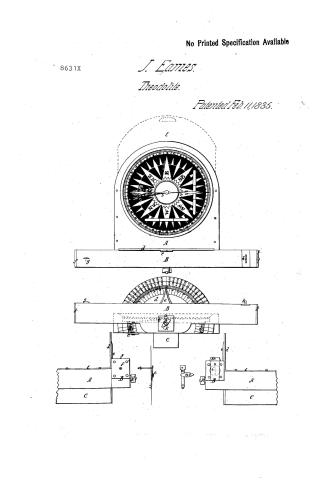
James Eames' Patent Drawing for a Theodolite

National Archives, Restored Patent Drawings (Record Group 241) · Full-size scan at the National Archives · Catalog record
Show the text on the drawing Hide (109 words)
Words on the drawing as machine-read by the National Archives; not checked. Useful mainly for searching.
88. OPTICS. / [157] Surveying Instr, / 252 / ⑆4⑇ / ATION / 863/-X / DIVISION. / James Sames / Theodolite. / Patentid 1835 / this / to / certify / that / this / of the n.Patents conformity to / act of 3am March 1837. sect 1st from and in with / which / letters / Patent / NE / MS / lames / 11" / February / 1535.c / day / of / april / 1838. / MemyL Eurnoth / Patents. / Sc / References. / A. Circumferenter. / B Tube / a.b.c. For holding neadle steady. / d Protractor. / c. Hand an protractor / g.h Sights on top of tube. / f. / throug the tube / K. Tumb screw. / l. Cover. / <<<<<<<<<<< / at
USPTO scan
The patent as scanned by the USPTO
-
 Page 1
-
 Page 2


U.S. Patent and Trademark Office · Google Patents
Show the transcription Hide (433 words)
Machine transcription (LightOnOCR) of the pages as scanned by the USPTO, most of them the handwritten copies made when the records were restored after the 1836 fire. Not checked; it can misread handwriting, so compare it with the scan.
Page 1.
No Printed Specification Available
8631X
J. Eames.
Theodolite.
Patented Feb 11, 1835.

Page 2.
Feb 11, 1835
James Eames of Newry, Maine
Letters Patent
The schedule referred to in these Letters Patent, and making part of the same containing a description in the words of the said James Eames himself of his improvement in the Theodolite or Surveyors Compass —
To all to whom these presents shall come, Be it known that I James Eames, of Newry, in the County of Oxford, and State of Maine, have invented a new Useful Theodolite or Surveyors Compass, and that the following is a full Veract description thereof: composed of several instruments now in use, brought together in my new invented way and manner, viz:
First, I take the Surveyors circumferenter without the usual index, and form the outside of the box, so as to preserve one side straight parallel with the north South line under the needle in the card — Secondly, I take the protractor, adding two lines, one to show the sag of chain, the other the rise & fall of uneven lands, and attach it to the straight side of the compass, so as to hang perpendicular —
Thirdly, I take the tube on index with prospect glasses inside of said tube, and attach it to the compass on the outside of the protractor in such a manner as to move round like the index of the theodolite when placed for taking heights and so forth, having placed & levelled my compass, I can raise my tube, so as to descry the object, then by casting my eye on the protractor, where the first end of the tube intersects the lines on the protractor, I see not only the degrees, but also the sag of the chains and also the rise of land for a certain distance. In descending ground, by lowering my tube, taking my object, and casting my eye upon the protractor directly under the further end of the tube where it intersects the lines of the protractor, and the degrees, sag of chains, and descent of ground is seen.
What I claim as my own invention, and not previously known, in the above described machine, is, in bringing the several instruments together, in my new invented way, as before described —
Witnesses
O’Neil W Robinson
O’Neil W Robinson Jr.
James Eames
(Patented) Feb 11, 1835.
(Drawing)
Published accounts: journal notice
Notice in the monthly list of patents, with remarks
Journal of the Franklin Institute, new ser., vol. 16 (1835), p. 160 · View the page
10. For an improvement in the Theodolite, or Surveyor's Compass; James Eames, Newry, Oxford county, Maine, February 11.
Remarks. The patentee says that, in the first place, he takes "the circumferentor, without the usual index, and forms the outside of the box so as to preserve one side straight, parallel with the north and south line under the needle in the card." Secondly, he takes "the protractor, adding two lines, one to show the swag of the chain, the other the rise and fall of the uneven lands, attaching it to the straight side of the compass, so as to hang perpendicular." Thirdly, he takes "the tube, or index, with prospect glasses inside of said tube, and attaches it to the compass on the outside of the protractor, in such a manner as to move round like the index of the theodolite, when placed for taking heights, &c." When the compass has been placed and leveled, the tube may be raised so as to descry the object, when, by casting the eye upon the protractor, where the first end of the tube intersects the lines thereon, the degrees, the swag of the chain, and the rise of land for a certain distance, are perceived. In descending ground, by lowering the tube, taking the object, and casting the eye upon the protractor, directly under the further end of the tube, where it intersects the lines of the protractor, the swag of the chain, and the descent of the ground, are seen. The claim is to "the above described machine, in bringing the several instruments together in my new invented way, as before described." We have thus given a full view of the foregoing improvement, and nearly in the words of the patentee, thereby enabling those who are acquainted with the use, and the various modifications, of the theodolite, or surveyor's compass, to judge of the extent of novelty and utility in the foregoing arrangement.
DATAMP: illustration
Illustrations from DATAMP


DATAMP (Directory of American Tool and Machinery Patents), via the Internet Archive · Archived DATAMP page
About this record
- Patentee
- DATAMP
- Date
- the Name and Date index of patents, DATAMP, USPTO records
- Invention
- DATAMP
- Listed in
- the Name and Date index of patents, DATAMP, USPTO records, Jim Shaw's X-patent list, the Journal of the Franklin Institute, Burke's List of Patents (1847)
- Burke's 1847 Patent Office list gives the same patent.