

Drawings and documents
USPTO scan
The patent as scanned by the USPTO
-
 Page 1
-
 Page 2
-
 Page 3
-
 Page 4


U.S. Patent and Trademark Office · Google Patents
Show the transcription Hide (1,030 words)
Machine transcription (LightOnOCR) of the pages as scanned by the USPTO, most of them the handwritten copies made when the records were restored after the 1836 fire. Not checked; it can misread handwriting, so compare it with the scan.
Page 1.
8644X
G. M. Alson,
Rotary Steam Engine,
Patented Feb. 20, 1835.
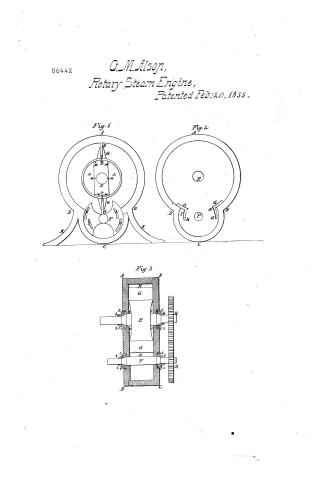
Fig. 1
Fig. 2
Fig. 3
Page 2.
Feb. 20, 1835 889
George M. Alsop 8644X
Letters Patent
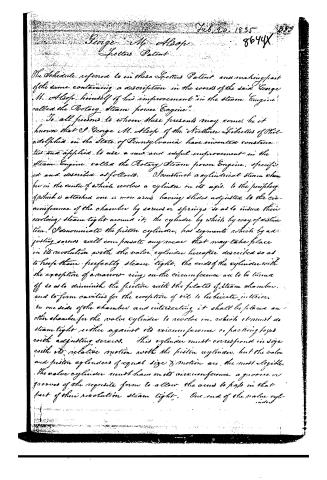
The Schedule referred to in these Letters Patent and making part of the same containing a description in the words of the said George M. Alsop himself of his improvement "in the Steam Engine called the Rotary Steam power Engine".
To all persons to whom these presents may come, be it known that I George M. Alsop of the Northern Liberties of Philadelphia in the State of Pennsylvania have invented constituted and applied to use a new and useful improvement in the Steam Engine called the Rotary Steam power Engine, specified and described as follows. I construct a cylindrical steam chamber in the centre of which revolves a cylinder on its axis, to the periphery of which is attached one or more arms having slides adjusted to the circumference of the chamber by screws or springs so as to induce their revolving steam tight around it, the cylinder by which by way of distinction, I denominate the piston cylinder, has segments which by adjusting screws will compensate any wear that may take place in its revolution with the valve cylinder hereafter described so as to keep them perfectly steam tight, the ends of the cylinder with the exception of a narrow ring on the circumference are to be turned off so as to diminish the friction with the plates of steam chamber, and to form cavities for the reception of oil to lubricate interior, on one side of the chamber and intersecting it shall be placed another chamber for the valve cylinder to revolve in, which it must as steam tight either against its circumference or packing boxes with adjusting screws. This cylinder must correspond in size with its relative motion with the piston cylinder, but the valve and piston cylinders of equal size & motion are the most eligible. The valve cylinder must have on its circumference a groove or grooves of the requisite form to allow the arms to pass in that part of their revolution steam tight. One end of the valve cylinder
Page 3.
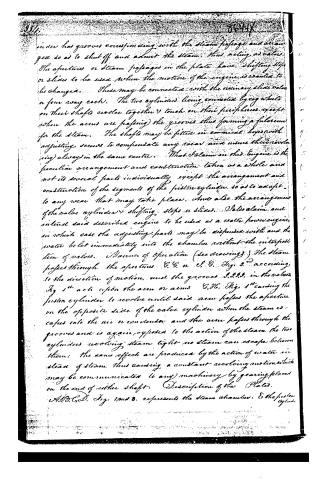
cylinder has grooves corresponding with the steam passages and arranged so as to shut off and admit the steam, thus acting as valves. The apertures or steam passages in the plate have shifting stops or slides to be used when the motion of the engine is wanted to be changed. These may be connected with the ordinary slide valves or form away each. The two cylinders being connected by cog wheels on their shafts revolve together & touch on their peripheries except when the arms are passing the grooves thus forming a fulcrum for the steam. The shafts may be fitted in conical boxes with adjusting screws to compensate any wear and insure their revolving always in the same centre. What I claim in this engine is the peculiar arrangement and construction taken as a whole and not its several parts individually except the arrangement and construction of the segments of the piston cylinder so as to adapt to any wear that may take place. And also the arrangement of the valve cylinders & shifting stops or slides. I also claim and intend said described engine to be used as a water power engine, in which case the adjusting parts may be dispensed with and the water be let immediately into the chamber without the interposition of valves. Manner of Operation (see drawings.) The steam passes through the apertures E. G. or S. G. Fig. 2nd according to the direction of motion, and the grooves S. S. S. in the valves Fig. 1st act upon the arm or arms E. H. Fig. 1st causing the piston cylinder to revolve until said arm passes the aperture on the opposite side of the valve cylinder when the steam escapes into the air or condenser and the arm passes through the grooves and is again exposed to the action of the steam. The two cylinders revolving steam tight no steam can escape between them; the same effects are produced by the action of water instead of steam thus causing a constant revolving motion which may be communicated to any machinery by gearing placed on the end of either shaft. Description of the Plates. A. B. C. D. Fig. 1 and 3. represents the steam chamber. E the piston cylinder.
Page 4.
8644X 385
linder. H. the valve cylinder G. G. that portion of the piston cylinder in which the slides H. H. are confined Fig. 1 S. S. S. S. presents the end of the valve cylinder corresponding with the openings S. S. and G. G. fig. 2 H. H. represents the supports of the machine. L. L. are segments of the piston cylinder which may be moved by adjusting screws m, m, m, m; m, m are the adjusting screws (springs) which keep the slides H. H. to the periphery of the cylinder. 2 fig 3. represent the conical boxes in which the shafts of the cylinders revolve. O. O. are cavities for holding oil to be supplied by holes through the plates of the steam chamber. R. R. are the cog wheels which regulate the motion of the cylinders Fig 2 H. H. C. S. represents one end of the steam chamber in the inside. E. E. are the openings for the shafts of the cylinders. S. S. and G. G. are the openings or grooves for the admission and emission of steam or water. H. H. are the steam stops or slides for changing the motion sliding from top to bottom of passages. In testimony that the above is a true specification of my said improvement as above described. I have hereunto set my hand and seal the 25th day of the first month in the year of our Lord one thousand eight hundred and thirty five.
George M. Alsop
Witnesses
James Calver
Robert Alsop
(Drawing)
1008 m-27
Ford
N.Y.C.
Published accounts: journal notice
Notice in the monthly list of patents, with remarks
Journal of the Franklin Institute, new ser., vol. 16 (1835), p. 165 · View the page
24. For a Rotary Steam Engine; George M. Alsop, city of Philadelphia, February 20.
Remarks. The patentee claims "in this engine, the peculiar arrangement and construction, taken as a whole, and not its several parts taken individually, except the arrangement and construction of the piston cylinder, so as to adapt it to any wear that may take place; and also the arrangement of the valve cylinder and shifting stops, or slides." The application of an engine, similarly coustructed, as a water power engine, is also claimed. The variations of this engine from some others of the rotary kind, manifest considerable ingenuity, but still leave the general principle of action the same with certain of its predecessors, offering nothing which appears to us likely to obviate the objections which have prevented their continued use.
About this record
- Patentee
- DATAMP
- Date
- the Name and Date index of patents, DATAMP, USPTO records
- Invention
- DATAMP
- Listed in
- the Name and Date index of patents, DATAMP, USPTO records, Jim Shaw's X-patent list, the Journal of the Franklin Institute, Burke's List of Patents (1847)
- The Franklin Institute's journal spells the name differently.
- Burke's 1847 Patent Office list gives the same patent.