

Drawings and documents
USPTO scan
The patent as scanned by the USPTO
-
 Page 1
-
 Page 2
-
 Page 3


U.S. Patent and Trademark Office · Google Patents
Show the transcription Hide (503 words)
Machine transcription (LightOnOCR) of the pages as scanned by the USPTO, most of them the handwritten copies made when the records were restored after the 1836 fire. Not checked; it can misread handwriting, so compare it with the scan.
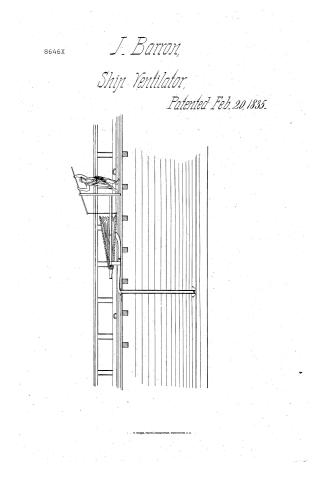
Page 1.
8646X
J. Barron,
Ship Ventilator,
Patented Feb. 20, 1835.

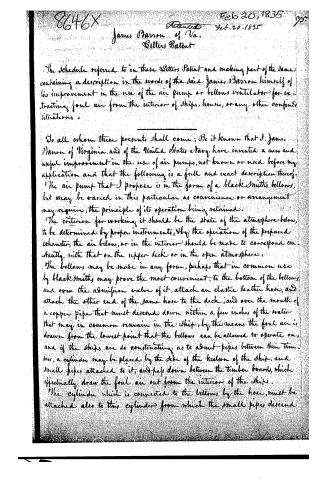
Page 2.
8646X
Feb 20, 1835
James Barron of Va.
Sitting Patent
The Schedule referred to in these Sitting Patent and making part of the same containing a description in the words of the said James Barron himself of his improvement in the use of the air pump or bellows ventilator for extracting foul air from the interior of ships, houses, or any other confined situations.
To all whom these presents shall come: Be it known that I, James Barron of Virginia, and of the United States Navy have invented a new and useful improvement in the use of air pumps, not known or used before my application and that the following is a full and exact description thereof.
The air pump that I propose is in the form of a black Smiths bellows, but may be varied in this particular as convenience or arrangement may require; the principle of its operation being retained.
The criterion for working it should be the state of the atmosphere below, to be determined by proper instruments; by the operation of the prepared exhaustor, the air below, or in the interior should be made to correspond constantly with that on the upper deck or in the open atmosphere.
The bellows may be made in any form, perhaps that in common use by black Smiths may prove the most convenient; to the bottom of the bellows, and over the admission valve of it, attach an elastic leather hose, and attach the other end of the same hose to the deck, and over the mouth of a copper pipe that must descend down within a few inches of the water that may in common remain in the ship, by this means the foul air is drawn from the lowest point that the bellows can be allowed to operate on, and if the ships are so constructing as to admit pipes between their timbers, a cylinder may be placed by the side of the keelson of the ship, and small pipes attached to it, and paly down between the timber boards, which effectually draw the foul air out from the interior of the ship.
The cylinder which is connected to the bellows by the hose, must be attached also to this cylinder from which the small pipes descend
Page 3.
8646X
into the interior of the ship, but this latter pipe, or cylinder and the small pipes may all be dispensed with, as it has been found that the perpendicular cylinder alone is quite sufficient. What I claim as my peculiar invention, or discovery, is this method as above described for extracting the foul air from ships, houses, and any other confined situations.
Witnesses
Jno. Saul
J. B. Van Zandt
James Barron
Drawing Model
(481 ud)
Published accounts: journal notice
Notice in the monthly list of patents, with remarks
Journal of the Franklin Institute, new ser., vol. 16 (1835), p. 167 · View the page
26. For an Air Pump for Extracting Foul Air from Ships, &c.; James Barron, United States Navy, city of Philadelphia, February 20.
Remarks. In the number of this journal for June, 1828, we published some extracts from, and remarks on, a pamphlet from the pen of Commodore Barron, "On the Causes of Dry Rot," which contained a description of the bellows used by him for ventilating the holds of ships, and which were constructed like the common smiths' bellows, having a tube leading from the valve hole on the lower board, into the hold of the vessel. However good the thing may be, and we have no doubt of its utility, it is public property, not being new to the public. This is a principle which was fully settled in the case of Sellers & Pennock v. Dialogue, see vol. iii., p. 184. "The true construction of the act is, that the first inventor cannot acquire a good title to a patent, if he suffers the thing invented to go into public use before he makes application for a patent."
About this record
- Patentee
- DATAMP
- Date
- the Name and Date index of patents, DATAMP, USPTO records
- Invention
- DATAMP
- Listed in
- the Name and Date index of patents, DATAMP, USPTO records, Jim Shaw's X-patent list, the Journal of the Franklin Institute, Burke's List of Patents (1847)
- Burke's 1847 Patent Office list gives the same patent.