

Drawings and documents
USPTO scan
The patent as scanned by the USPTO
-
 Page 1
-
 Page 2
-
 Page 3


U.S. Patent and Trademark Office · Google Patents
Show the transcription Hide (679 words)
Machine transcription (LightOnOCR) of the pages as scanned by the USPTO, most of them the handwritten copies made when the records were restored after the 1836 fire. Not checked; it can misread handwriting, so compare it with the scan.
Page 1.
8701X
J. BAKER.
Car Wheel.
Patented Mar. 20, 1835.

AM. PHOTO-LITHO. CO. N.Y. (OSBORNE'S PROCESS)
Page 2.
8701X Mar 20, 1835 2/3.
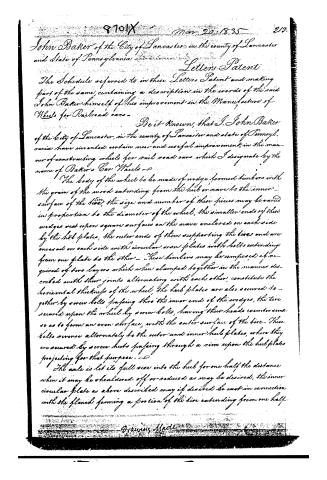
John Baker of the City of Lancaster in the county of Lancaster and State of Pennsylvania
Letters Patent
The Schedule referred to in these Letters Patent and making part of the same, containing a description in the words of the said John Baker himself of his improvement in the Manufacture of Wheels for Railroad cars.
Be it Known, that I, John Baker of the City of Lancaster, in the county of Lancaster and state of Pennsylvania have invented certain new and useful improvement in the manner of constructing wheels for rail road cars which I designate by the name of Baker’s Car Wheels.
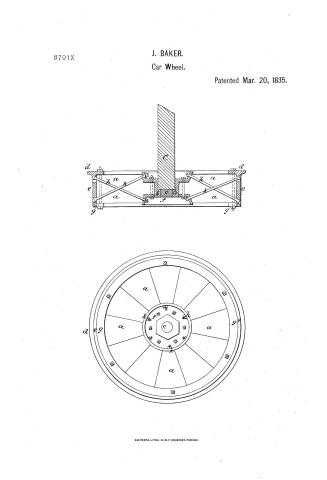
The body of the wheel to be made of wedge formed timbers with the grain of the wood extending from the hub or nave to the inner surface of the tire; the size and number of these pieces may be varied in proportion to the diameter of the wheel, the smaller ends of these wedges rest upon square surfaces on the nave enclosed on each side by the hub plates, the outer ends of them supporting the tire and are encased on each side with circular iron plates with bolts extending from one plate to the other. These timbers may be composed if required of two layers which when clamped together in the manner described with their joints alternating with each other, constitute the horizontal thickness of the wheel. The hub plates are also secured together by screw bolts passing thro’ the inner end of the wedges, the tire secured upon the wheel by screw bolts, having their heads countersunk so as to form an even surface, with the outer surface of the tire. These bolts reverse alternately to the outer and inner hub plates, where they are secured by screw nuts passing through a rim upon the hub plates projecting for that purpose.
The axle is let its full size into the hub for one half the distance when it may be shouldered off or reduced as may be desired, the inner circular plate as above described may if desired be cast in connection with the flanch forming a portion of the tire extending from one half
Drawing Made
Page 3.
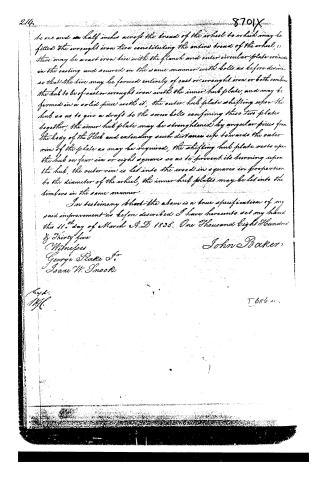
to one and a half inches across the tread of the wheel to which may be fitted the wrought iron tire constituting the entire tread of the wheel, or there may be a cast iron tire with the flanch and outer circular plate combined in the casting and secured in the same manner with bolts as before described, so that the tire may be formed entirely of cast or wrought iron or both combined, the hub to be of cast or wrought iron with the inner hub plate, and may be formed in a solid piece with it, the outer hub plate shifting upon the hub so as to give a draft to the screw bolts confining these two plates together, the inner hub plate may be strengthened by angular pieces from the body of the flitch and extending such distances up towards the outer rim of the plate as may be required, the shifting hub plate rests upon the hub on four six or eight squares so as to prevent its burning upon the hub, the outer rim is let into the wood in squares in proportion to the diameter of the wheel, the inner hub plates may be let into the timbers in the same manner.
In testimony whereof the above is a true specification of my said improvement as before described I have hereunto set my hand this 11th day of March A.D. 1835. One Thousand Eight Hundred & Thirty five
Witnesses
George Flake Jr.
Isaac W. Smooke
John Baker
T 686
Published accounts: journal notice
Notice in the monthly list of patents, with remarks
Journal of the Franklin Institute, new ser., vol. 16 (1835), p. 244 · View the page
44. For Wheels for Rail-road Cars; John Baker, Lancaster, Lancaster county, Pennsylvania, March 20.
Remarks. The body of this wheel is to be made of wedge formed pieces of wood, extending from the hub to the rim, or tire, the grain of the wood being in that direction. What are called hub plates are used to embrace the wood on each side, around the hub, bolts passing through from one to the other. The rim also is bolted to these plates, they having a flanch cast on them for that purpose; these bolts cross from the outer edge of the rim to the inner hub plate, and from the inner edge to the outer hub plate, X fashion. "The axle is let its full size into the hub for one-half the distance, when it may be shouldered off, or reduced, as may be desired." There is no claim made, and what it is intended to patent must be inferred from the foregoing description.
About this record
- Patentee
- DATAMP
- Date
- the Name and Date index of patents, DATAMP, USPTO records
- Invention
- DATAMP
- Listed in
- the Name and Date index of patents, DATAMP, USPTO records, Jim Shaw's X-patent list, the Journal of the Franklin Institute, Burke's List of Patents (1847)
- Burke's 1847 Patent Office list gives the same patent.