

Drawings and documents
USPTO scan
The patent as scanned by the USPTO
-
 Page 1
-
 Page 2
-
 Page 3
-
 Page 4


U.S. Patent and Trademark Office · Google Patents
Show the transcription Hide (1,013 words)
Machine transcription (LightOnOCR) of the pages as scanned by the USPTO, most of them the handwritten copies made when the records were restored after the 1836 fire. Not checked; it can misread handwriting, so compare it with the scan.
Page 2.
United States Patent
Patent No.: X8704
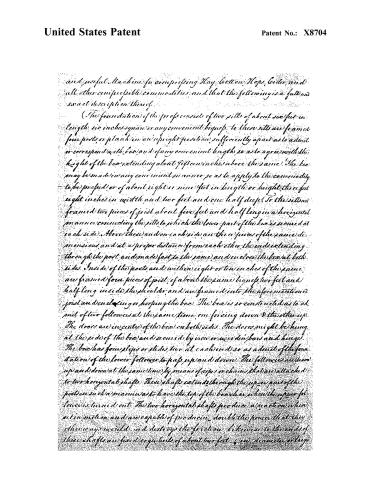
and useful machine for compressing Hay, Cotton, Hops, Cedar, and all other compressible commodities, and that the following is a full and exact description thereof.
(The foundation of the press consists of two pillars of about six feet in length, six inches square or any convenient height. To these pillars are framed four posts or planks in an upright position, sufficiently apart as to admit or correspond with the box, and of any convenient length, so as to agree with the height of the box, extending about fifteen inches above the same. The box may be made in any convenient manner so as to apply to the commodity to be pressed, or of about eight or nine feet in length or height, three feet eight inches in width, and two feet and one half deep. To the pillars are framed two pieces of joist, about five feet and half long in a horizontal manner, connecting the pillars to which the lower part of the box is secured at each side. Above these, and on each side, are three pieces of the same dimensions, and at a proper distance from each other, the ends extending through the post, and made fast to the same, and enclose the box at both sides. Inside of the posts, and within eight or ten inches of the same, are framed four pieces of joist, of about the same height, two feet and half long inside the shoulder, and are framed into the aforementioned joist and enclose or horning the box. The box is so constructed as to admit of two followers at the same time, one forcing down & the other up. The doors are in centre of the box, on both sides. The doors might be hung at the side of the box, and secured by iron or wooden bars and hinges. The box has four slips or slides, two at each end, so as to admit of the foundation of the lower followers to pass up and down. The followers are drawn up and down at the same time, by means of ropes or chains, that are attached to two horizontal shafts. These shafts extend through the upper part of the posts in such a manner as to leave the top of the box clear when the upper followers are turned out. The two horizontal shafts produce a reaction when set in motion, and are capable of producing double the power that they otherwise would, and destroy the friction, likewise, to the ends of these shafts are fixed large wheels of about two feet in diameter, or large
Page 3.
United States Patent
Patent No.: X8704
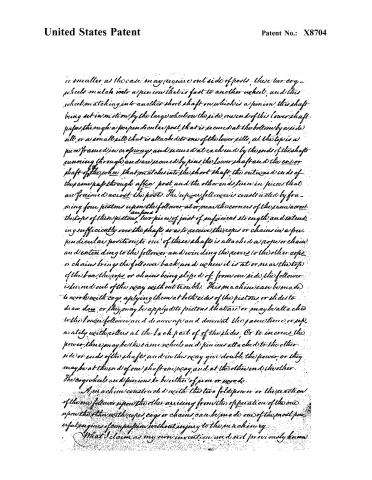
is smaller, as the case may require, out side of posts, these two cog-wheels match into a pinion that is fast to another wheel, and this wheel matching into another short shaft on which is a pinion, this shaft being set in motion by the large wheel on the side, one end of this lower shaft passes through a perpendicular post, that is secured at the bottom by a side sill, or a small sill that is attached to one of the lower sills, at the top is a piece framed in or of way, and secured at each end by the ends of the shaft running through, and are secured by pins, the lower shaft and the end or shaft of the wheel that matches into the short shaft, the outward ends of the same pass through a free post, and the other ends turn in pieces that are framed across the posts. The upper follower is constructed by framing four pistons upon the follower at or near the corners of the same across the tops of these pistons, two pieces of joist of sufficient strength, and extending sufficiently over the shaft, so as to receive the rope or chains in a perpendicular position, to one of these shafts is attached a rope or chain and extending to the follower, and winding the rope to the other rope or chains bring the follower back, and when it is at or near the top of the box, the rope or chains being slipped off from one side, the follower is turned out of the way without trouble. This machine can be made to work with cog, applying them at both sides of the pistons or slides to draw down, or they may be applied to pistons that are or may be attached to the lower follower, and drawn up and down at the same time, or separately with rollers at the back part of of the slides, Or to increase the power, there may be the same wheels and pinions attached to the other side or ends of the shaft, and in this way give double the power, or they may be at the end of one shaft one way, and at the other end, the other. The cog wheels and pinions to be either of iron or wood.
A machine constructed with this two fold power or the reaction of the one follower upon the other arising from the operation of the one upon the other with ropes, cogs or chains, can be made one of the most powerful engines of compression without injury to the machinery.
What I claim as my own invention, and not previously known.
Page 4.
United States Patent
Patent No.: X8704
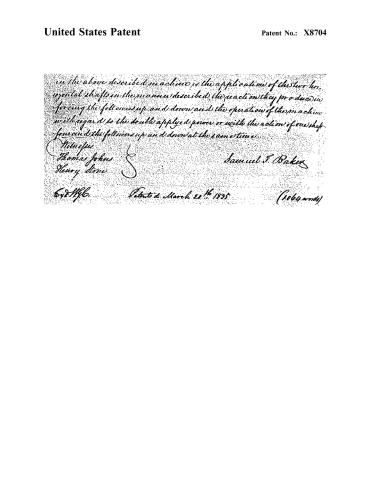
in the above described machine, is the application of the two horizontal shafts in the manner described, the reaction they produce in forcing the followers up and down, and the operation of the machine with regard to the double applied power or with the action of one shaft forcing the followers up and down at the same time.
Witnesses
Thomas Johns
Henry Stone
Samuel T. Baker
Patented March 20th 1835
(2064 words)
Published accounts: journal notice
Notice in the monthly list of patents, with remarks
Journal of the Franklin Institute, new ser., vol. 16 (1835), p. 244 · View the page
42. For a Press for Hay, Cotton, Hops, &c.; Samuel F. Baker, Graham, Cumberland county, Maine, March 20.
Remarks. The patentee of this machine apprehends that he has doubled the power which he applies, by the reaction, as he terms it, of two followers one upon the other. The articles to be pressed are enclosed within a suitable box, and by turning a power wheel, furnished with pins, or rounds, for that purpose, shafts which cross the press are made to wind or unwind ropes, so as to move the followers, there being a gearing of wheels and pinions for that purpose, which is fully represented in the drawing. The patentee says that "A machine constructed with this two-fold power, or the reaction of one follower upon the other, arising from the operation of one upon the other with ropes, cogs, or chains, can be made one of the most powerful engines of compression, without injury to the machinery." "What I claim as my own invention, is the application of the two horizontal shafts in the manner described, the reaction they produce in forcing the followers up and down, and the operation of the machine with regard to the double applied power, or with the action of one shaft forcing the followers up and down at the same time." If the patentee has not yet discovered his error, it is because he has not built and fairly tried an operating machine.
About this record
- Patentee
- DATAMP
- Date
- the Name and Date index of patents, DATAMP, USPTO records
- Invention
- DATAMP
- Listed in
- the Name and Date index of patents, DATAMP, USPTO records, Jim Shaw's X-patent list, the Journal of the Franklin Institute, Burke's List of Patents (1847)
- Burke's 1847 Patent Office list gives the same patent.