

Drawings and documents
USPTO scan
The patent as scanned by the USPTO
-
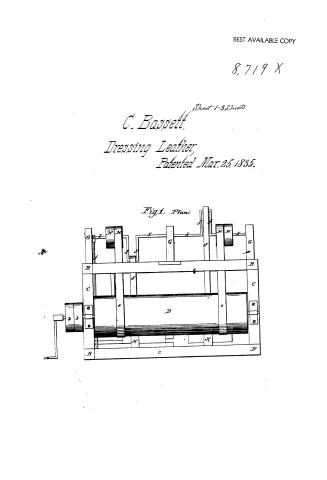 Page 1
-
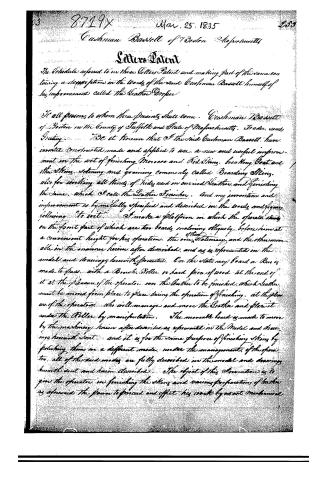 Page 2
-
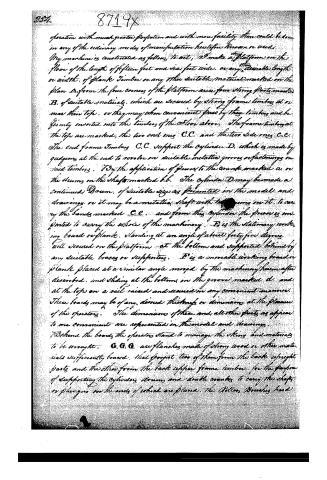 Page 3
-
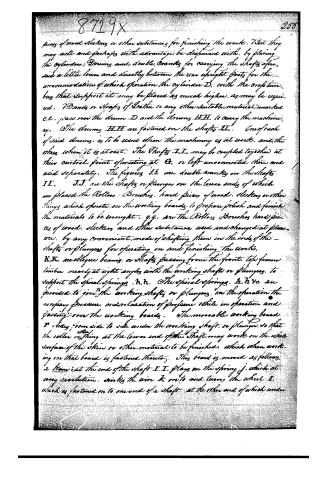 Page 4
-
 Page 5


U.S. Patent and Trademark Office · Google Patents
Show the transcription Hide (1,523 words)
Machine transcription (LightOnOCR) of the pages as scanned by the USPTO, most of them the handwritten copies made when the records were restored after the 1836 fire. Not checked; it can misread handwriting, so compare it with the scan.
Page 1.
BEST AVAILABLE COPY
8,719 X
Sheet 1-3 Sheets.
C. Bassett,
Dressing Leather,
Patented Mar. 25, 1835.
Fig. 1. Plan.

Page 2.
8719x Mar. 25, 1835 253
Cashman Bassett of Boston Massachusetts
Letters Patent
The Schedule referred to in these Letters Patent and making part of the same containing a description in the words of the said Cashman Bassett himself of his improvement called the Leather Finisher
To all persons to whom these presents shall come. Cashman Bassett of Boston in the County of Suffolk and State of Massachusetts. To all, and every, greeting.
Know ye that the said Cashman Bassett have invented, constructed, made and applied to use, a new and useful improvement in the art of finishing Morocco and Kid Skins, beating Goat and other Skins, staining and graining commonly called Boarding Skins, also for working all kinds of hides used in cured Leather, and finishing the same, which I call the Leather Finisher. And my invention and improvement is by me fully specified and described in the words and figures following “to wit”: I make a platform on which the operator stands on the front part of which are two boards inclining obliquely before him at a convenient height for his operation. The one of that Stationary, and the other moveable in the manner herein after described, and as is represented in the model and drawings herewith presented. On the stationary board a Bar is made to pass with a Brush Roller or hard piece of wood at the end of it at the pleasure of the operator over the leather to be finished, which leather must be moved from place to place during the operation of finishing, at the pleasure of the operator who will manage and move the leather and place it under the Roller by manipulation. The moveable board is made to move by the machinery herein after described as represented in the Model and drawings herewith sent, and it is for the same purpose of finishing Skins by polishing them in a different mode, under the management of the operator, all of the said modes are fully described in the model and drawings herewith sent and herein described. The object of this invention is to give the operator in finishing the Skins and various preparations of leather as aforesaid the power to forced and effect his work by exact mechanical
Page 3.
operation with much greater perfection and with more facility than could be done in any of the ordinary modes of manufacture heretofore known or used.
My machine is constructed as follows, to wit, I make a platform on the floor of the length of fifteen feet and six feet wide, or any other desirable length or width, of plank timber or any other suitable material marked on the plan A. From the four corners of the platform arise four strong posts marked B, of suitable material, which are secured by strong frame timbers at or near their tops, or they may when convenient pass by these timbers and be firmly inserted into the timbers of the floor above. The frame timbers at the top are marked, the two end ones C.C. and the two side ones C.C. The end frame timbers C.C. support the cylinder D, which is made by guides at the end to revolve on suitable metallic grooves or fastenings on said timbers. By the application of power to the crank marked a, or the drums on the shaft marked b.b. The cylinder D may be made a continued Drum, of suitable size as presented in the model and drawings, or it may be a metallic shaft with the grooves on it, to carry the bands marked C.C. and from this cylinder the power is imparted to carry the whole of the machinery. E is the stationary working board or plank, standing at an angle of about forty-five degrees, well secured on the platform at the bottom and supported behind by any suitable braces or supports. F is a movable working board or plank placed at a similar angle moved by the machinery herein after described, and sliding at the bottom in the groove marked d, and at the top on a rail raised and secured in any convenient manner. These boards may be of any desired thickness or dimension at the pleasure of the operator. The dimensions of these and all other parts as appear to me convenient are represented in the model and drawings.
Behind the boards the operator stands to manage the strings and materials to be wrought. G.G.G. are planks made of strong wood or other materials sufficiently broad, that project two of them from the back upright posts and the other from the back upper frame timbers, for the purpose of supporting the cylinder drums and double cranks to carry the shafts or plungers on the ends of which are placed the Roller Brushes hard
Page 4.
pieces of wood, slickers or other substances for finishing the works. But they may well and perhaps with advantage be dispensed with, by placing the cylinders, Downs and double Cranks for carrying the shafts aforesaid a little lower and directly between the rear upright posts for the accommodation of which operation the cylinder D, with the crofton bags that support it may be placed as much higher as may be required. Bands or straps of leather or any other suitable material marked c.c. pass over the drum D and the drums H.H. to carry the machinery. The drums H.H. are fastened on the shafts II. One of each of said drums is to be used when the machinery is at work, and the other when it is at rest. The shafts I.I. may be coupled together at their central point of meeting at G, or left unconnected there and used separately. The figures f.f. are double cranks on the shafts II. J.J. are the shafts or plungers on the lower ends of which are placed the rollers, brushes, hard pieces of wood, slickers or other things which operate on the working boards to prepare, polish and finish the materials to be wrought. g.g. are the rollers, brushes, hard pieces of wood, slickers and other substances used and changed at pleasure by any convenient mode of shifting them in the ends of the shafts or plungers for operating on and finishing the works. K.K. are oblique beams or shafts passing from the front top frame timber nearly at right angles with the working shafts or plungers to support the spiral springs n.n. The spiral springs n.n. are provided to give the working shafts or plungers in the operation the necessary pressure and relaxation of pressure while in operation and passing over the working boards. The moveable working board P slides from side to side under the working shaft or plunger so that the roller or thing at the lower end of the shaft may work on the whole surface of the skin or other material to be finished which when working on that board is fastened thereto. This board is moved as follows. A beam at the end of the shaft I.I. plays on the spring j. which at every revolution winds the wire k on to and turns the wheel L which is fastened on to one end of a shaft at the other end of which under
Page 5.
The board F is the caged wheel-ma. turning under a ratchet which is furnished to and moves the board F by moderate degrees until it is entirely moved from under the shaft or plunger which operates over it. A catch is placed behind the wheel I. to prevent it from turning back while the spring K is detached from the wheel 2. When the movable board has passed entirely by the shaft or plunger, or as far as the operator deems, any simple machinery may be applied to detach the catch and the spring K at the same time from the cage of the wheel 2 when the movable board will be carried back to its original station by a suitable weight attached by a line or strap to the cylinder a around which it winds up and raises the weight while the movable board is progressing outward. By means of my combination of machinery an operator of common skill may with greatly increased speed and accuracy of work go through the process of refining, graining, boarding, polishing and finishing string hides &c used to make morocco and other soft leather and all kinds of cured leather.
In testimony that the above is a true description of my said improvement, I have hereunto set my hand this twenty-third day of January in the year of our Lord one thousand eight hundred and thirty-five.
Witnesses
George M. Adams
Augustus Peabody
Cashman Barrett
(Drawing) (484 words)
1835
Published accounts: journal notice
Notice in the monthly list of patents, with remarks
Journal of the Franklin Institute, new ser., vol. 16 (1835), p. 252 · View the page
58. For a Leather Finisher; Cuchman Bassett, Boston, Massachusetts, March 25.
Remarks. The machinery described is to be applied to the "finishing of morocco and kid skins; breaking goat and other skins; softening and graining, commonly called boarding, skins; also for working all kinds of hides used in curried leather, and finishing the same." The description is not drawn up by one acquainted with machinery, and the drawing is a mere outline, but imperfectly representing the apparatus. The intention of the machine, however, is to give a vibratory motion to a shaft, in the end of which there is placed a brush, roller, slicker, grainer, or other instrument, which is to be passed over the leather. There is no claim made, and as there are patents for the same purpose, in which machinery very similar to that intended to be described is employed, we dismiss the affair until more light is thrown upon it.
About this record
- Patentee
- DATAMP
- Date
- the Name and Date index of patents, DATAMP, USPTO records
- Invention
- DATAMP
- Listed in
- the Name and Date index of patents, DATAMP, USPTO records, Jim Shaw's X-patent list, the Journal of the Franklin Institute, Burke's List of Patents (1847)
- Burke's 1847 Patent Office list gives the same patent.