

Drawings and documents
USPTO scan
The patent as scanned by the USPTO
-
 Page 1
-
 Page 2
-
 Page 3
-
 Page 4
-
 Page 5


U.S. Patent and Trademark Office · Google Patents
Show the transcription Hide (1,267 words)
Machine transcription (LightOnOCR) of the pages as scanned by the USPTO, most of them the handwritten copies made when the records were restored after the 1836 fire. Not checked; it can misread handwriting, so compare it with the scan.
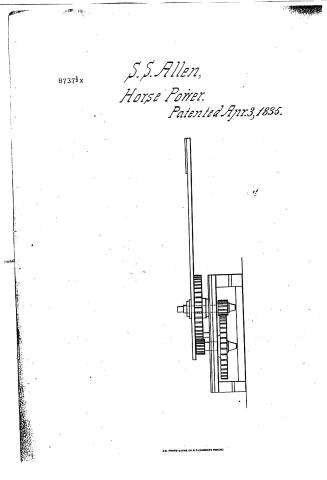
Page 1.
8737½x
S. S. Allen,
Horse Power.
Patented Apr. 3, 1835.
A.M. PHOTO-LITHO. CO. N.Y. (OSBORNE'S PROCESS)
Page 2.
Apr 3 1835
Samuel W. Allen.
8737 1/2 x Letters Patent.
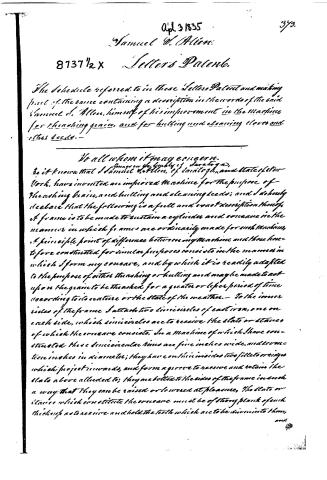
The schedule referred to in these Letters Patent and making part of the same containing a description in the words of the said Samuel W. Allen, himself of his improvement in the machine for threshing grain, and for hulling and cleaning clover and other seeds.
To all whom it may concern.
Be it known that I Samuel W. Allen, of Saratoga, and state of New York, have invented an improved machine for the purpose of threshing grain, and hulling and cleaning seeds; and I do hereby declare that the following is a full and exact description thereof.
A frame is to be made to sustain a cylinder and cone in the manner in which frames are ordinarily made for such machines. A principal point of difference between my machine and those heretofore constructed for similar purposes consists in the manner in which I form my cone, and by which it is readily adapted to the purpose of either threshing or hulling and may be made to act upon the grain to be threshed for a greater or lesser period of time according to its nature or the state of the weather.
To the inner sides of the frame I attach two semicircles of cast iron, one on each side, which semicircles are to receive the slats or staves of which the cone consists. In a machine of which I have constructed these semicircular rims are five inches wide, and seventeen inches in diameter; they have on their insides two fillets or ridges which project inwards, and form a groove to receive and retain the slats above alluded to; they are bolted to the sides of the frame in such a way that they can be raised or lowered at pleasure. The slats or staves which constitute the cone must be of strong plank of such thickness as to receive and hold the teeth which are to be driven into them, and
Page 3.
and they may be of such width that about twelve of them when placed in the circular groove will fill the semicircle, when used for threshing the concave bed may extend round from the bottom to the feeding table, and from about one fifth of a circle, but the number of slats may be diminished or increased depending upon the ripeness and degree of the grain, when used for hulling or clover or other similar seeds, the whole of the semicircle may be filled with slats. The cylinder is to be made of wood in the usual way, and teeth are to be driven into the cylinder and concave, in the following manner. Each slat is to be divided lengthwise by drawing through two parallel lines, about one inch apart, and transverse lines at the distance of about one inch and eight apart, from end to end. The teeth are then to be set at the intersections of these lines in the following manner commencing at the end of the first row in the first slat, and setting a tooth in every other cross line alternately setting one and skipping one, the second row then commences in the second line so that the teeth in this shall follow the blanks in the first row, and this manner of setting is to be continued throughout all the pieces forming the concave. The teeth may be cut from 3/8 to 1/2 inch and are to project out about one inch, they may be either square or round, in the bed however, I prefer to use the square, excepting in two or three of the first rows, as the grain is then kept as it is drawn in. In order to give them greater strength, I set the first row double; this may be done by setting a row of square teeth, and immediately in front of them a row of round ones leaning or raking back, so that the outer edges of the two are in contact. The teeth throughout, are not to stand vertically, but are to incline back at an angle of ten or fifteen degrees, according to the judgment of the builder the exact rake not being important, the object of this is to prevent the cutting and jamming of the grain but in accomplishing this it is necessary to be careful not to give such a rake as would allow the grain to pass too readily through the Machine.
Page 4.
8737 ½ X
The cylinder is to be divided into circles corresponding with those on the bed piece, or concave, and twelve parallel equidistant lines are then to be drawn from end to end; in the intersections of these lines the teeth are to be placed; alternately in every third circle, letting one and missing two; the second parallel line should commence one tooth back of the first, so as to follow a blank, the third now commences in the third circle, and so on throughout the whole. I prefer to set the whole of these teeth double, in which case a square tooth may be first set vertically and then around one leaving back against it at a proper rake, for the same purpose as in the bed—Screw the cylinder with sheet iron, first boring the holes in the wood for the teeth, and afterwards punching through the sheet iron to set them. The feeding table is like those in common use. I have already stated that for hulling the concave bed is to be widened out in doing this I have found it advantageous to make the teeth of greater breadth in the two or three last additional rows to cause the rubbing to be more completely performed; and instead of the iron teeth, in this part, I sometimes employ pieces of raw hide. It is scarcely necessary to observe that in drawing the circles and setting the teeth, care must be taken that those on the cylinder will pass between those in the concave. When seed is to be hulled a hopper is to be placed above the cylinder, provided with a slide, or throw board to regulate the feed, the seed being placed in the hopper is carried round the concave circular bed, and delivered at the back of the machine at about the centre of the cylinder where it falls down an inclined board, under which is a fan wheel, by which the seed and chaff are separated. I have in the foregoing machine described many parts of which I do not claim to be the inventor, and I have, in some instances mentioned the dimensions of certain parts, which, however, admit of much variation according to the size of the machine, and the power to be employed in driving it. All that
1
Page 5.
376. 8737 ½x
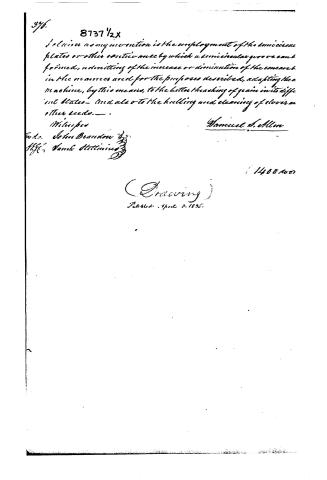
I claim as my invention is the employment of the conical plates or other contrivance by which a conical groove can be formed, admitting of the increase or diminution of the conical in the manner used for the purposes described, adapting the machine, by this means, to the better threshing of grain in its different states— and also to the hulling and cleaning of clover or other seeds.
Witnesses
Samuel S. Allen
Fwd. John Brandon
H.C. James Hettinius
1400.00
(Tracing)
Passed April 3, 1835.
Published accounts: journal notice
Notice in the monthly list of patents
Journal of the Franklin Institute, new ser., vol. 15 (1835), p. 434 · View the page
194. Horse power.-Samuel S. Allen, Saratoga Springs, New York,
Published accounts: journal notice
Notice in the monthly list of patents, with remarks
Journal of the Franklin Institute, new ser., vol. 16 (1835), p. 314 · View the page
The screw in this press is to have a shaft, equal in length to itself, upon which no screw is cut; this shaft may be either square, polygonal, or cylindrical; if of the latter form, it is to have a groove its whole length, to receive a feather in the bored hub of a wheel through which it is to slide; if angular, the hole in the hub is fitted to receive it. The opening in the centre of this wheel allows the shaft to slide easily through it, and the wheel may be turned in any convenient way, but an endless screw crossing the frame of the press, and taking into the teeth on the wheel, is preferred. The wheel is confined between cheeks, and when it is turned, the press screw working in a box in the usual way, the follower is moved as desired. 23. For a Thrashing and Hulling Machine; Samuel S. Allen, Saratoga Springs, Saratoga county, New York, April 3.
Remarks. The patentee says, "All that I claim as my invention, is the employment of the semicircular plates, or other contrivance, by which a semicircular groove can be formed, admitting of the increase or diminution of the concave bed, in the manner, and for the purpose, described; adapting the one machine, by this means, to the better thrashing of grain in its different states, and also to the hulling and cleaning of clover, and other seeds."
Published accounts: journal notice
Notice in the monthly list of patents, with remarks
Journal of the Franklin Institute, new ser., vol. 16 (1835), p. 315 · View the page
24. For a Horse Power; Samuel S. Allen, Saratoga Springs, Saratoga county, New York, April 3.
Remarks. This is one of those horse powers in which the horse walks round in the old-fashioned way. The improvement claimed is in the mode of gearing the wheels, and consists in "passing the second vertical shaft into, or through, a socket within, or below, the main driving wheel, by which the gearing is rendered more simple and compact; and the particular arrangement and combination of the parts by which this is attained."
About this record
- Patentee
- Jim Shaw's X-patent list
- Date
- the Name and Date index of patents, USPTO records, Jim Shaw's X-patent list
- Invention
- the Name and Date index of patents
- Listed in
- the Name and Date index of patents, USPTO records, Jim Shaw's X-patent list, the Journal of the Franklin Institute, Burke's List of Patents (1847)
- Burke's 1847 Patent Office list gives the same patent.