

Drawings and documents
National Archives restored drawings: drawing
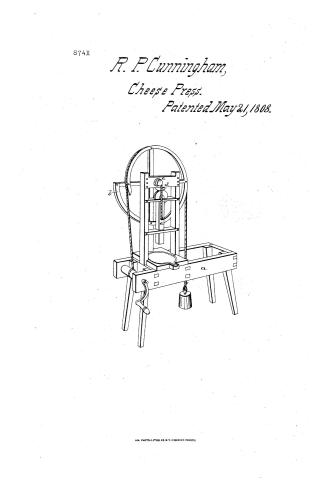
R.P. Cunningham's Patent Drawing for a Press

National Archives, Restored Patent Drawings (Record Group 241) · Full-size scan at the National Archives · Catalog record
Show the text on the drawing Hide (69 words)
Words on the drawing as machine-read by the National Archives; not checked. Useful mainly for searching.
100. press 28. Cheese / [45] Cheese. / $1.50 / Packing / CLASSIFICATION / 874 X / DIVISION. / R.P.Crumingham d / Prefs. / Latented: May. 21ˢᵗ.1808 / References / a. Frame. / b. Wheel. / c, Axis. / d. Truster. / e. Prefser or bearer. / OIR / Patent Office Sept 8th 1838, / Made under the direction of the Commisioner / F.Benne.del / of Patents in conformity with act3 March 1837, / Commiprina ALSWmorth of Patents,
USPTO scan
The patent as scanned by the USPTO
-
 Page 1
-
 Page 2
-
 Page 3
-
 Page 4


U.S. Patent and Trademark Office · Google Patents
Show the transcription Hide (940 words)
Machine transcription (LightOnOCR) of the pages as scanned by the USPTO, most of them the handwritten copies made when the records were restored after the 1836 fire. Not checked; it can misread handwriting, so compare it with the scan.
Page 1.
874X
R. P. Cunningham,
Cheese Press.
Patented May 21, 1808.

A.M. PHOTO-LITHO. CO. N.Y. (OSBORNE'S PROCESS)
Page 2.
874X
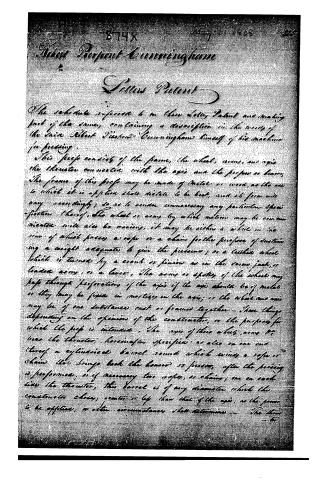
Robert Percival Cunningham
Letters Patent
The schedule annexed to these Letters Patent and making part of the same, containing a description in the words of the said Robert Percival Cunningham himself of his machine for pressing.
This press consists of the frame, the wheel, arms, and axis, the thresher connected with the axis and the proper or beam. The frame of this press may be made of metal or wood, as the use to which it is applied shall dictate to be best, and it may vary accordingly; so as to render unnecessary any particular specification thereof. The wheel or arms by which motion may be communicated will also be various; it may be either a wheel in the form of which serves as rope or a chain for the purpose of sustaining a weight adequate to give the pressure, or a tatchet wheel which is turned by a crank or pinion as in the screw jack, or levers, arms, or a lever. The arms or spokes of the wheel may pass through perforations of the axis if the axis should be of metal, or they may be fixed in mortices in the axis; or the wheel and axis may be of one substance cast or framed together—these things depending on the opinion of the constructor, or the purpose for which the press is intended. The axis of these wheels, arms, or levers, the thresher, hereinafter specified, or also on one end thereof a cylindrical barrel round which winds a rope or chain that brings back the beam or press, after the pressing is performed, or if necessary two ropes, or chains; one on each side the thresher, this barrel is of any diameter which the constructor chooses, greater or less than that of the axis, as the power to be applied, or other circumstances shall determine. The thresher
Page 3.
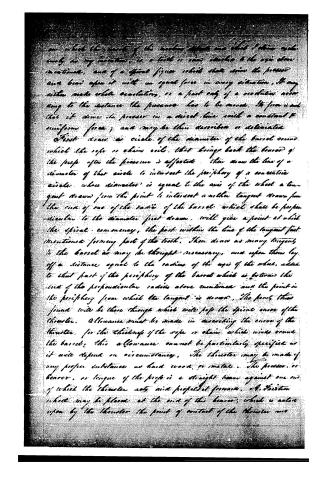
on which the results of the machine depend, and what I have already, as my invention, is a tooth or cam attached to the axis above mentioned, and of a spiral figure which shall drive the press and bear upon it with an equal force in every situation. It may either make whole oscillation, or a part only of a revolution according to the distance the pressure has to be moved. Its form is such that it drives the press in a direct line with a constant & uniform force; and may be thus described or delineated.
First draw a circle of the diameter of the barrel round which the rope or chain coils. That brings back the lever of the press after the pressure is effected. Then draw the line of a diameter of that circle to intersect the periphery of a concentric circle, whose diameter is equal to the axis of the wheel, a tangent drawn from this point to intersect another tangent drawn from the end of one of the radii of the barrel, which shall be perpendicular to the diameter first drawn, will give a point at which the spiral commences, the part within the line of the tangent just mentioned forming part of the tooth. Then draw as many tangents to the barrel as may be thought necessary, and upon them lay off a distance equal to the radius of the axis of the wheel, where to that part of the periphery of the barrel which is between the end of the perpendicular radius above mentioned and the point in the periphery from which the tangent is drawn. The points thus found will be those through which will pass the spiral curve of the thimble. Allowance must be made in describing the curve of the thimble, for the thickness of the rope or chain which winds round the barrel; this allowance cannot be particularly specified as it will depend on circumstances. The thimble may be made of any proper substance as hard wood, or metal. The press, or bearer, or tongue of the press is a straight beam against one end of which the thimble acts and propels it forward. A friction wheel may be placed at the end of the beam, which is acted upon by the thimble the point of contact of the thimble and
Page 4.
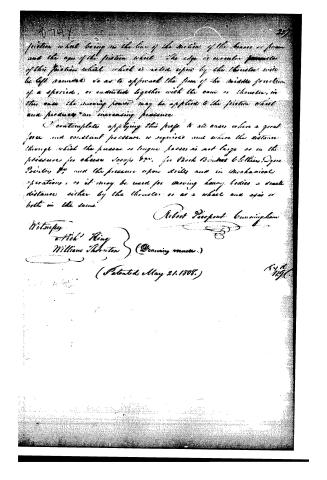
friction wheel being in the line of the motion of the beam or frame and the axis of the friction wheel. The edge or circular perimeter of this friction wheel which is acted upon by the thresher will be left rounded so as to approach the form of the middle portion of a spoked, or cuneated together with the cone or thresher, in this case the moving power may be applied to the friction wheel and produce an increasing pressure.
I contemplate applying this paper to all cases where a great force and constant pressure is required and where the distance through which the pressure or tongue presses is not large as in the processes for cheese, scrapers, etc., for book binders, etc., Open Printing, etc., and the pressure upon stiles and in mechanical operations, so it may be used for moving heavy bodies a small distance either by the thresher or as a wheel and axis or both in the same.
Robert Newport Cunningham
Witnesses
Nich'l King
William Thornton (Drawing made.)
(Patented May 21, 1808.)
About this record
- Patentee
- Jim Shaw's X-patent list
- Date
- the Name and Date index of patents, USPTO records, Jim Shaw's X-patent list
- Invention
- the Name and Date index of patents
- Listed in
- the Name and Date index of patents, USPTO records, Jim Shaw's X-patent list, S. A. Elliot's printed list of patents, Burke's List of Patents (1847)
- S. A. Elliot's printed list of patents gives the same name and date.
- Burke's 1847 Patent Office list gives the same patent.