

Drawings and documents
USPTO scan
The patent as scanned by the USPTO
-
 Page 1
-
 Page 2
-
 Page 3
-
 Page 4
-
 Page 5


U.S. Patent and Trademark Office · Google Patents
Show the transcription Hide (1,394 words)
Machine transcription (LightOnOCR) of the pages as scanned by the USPTO, most of them the handwritten copies made when the records were restored after the 1836 fire. Not checked; it can misread handwriting, so compare it with the scan.
Page 2.
United States Patent
Patent No.: X8768
William Scarborough, Savannah, Ga.
Letters Patent
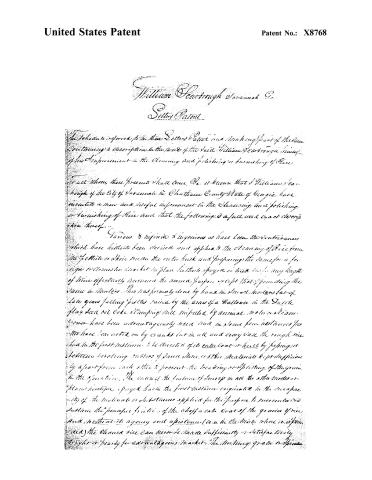
The Schedule referred to in these Letters Patent and making part of the same, containing a description to the words of the said William Scarborough himself of his Improvement in the Cleaning and polishing or furnishing of Rice.
To all whom these presents shall come, Be it known that I William Scarborough of the City of Savannah in Chatham County State of Georgia have invented a new and useful Improvement in the Cleaning and polishing or furnishing of Rice and that the following is a full and exact description thereof.
Various & infinite & ingenious as have been the contributions which have hitherto been devised and applied to the cleaning of Rice from the Pellicle or Skin upon the outer husk and preparing the same for a foreign or domestic market to place hitherto if any or tried has in any length of time effectively answered the desired purpose except that of pounding the same in Mortars. This has formerly done by hand in small quantities but of late years falling pastes raised by the use of a Wallower in the District play Rice oil Cake stamping mill supplied by animal, water or steam power have been advantageously used and in some few instances potatoes have been used on by cranks but in all and every case the rough rice has in the first instance to be cleaned of its outer coat or husk by friction between revolving rollers of stone stone or other materials kept separate by a part from each other to prevent the breaking or splitting of the grain in the operation. The cause of the failure of success in all the other modes or plans heretofore proposed has in the first instance originated in the incapacity of the materials or substances applied for the purpose to overcome and sustain the powerful friction of the chaff and outer coat of the grains of rice and in the lack of its agency and assistance (even in the Mortar where it is applied) the cleaned rice can never be made sufficiently or satisfactorily bright or clearly for advantageous market. The Machine grate or Spindle
Page 3.
United States Patent
Patent No.: X8768
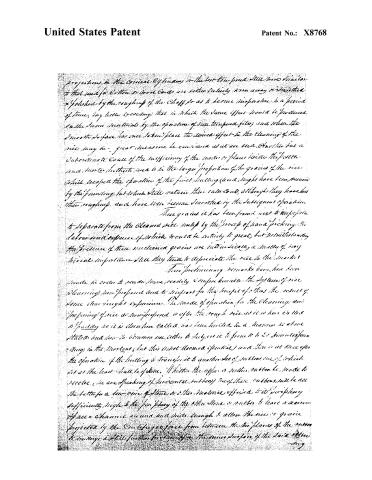
projections in the Conical Cylinders in the last two pounds. Still more similar to that used for Cotton or Wood Coarse are either entirely worn away or shortened & polished by the roughing of the Chaff, so as to become insuperable in a period of time, very little exceeding that in which the same effect would be produced on the same material by the operation of such tempered files, and when the smooth surface has once taken place the desired effect in the cleaning of the rice may in - great measure be considered as at an end. Another but a subordinate cause of the insufficiency of the mode or plan herein described, since, mortar hitherto used is in the large proportion of the grains of the rice which escaped the operation of the first hulling (and might have been removed by the pounding), but which still retain their outer coats, although they have lost their roughness, and have since become smoothened by the subsequent operation.
These grains it has been found next to impossible to separate from the cleaned rice solely by the process of hand picking, the labour and expense of which would be entirely too great, but notwithstanding the presence of these uncleaned grains are not necessarily a matter of any special importance, still they tend to depreciate the rice in the market.
These preliminary remarks have here been made in order to render more readily comprehensible the system of rice cleaning now proposed and to impart for the benefit of others the result of some thorough experience. The mode of operation for the cleaning and preparing of rice as now proposed is after the rough rice as it is here called is spread as it is elsewhere called, has been hulled in a manner as above stated and then in common use either to subject it to from 10 to 20 minutes (or more) in the Mortars (but this is not deemed expedient) and then is at once after the operation of the hulling to transfer it to another set of rubbers, one of which at the least shall be of stone. Whether the upper or better rubber be made to receive (we are speaking of horizontal rubbers) one of these rubbers shall be all the better for a low-ride of stone or other material offered to its periphery sufficiently rough to the periphery of the other stone or rubber to leave a narrow space or channel around and wide enough to allow the rice or grains projected by the Conical surface from between the two planes of the rubbers to undergo a still further friction upon the inner surface of the said other
- 20 -
Page 4.
United States Patent
Patent No.: X8768
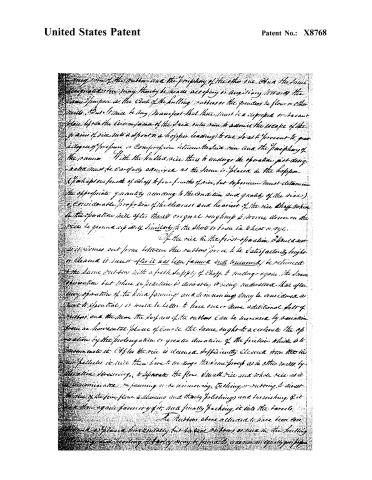
The inner rim of the rubber and the periphery of the other rim. Thus the same classification may thereby be made necessary or auxiliary to avoid the same purpose as the cost of the hulling rubbers or the grinders in flour or other mills. But it will be any manifest that there must be a cupped or beaker-like lip in the circumference of the said outer rim to admit the escape of the grains of rice into a spout or a hopper leading to one side to prevent to great a degree of pressure or compression between the said rim and the periphery of the inner. With the hulled rice thus to undergo the operation just described must be carefully arranged as the same is placed in the hopper (perhaps one fourth of a foot to four pounds of rice, but experience must determine the appropriate quantity according to the condition and quality of the rice), a considerable proportion of the cleanest and heaviest of the rice shall remain in the operation until after the original roughing is (more or less) on the rice be ground up itself similarly to the shorts or bran in wheat or rye.
If the rice in the first operation should not as it comes out from between the rubber grooves be satisfactorily bright or cleaned it must after it has been fanned and screened be returned to the same position with a fresh supply of chaff to undergo again the same operation but where in practice is desirable, it being understood that after every operation of the kind fanning and screening may be considered as next to optional, it would be better to have one or more additional sets of rubbers and the more the surface of the rubbers can be increased by rotation from an horizontal plane of course the same ought to accelerate the operation by the prolongation or greater duration of the friction which is to consummate it. After the rice is cleaned sufficiently cleaned from the husks and pellets it will then have to undergo the same process as in other mills, by elevation, screening, to separate the flour, small rice and whole rice as it is designated, re-fanning or re-screening, fushing or rubbing, to dislodge the fine flour adhering and thereby polishing and furnishing, if it is not done again fanning of it, and finally packing, it into the hogsheads.
The rubbers above alluded to have been one set placed horizontally, but to have rubbers as such in the hulling, cleaning and grinding of barley may be found to answer an equally good purpose.
Page 5.
United States Patent
Patent No.: X8768
What I Claim as my invention and not previously known in the cleaning and preparing of rough rice or flour by the above described process is the application of Stone by itself, or with wood or any other material with which it (the Stone) can act in combination together with the use and proper admixture of the Chaff to use and promote the friction necessary and essential for the proposed object Washington City 6th April 1835
Witnesses
Fred. A. Clark
William Wallis
Wm. Scarbrough
7530 w 85
Published accounts: journal notice
Notice in the monthly list of patents
Journal of the Franklin Institute, new ser., vol. 15 (1835), p. 435 · View the page
211. Rice cleaner.-Wm. Scarborough, Savannah, Georgia,
About this record
- Patentee
- DATAMP
- Date
- the Name and Date index of patents, DATAMP, USPTO records
- Invention
- DATAMP
- Listed in
- the Name and Date index of patents, DATAMP, USPTO records, Jim Shaw's X-patent list, the Journal of the Franklin Institute, Burke's List of Patents (1847)
- Burke's 1847 Patent Office list gives the same patent.