

Drawings and documents
USPTO scan
The patent as scanned by the USPTO
-
 Page 1
-
 Page 2
-
 Page 3


U.S. Patent and Trademark Office · Google Patents
Show the transcription Hide (784 words)
Machine transcription (LightOnOCR) of the pages as scanned by the USPTO, most of them the handwritten copies made when the records were restored after the 1836 fire. Not checked; it can misread handwriting, so compare it with the scan.
Page 1.
NO PRINTED COPY OF SPECIFICATION IN OFFICE.
8771X
P. M. Wright.
Grist Mill.
Patented Apr. 14, 1836.
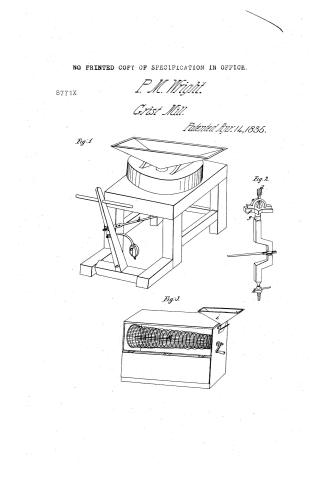
Fig. 1
Fig. 2
Fig. 3
Page 2.
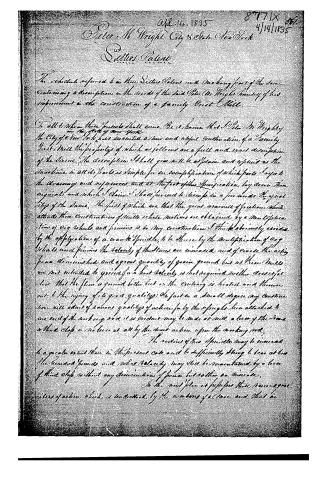
Peter M. Wright City & State New York
Letters Patent
The schedule referred to in these Letters Patent and one being part of the same containing a description in the words of the said Peter M. Wright himself of his improvement in the construction of a family Trust Mill.
To all to whom these presents shall come, Be it known that I Peter M. Wright of the City of New York, in the State of New York, have invented a new and useful construction of a Family Trust Mill the property of which as follows are a full and exact description of the same. The description shall give with it as plain and explicit as the machine in all its parts is simple, for an exemplification of which parts I refer to the drawings and references, and at the foot of this Specification, lay down their original and which I claim. I shall proceed to claim in a few words the great idea of the same. The first of which are that the great amount of friction which attends these constructions of mills whose motions are obtained by a multiplication of cog wheels and pinions is in my construction I think obviously avoided by the application of a crank & spindle, to be driven by the multiplication of cog wheels and pinions the velocity of the stones are increased and of course the acting force diminished and a great quantity of grain ground but as these mills are not intended to grind for a heat velocity is not required neither does it follow that the flour is ground better but as the centring is heated and therefore out of the injury of its good quality; On the fact in a small degree my construction will admit of various qualities of action for by the thoughts here attached to one end of the working rod it is evident may be made as will a lever of the same a third class a no less at all by the direct action upon the working rod.
The radius of this Spindle may be increased to a greater extent than in this present case and be sufficiently strong to bear at least the hundred pounds and what velocity may still be maintained by a lever of third class without any diminution of power but rather an increase.
On the next plan is proposed these numerous classes of action which is understood by the watchers of a stone and that be
Page 3.
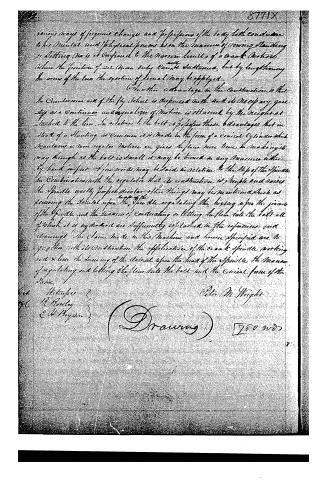
various ways of frequent changes and properties of the body both conducive to his mental and physical powers as in the manner of moving, standing or sitting. Nor is it confined to the narrow limits of a book author whose the position of one man only can be sustained, but by lengthening the arms of the law the operation of several may be applied.
Another advantage in the construction is that the circumference and of the fly wheel is dispensed with and its necessary gear stop as a continuous and equalizer of motion is obtained by the weights attached to the lever. In relation to the belt it possesses these advantages that in stead of a slanting or common it is made in the form of a conical cylinder which maintains a more regular motion or gives the flow more time to making its way through as the belt is small it may be turned in any manner either by hand or feet. A few words may be said in relation to the slip of the spindle in combination with the regulator that its construction is simple and makes the spindle nearly perpendicular other things may be mentioned such as securing the datum upon the spindle regulating the bearing upon the joints of the spindle and the manner of conducting or letting the flow into the belt all of which it is understood are sufficiently explained in the references and drawings. The claim made in this machine and herein specified are to greater with its construction, the application of the conical spindle working rod & lever, the bearing of the datum upon the head of the spindle, the manner of regulating and letting the flow into the belt and the conical form of the same.
Peter M. Wright
( Drawing ) 780 words
Exh. 1846
W. H. Hughes
R. Bentley
C. H. Brydon
Published accounts: journal notice
Notice in the monthly list of patents
Journal of the Franklin Institute, new ser., vol. 15 (1835), p. 435 · View the page
219. Grist mill.-Peter M. Wright, city of New York,
Published accounts: journal notice
Notice in the monthly list of patents, with remarks
Journal of the Franklin Institute, new ser., vol. 16 (1835), p. 322 · View the page
47. For an improvement in Marine Railways; Washington Van Duzen, Shipwright, Kensington, Philadelphia county, Pennsylvania, April 14.
Remarks. The drawings would be required to show the particular form and construction of those parts of the marine rail way, upon which the patentee depends for the support of his claim, its general construction being similar to that known as Morton's. The following is the claim: "The use of iron, or other metal, rollers, ormed as described, to work between the two sets of double rails, having connecting bars to confine the rollers to their stations. I do not claim the connecting bars, nor the use of rollers generally, they having been before known, but limit my claim under this head to the particular kind of rollers shown in the drawings. The application of the screws in the uprights to the cradle bars. The application of the ratch wheels to act as a cog wheel upon the rack, as a substitute for chains the length of the carriage. The construction and application of the purchase bar, or lever for raising the vessel clear of the carriage, by means of the lifting screws and blocks. The mode of applying and relieving the spring falls which work upwards into the rack, affixed to the under or lower side of the carriage sill, all of which are described in the foregoing specification."
Published accounts: journal notice
Notice in the monthly list of patents, with remarks
Journal of the Franklin Institute, new ser., vol. 16 (1835), p. 323 · View the page
49. For a Family Grist Mill; Peter M. Wright, city of New York, April 14.
Remarks. "The claims made in this machine, and herein specified, are, together with its construction, the application of the crank spindle, working rod, and levers; the screwing of the damsel upon the head of the spindle; the manner of regulating and letting the flour into the bolt, and the conical form of the same." It is not proposed to give great velocity to the runners of this mill, the patentee deeming this unnecessary for family use, and generally injurious to the flour. It is intended to have a crank upon the spindle of the runner, and to extend a pitman from this to a vibrating lever, having handles, by which a man may pull and push alternately. There are a number of figures in the drawing, representing the individual parts of the apparatus, and in the specification a great deal more of disquisition than of description; of the latter, however, there is enough, particularly in the references to the drawings.
About this record
- Patentee
- DATAMP
- Date
- the Name and Date index of patents, DATAMP, USPTO records
- Invention
- DATAMP
- Listed in
- the Name and Date index of patents, DATAMP, USPTO records, Jim Shaw's X-patent list, the Journal of the Franklin Institute, Burke's List of Patents (1847)
- Burke's 1847 Patent Office list gives the same patent.