

Drawings and documents
USPTO scan
The patent as scanned by the USPTO
-
 Page 1
-
 Page 2
-
 Page 3
-
 Page 4
-
 Page 5
-
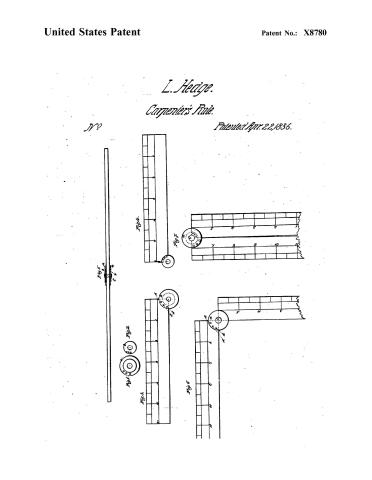 Page 6


U.S. Patent and Trademark Office · Google Patents
Show the transcription Hide (914 words)
Machine transcription (LightOnOCR) of the pages as scanned by the USPTO, most of them the handwritten copies made when the records were restored after the 1836 fire. Not checked; it can misread handwriting, so compare it with the scan.
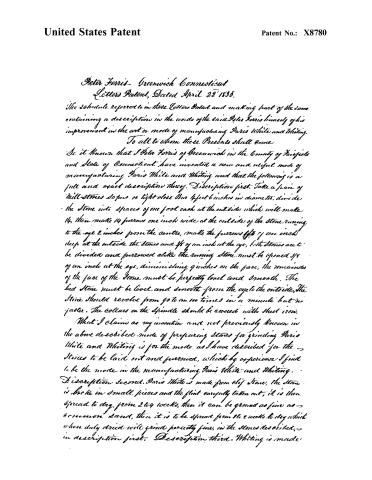
Page 2.
United States Patent
Patent No.: X8780
Peter Ferris — Greenwich Connecticut
Letters Patent, Dated April 22 1838.
The schedule referred to in these Letters Patent and making part of the same containing a description in the words of the said Peter Ferris himself of his improvement in the art or mode of manufacturing Paris White and Whiting.
To all to whom these Presents shall come
Be it known that I Peter Ferris of Greenwich in the County of Fairfield and State of Connecticut have invented a new and useful mode of manufacturing Paris White and Whiting and that the following is a full and exact description thereof.
Description first. Take a pair of Mill-stones 80 pms or light close 80s 4 feet 6 inches in diameter, divide the stone into spaces of one foot each at the outside which will make 14, then make 14 furrows one inch wide at the outside of the stone running to the eye 2 inches from the centre, make the furrows 1/8 of an inch deep at the outside the stones and 3/8 of an inch at the eye, the stones are to be divided and furrowed alike the running stone must be opened 3/8 of an inch at the eye, diminishing 9 inches on the face; the remainder of the face of the stone must be perfectly level and smooth. The bed stone must be level and smooth from the eye to the outside. The stone should revolve from 90 to an 100 times in a minute but no faster. The collars on the spindle should be covered with sheet iron.
What I claim as my invention and not previously known in the above described mode of preparing stones for grinding Paris White and Whiting is for the mode as I have described for the stones to be laid out and furrowed, which by experience I find to be the mode in the manufacturing Paris White and Whiting.
Description second. Paris White is made from clay stone, the stone is broke in small pieces and the flint carefully taken out, it is then spread to dry, from 2 to 4 weeks, then it can be ground as fine as common sand, then it is to be spread from 16 to 2 weeks to dry which when duly dried will grind perfectly fine, in the stones described, in description first.
Description third. Whiting is made
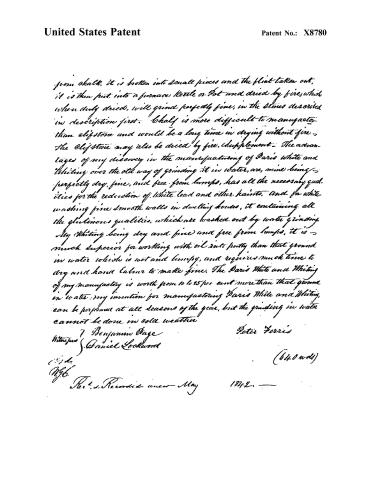
Page 3.
United States Patent
Patent No.: X8780
from chalk, it is broken into small pieces and the float taken out, it is then put into a furnace kettle or Pot and dried by fire, which when duly dried, will grind perfectly fine, in the stones described in description first. Chalk is more difficult to manufacture than slipstone and would be a long time in drying without fire, the slipstone may also be dried by fire. Supplement: The advantages of my discovery in the manufacturing of Paris white and Whiting over the old way of grinding it in water, are, mine being perfectly dry, fine, and free from lumps, has all the necessary qualities for the reduction of white lead and other paints, and for white washing fine smooth walls in dwelling houses, it containing all the glutinous qualities, which are washed out by water grinding. My Whiting being dry and fine and free from lumps, it is much superior for working with oil into putty than that ground in water which is wet and lumpy, and requires much time to dry and hard labour to make fine. The Paris White and Whiting of my manufacturing is worth from 10 to 25 per cent more than that ground in water. My invention for manufacturing Paris White and Whiting can be performed at all seasons of the year, but the grinding in water cannot be done in cold weather.
Witnesses: Benjamin Page
Daniel Lockwood
Peter Ferris
(640 words)
Rec’d & Recorded anew May 1842.
Page 4.
United States Patent
Patent No.: X8780
X8780
Missing Page 521
Drawings of a
"Carpenter's Rule"
dated 4/22/1835
Page 5.
United States Patent
Patent No.: X8780
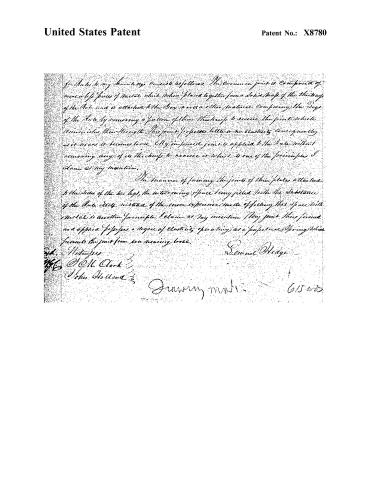
for Stakes to my knowledge consist as follows. The common joint is composed of mere a few pieces of metal which when placed together form a solid mass of the thickness of the stake and is attached to the legs or rods or other material composing the legs of the stake by removing a portion of their thickness to receive the joint which diminishes their strength. The joint possesses little or no elasticity consequently it means it becomes loose. My improved joint is applied to the stake without removing any of its thickness to receive it which is one of the principles I claim as my invention.
The manner of forming the joints of these plates attached to the sides of the two legs, the intervening space being filled with the substance of the stake itself instead of the more expensive mode of filling that space with metal is another principle I claim as my invention. My joint thus formed and applied possesses a degree of elasticity operating as a perpetual spring which prevents the joint from becoming loose.
Witnesses
J. H. Clark
John Holland
Signed
Samuel Hedge
Drawing made: 6/15/185
Page 6.
United States Patent
Patent No.: X8780
L. Hedge.
Carpenter's Rule.
Patented Apr. 22, 1836.
No.

Fig. 1.
Fig. 2.
Fig. 3.
Fig. 4.
Fig. 5.
Fig. 6.
Fig. 7.
Fig. 8.
Fig. 9.
Fig. 10.
Published accounts: journal notice
Notice in the monthly list of patents
Journal of the Franklin Institute, new ser., vol. 15 (1835), p. 435 · View the page
243. Paris white, making.-Peter Ferris, Greenwich, Conn.
Published accounts: journal notice
Notice in the monthly list of patents, with remarks
Journal of the Franklin Institute, new ser., vol. 16 (1835), p. 330 · View the page
73. For an improvement in the mode of manufacturing Paris White; Peter Ferris, Greenwich, Fairfield county, Connecticut, April 24.
Remarks. The Paris white, or whiting, according to the process of the patentee, is to be made by dry grinding the material from which it is formed, instead of grinding it as usual, in water; he states that when thus made it is worth from 10 to 25 per cent. more than that ground in water. This may be the case for some purposes, but we know that much of the whiting which is manufactured is not fit for the gilders' use unless it has been well washed, in order to separate from it the silex that is almost always contained in chalk; probably the patentee may use the Agaric mineral, but this he does not mention.
About this record
- Patentee
- DATAMP
- Date
- the Name and Date index of patents, DATAMP, USPTO records
- Invention
- DATAMP
- Listed in
- the Name and Date index of patents, DATAMP, USPTO records, Jim Shaw's X-patent list, the Journal of the Franklin Institute, Burke's List of Patents (1847)
- The Franklin Institute's journal gives a different date.
- Burke's 1847 Patent Office list gives the same patent.