

Drawings and documents
USPTO scan
The patent as scanned by the USPTO
-
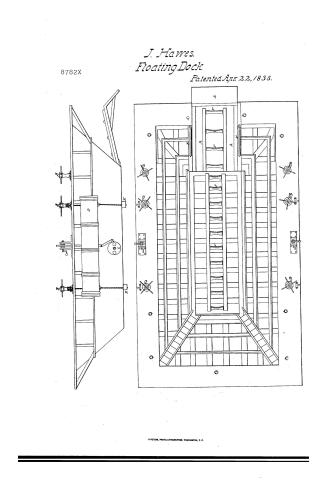 Page 1
-
 Page 2
-
 Page 3


U.S. Patent and Trademark Office · Google Patents
Show the transcription Hide (619 words)
Machine transcription (LightOnOCR) of the pages as scanned by the USPTO, most of them the handwritten copies made when the records were restored after the 1836 fire. Not checked; it can misread handwriting, so compare it with the scan.
Page 1.
8782X
J. Hawes.
Floating Dock.
Patented Apr. 22, 1835.

H. PETERS, PHOTO-LITHOGRAPHER, WASHINGTON, D. C.
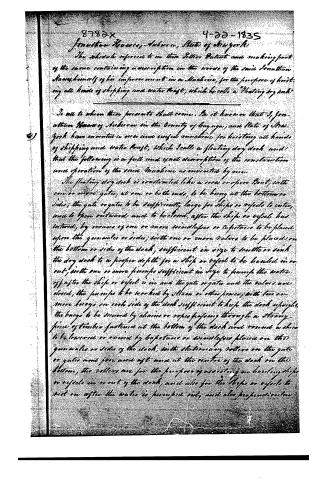
Page 2.
8782X 4-22-1835
Jonathan Hanes, Auburn, State of New York
The schedule referred to in this Letter Patent and making part of the same containing a description in the words of the said Jonathan Hanes himself of his improvement in a Machine, for the purpose of hoisting all kinds of shipping and water craft, which he calls a "Floating dry dock."
To all to whom these presents shall come. Be it known that I, Jonathan Hanes of Auburn in the County of Cayuga, and State of New York have invented a new and useful machine for hoisting all kinds of shipping and water craft, which I call a floating dry dock and that the following is a full and exact description of the construction and operation of the said Machine as invented by me.
The floating dry dock is constructed like a scow or open boat, with one or more gates, at one or both ends, to be hung at the bottom or sides; the gate or gates to be sufficiently large for ships or vessels to enter, and to open outward and to be closed, after the ship or vessel has entered, by means of one or more windlasses or capstans to be placed upon the gunwales or sides, with one or more valves to be placed on the bottom or sides of the dock, sufficient in size to sink the dry dock to a proper depth for a ship or vessel to be hauled in or out, with one or more pumps sufficient in size to pump the water off after the ship or vessel is in and the gate or gates and the valves are closed; the pumps to be worked by steam or other power, with two or more buoys on each side of the dock sufficient to keep the dock afloat, the buoys to be secured by chains or ropes passing through a strong piece of timber fastened at the bottom of the dock and round a shoe to be lowered or raised by capstans or windlasses placed on the gunwales or sides of the dock, with stationary rollers on the gate or gates and fore and aft and at the centre of the dock on the bottom, the rollers are for the purpose of assisting in hauling ships or vessels in or out of the dock, and also for the ships or vessels to rest on after the water is pumped out, and also perpendicular
Page 3.
Stationary rollers on each side of the gate way to aid in hauling ships or vessels in or out of the dock, with a sufficient number of weights in different parts of the dry dock to aid in hauling the ships or vessels in or out of the dock.
The size and strength of the dock and the materials of which they are constructed are in all cases to be proportioned to the size of the ships or vessels for which the docks are intended. The dock is particularly adapted to repairing all kinds of shipping.
In testimony that the above is a full and correct description of the construction and use of my machine as invented by me, I have hereunto set my hand this eighteenth day of February in the year eighteen hundred and thirty-five.
Jonathan Hawes
Witnesses
R. Cook
Millet Lounsbury
(567 words)
(Patented April 22, 1835.)
Graining Made
Published accounts: journal notice
Notice in the monthly list of patents
Journal of the Franklin Institute, new ser., vol. 15 (1835), p. 435 · View the page
227. Dry dock for ships. Jonathan Hawes, Cayuga county, New York,
Published accounts: journal notice
Notice in the monthly list of patents, with remarks
Journal of the Franklin Institute, new ser., vol. 16 (1835), p. 325 · View the page
57. For a Floating Dry Dock; Jonathan Hawes, Auburn, Cayuga county, New York, April 22.
Remarks. This dock is described as though such a thing had never before been made, or thought of, there not being any one thing mentioned as new, or claimed as invented by the patentee. It is to be a floating trunk, with gates at one or both ends to admit and enclose vessels, and pumps to discharge the water. We have described several such, and could refer to more, were it necessary to do so.
About this record
- Patentee
- DATAMP
- Date
- the Name and Date index of patents, DATAMP, USPTO records
- Invention
- DATAMP
- Listed in
- the Name and Date index of patents, DATAMP, USPTO records, Jim Shaw's X-patent list, the Journal of the Franklin Institute, Burke's List of Patents (1847)
- Burke's 1847 Patent Office list gives the same patent.