

Drawings and documents
USPTO scan
The patent as scanned by the USPTO
-
 Page 1
-
 Page 2
-
 Page 3
-
 Page 4
-
 Page 5
-
 Page 6


U.S. Patent and Trademark Office · Google Patents
Show the transcription Hide (1,614 words)
Machine transcription (LightOnOCR) of the pages as scanned by the USPTO, most of them the handwritten copies made when the records were restored after the 1836 fire. Not checked; it can misread handwriting, so compare it with the scan.
Page 1.
No Printed Specification Available
8798X
F. STITH.
Hemp Brake.
Patented April 22, 1835.
Fig. 3
Fig. 2
Fig. 1
Fig. 4
N. PETERS, Photo-Lithographer, Washington, D.C.
Page 2.
Apr 22 1835
Fernando Litta
8198 X Letters Patent.
The Schedule referred to in these Letters Patent, and making part of the same, containing a description in the words of the said Fernando Litta, himself of his improvement in a Machine for the purpose of breaking of hemp and flax.
To all to whom these presents shall come.
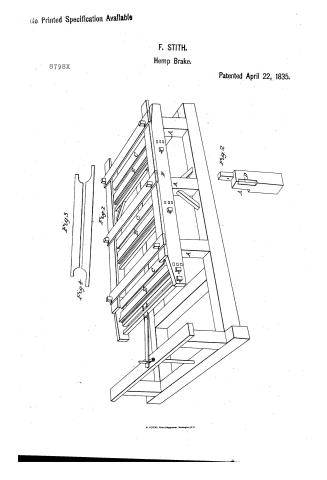
Be it known that I, Fernando Litta of the Town of Franklinton, County of Williamson and State of Tennessee, have invented a new and useful Machine for breaking of hemp, and flax and that the following is a full and exact description of the construction and operation of the said Machine as invented and put in operation by me at my Hay creek plantation in this county. viz. The brake which I had put up at my plantation during the last Autumn, consists of two parts which I call male and female or running and stationary frames. The stationary or female frame is constructed after the following manner. The base or foundation of two pieces of scantling placed parallel and opposite to each other are securely joined together by two cross braces of the same description of scantling, this base is 13 feet long and 4 feet wide and the scantling of which it is made 5 inches wide and 6 inches thick. Upon each of the long scantling, stand three uprights 4 feet apart, and the frame being 4 feet wide makes them 4 feet apart every way. These uprights are three feet in height of timbers of timbers 5 or 6 inches wide and three inches thick standing the broad way across the long timbers of the base. At 3 inches from the base each of these uprights are shouldered on their inside sides two inches deep, and extending to their upper extremities. These shoulders are for the purpose of receiving and supporting the runners of the Male portion of the brake. 11 right inches above these shoulders the uprights are cut into tenants to fasten on the upper
Page 3.
upper longitudinal timbers of the stationary frame, these timbers are 10 feet 10 inches long 5 inches wide and 4 inches thick. Lastly these uprights terminate in tenants about 3 1/2 inches each way to hold on the upper or roof base there in number 4 feet 3 inches long 4 inches wide by two and a half inches thick. The middle set of uprights are braced each way forwards and back. Across the front of each of the uprights just below the tenants for the upper longitudinal timbers and opposite to the part shouldered to receive the running frame, blocks are taken out to the number desired, say 3, 4, 5 or more are inch deep, one inch wide and about one inch and a half apart, to receive the slats which constitute the female or stationary part of the brake. Into these mortices are heating places thus formed, are fitted the back parts of the slats, these slats are made of hickory timber split out and deepened down to about one inch in thickness on their backs, and diminished to a half inch in front. They are about 3 or 4 inches wide and four feet long, and fitted into the places designed for them in the uprights. These female slats being fitted to their places are made fast in them, by means of plates of iron 6 in number one over each end of each set of plates. These plates are 10 inches long 1 1/2 inches wide, and a quarter of an inch thick. They are fitted over the fronts of the slats by cutting of them down in front, in the form of a shoulder so that the plates rest on them all level, through each of these plates of iron run two bolts which passing also through the uprights are made secure by turn-laps on their extremities. In the basement frame of the brake, rests three heavy brace pieces of plank 4 feet long and 1 1/2 inches broad; these are attached in the rear of each set of uprights, and are designed for the laborer to stand on. This constitutes the whole of the female or stationary portion of the Machine. I will now describe the male portion or the running frame; this consists of two pieces of beaulting 12 feet 3 inches long 7 inches wide, by two and a half
Page 4.
a half inch or thick, framed together by mortising and tenon, one member 4 feet 5 inches long, 2 inches wide and 2 1/2 inches thick. Three of these are bolted to each other in the rear of their respective sets of slots, passing through the runners so as to be longer on the outside. The fourth one is in front, framed in the same way, and serves with its weight serving as a bar to secure the iron bolt that holds the pitman. These front braces give still greater security and strength by means of a couple of iron bolts that run through these, and bind them both together on each side of the hooked bolt that holds the pitman, at such distances three runners receive the male slots by sets of two, three, or more slots for each set; this running frame with its sets of male or slots and men bars are so framed and fitted as to resemble the before described stationary frame, and rest on the shoulders of the same. The machine that I have had constructed, having been designed for experimental times, three brakes in it each constructed to accommodate two or three slots, these slots like those of the stationary frame, are of hickory timber about one and a half inches thick on the back part and tapering in front to a half inch made round and smooth on the edges, and between three and four inches in broad. The ends of these slots terminate in tenon locking through the sides of the runners each way, and no separate iron band fast by means of their shoulders in the inside and the bars of the men bars on the outsides of the runners, that one of the men bars of the running frame which stands in the rear is furnished with braces. This constitutes the whole of what I call the male portion of the machine.
The machine is propelled by water power by means of a windlass hook on the upper extremity of the shaft of my water wheel, one revolution of the wheel turns by the aid of the pitman twice a play of 15 inches to the running frame. This running frame with its sets of male slots are placed in such relation to the
Page 5.
to the female slats of the stationary frame, that at every revolution the one set passes into the other and re-enters again. Each laborer now takes his stand on the broad plank placed on the basement of the stationary frame and with both hands feeds the machine, first holding the hemp by one extremity and then by the other, shaking it occasionally until he sees that it is well broke and freed from hems. He then hands it to the attendant or lays it aside and takes it in another turn of the raw material. I propose to have three or four brakes to each machine, to put one hand to each brake, and to let a fourth or a fifth, as the case may be, wait on the whole, to hand up the raw material and to lay aside the cleaned hemp. From the experiments that I have made with the machine now in operation at my plantation, I am satisfied that it may be equally well put in motion by horse or steam power. I am also convinced that it may be overtaxed or diminished on the same plan as to employ as many as 2, 3, 4, 5, or more hands according to the power that can be brought to act on it. I have learnt from actual experiment that the machine will do a good business at seventy-five strokes or revolutions in the minute, and that its operations improve with the velocity of its movement, that the proper principle for regulating its speed is the quantity at which a hand can feed it, which is near 100 strokes in the minute. For the purpose of lessening the friction, the wear and the power necessary to propel the machine, I propose to rest the runners on friction wheels placed on the shoulders of the uprights, or on metallic plates, also plating the under surface of the runners with iron or other metal. Specifications. What I claim as my own invention and not previously known in the above described machine is the plan of running a brake in the horizontal manner, and so constructing of it as to act one, two, three, four or more brakes at the same time and in the
Page 6.
8798x
the same frame. The advantage that I am aware to exist in my mode of confining the slats, is that it allows them to fly while they are still half fast, each to its place, and the quality with which one is taken out and another substituted in its place, when it becomes necessary to shift them. The slats of my brakes are all diminished in thickness from either extremity to the centre, so as to enlarge the spaces between them in the central portion while they approach towards either end.
Witness
The Warden
No. 3
(1632 words)
(Drawing)
(Granted April 22, 1835)
5
Published accounts: journal notice
Notice in the monthly list of patents
Journal of the Franklin Institute, new ser., vol. 15 (1835), p. 435 · View the page
226. Hemp breaking machine.-Ferdinando Stith, Franklin, Tenn.
Published accounts: journal notice
Notice in the monthly list of patents, with remarks
Journal of the Franklin Institute, new ser., vol. 16 (1835), p. 325 · View the page
56. For a machine for Breaking Hemp and Flax; Ferdinand Stith, Franklin, Williamson county, Tennessee, April 22.
Remarks. This brake consists of two long horizontal frames, one under the other, the uppermost of which is stationary, whilst the lowermost is made to vibrate backward and forward by means of a pitman, operated upon by a crank. From the stationary, horizontal frame, descends four, or any other convenient number of, vertical frames, having slats at suitable distances crossing them from one side to the other of the machine. The lower, or movable frame, which traverses upon friction rollers, has an equal number of vertical frames rising from it, which are furnished with slats corresponding with, and working into, the spaces between the slats on the stationary frame. The claim is to "the plan of running a brake in the horizontal manner, and so constructing it as to work one, two, three, four, or more, brakes at the same time, and in the same frame."
About this record
- Patentee
- DATAMP
- Date
- the Name and Date index of patents, DATAMP, USPTO records
- Invention
- DATAMP
- Listed in
- the Name and Date index of patents, DATAMP, USPTO records, Jim Shaw's X-patent list, the Journal of the Franklin Institute, Burke's List of Patents (1847)
- Burke's 1847 Patent Office list gives the same patent.