

Drawings and documents
USPTO scan
The patent as scanned by the USPTO
-
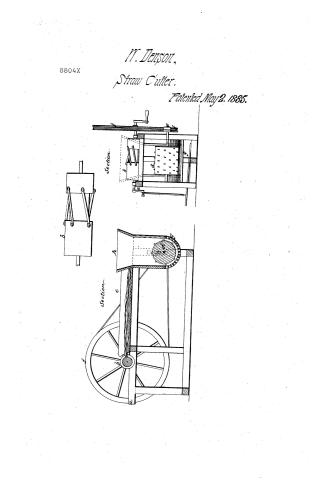 Page 1
-
 Page 2
-
 Page 3
-
 Page 4


U.S. Patent and Trademark Office · Google Patents
Show the transcription Hide (901 words)
Machine transcription (LightOnOCR) of the pages as scanned by the USPTO, most of them the handwritten copies made when the records were restored after the 1836 fire. Not checked; it can misread handwriting, so compare it with the scan.
Page 1.
8804X
W. Denson.
Straw Cutter.
Patented May 2, 1885.

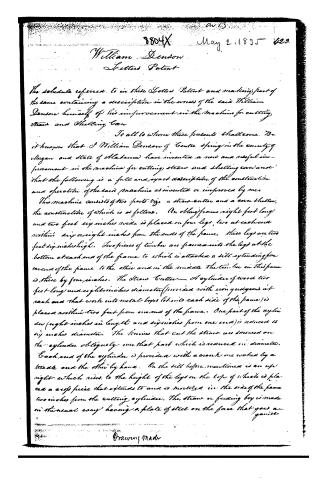
Page 2.
No. 13.
8804X May 2, 1835 429.
William Denson
Letters Patent
The schedule referred to in these Letters Patent and making part of the same containing a description in the words of the said William Denson himself of his improvement in the machine for cutting straw and shelling corn.
To all to whom these presents shall come. Be it known that I William Denson of Centre Spring in the county of Morgan and State of Alabama have invented a new and useful improvement in the machine for cutting straw and shelling corn and that the following is a full and exact description of the construction and operation of the said machine as invented or improved by me.
This machine consists of two parts viz: a straw-cutter and a corn sheller, the construction of which is as follows. An oblong frame eight feet long and two feet six inches wide is placed on four legs, two at each end within six or eight inches from the ends of the frame. These legs are two feet six inches high. Two pieces of timber are fastened into the legs at the bottom at each end of the frame to which is attached a sill extending from one end of the frame to the other and in the middle the timber in this frame is three by four inches. The straw Cutter—A cylinder of wood two feet long and eight inches diameter (provided with iron cutters at each end that work into metal boxes bolted into each side of the frame) is placed within two feet from one end of the frame. One part of the cylinder (eight inches in length and six inches from one end) is reduced to six inches diameter. The knives that cut the straw are screwed on the cylinder obliquely over that part which is reduced in diameter. Each end of the cylinder is provided with a crank one worked by a treadle and the other by hand. On the sill before mentioned is an upright which rises to the height of the legs on the top of which is placed a cross piece that extends to and is mortised in the side of the frame two inches from the cutting cylinder. The straw or feeding box is made in the usual way having a plate of steel on the face that goes against
Drawing made
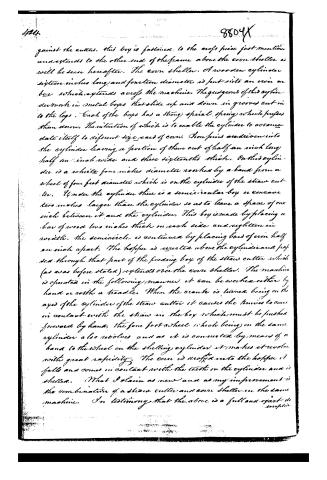
Page 3.
against the cutters, this boy is fastened to the cross piece just mentioned and extends to the other end of the frame above the corn sheller as will be seen hereafter. The corn sheller. A wooden cylinder sixteen inches long and fourteen diameter is fast to a iron axle which extends across the machine. The guides of this cylinder work in metal boys that slide up and down in grooves cut in to the legs. Each of the boys has a strong spiral spring which presses them down. The intention of which is to enable the cylinder to accommodate itself to different size ears of corn. Iron pins are driven into the cylinder leaving a portion of them out of half an inch long half an inch wide and three sixteenths thick. On this cylinder is a wheel four inches diameter worked by a hand from a wheel of four feet diameter which is on the cylinder of the straw cutter. Under the cylinder there is a semicircular boy or concave two inches larger than the cylinder so as to leave a space of one inch between it and the cylinder. This boy is made by placing a bar of wood two inches thick on each side and eighteen in width. The semicircle is continued by placing bars of iron half an inch apart. The hopper is erected above the cylinder and passed through that part of the feeding box of the straw cutter which (as was before stated) extends over the corn sheller. The machine is operated in the following manner it can be worked either by hand or with a treadle. When the cranks is turned being on the axis of the cylinder of the straw cutter it causes the knives to come in contact with the straw in the boy which must be pushed forward by hand, the four foot wheel which being on the same cylinder also revolves and as it is connected by means of a band to the wheel on the shelling cylinder it makes it revolve with great rapidity. The corn is dropped into the hopper it falls and comes in contact with the teeth on the cylinder and is shelled. What I claim as new and as my improvement is the combination of a straw cutter and corn sheller on the same machine. In testimony that the above is a full and exact description
Page 4.
8804X 425.
description of the construction and operation of my machine as written or improved by me. I have hereunto set my hand this nineteenth day of January in the year of our Lord one thousand eight hundred and thirty five
Witnesses
A. G. Beach -n
H. A. Garrison
William Denson
'71 ord
Ford
MGC
Published accounts: journal notice
Notice in the monthly list of patents, with remarks
Journal of the Franklin Institute, new ser., vol. 16 (1835), p. 385 · View the page
49 equal pressure of the convex pad, carved or cast on a plate of any material whatever, united in the centre by a hinge, thereby making equal pressure," &c. 3. For a Machine for cutting Straw and shelling Corn; William Denson, Centre Springs, Morgan county, Alabama, May 2.
Remarks. The claim made is to "the combination of a straw cutter and corn sheller in the same machine;" a claim which we think altogether untenable. Will any one say that a patent can be sustained for spinning cotton and grinding scythes, by the power of the same steam engine? Yet a negative answer to this question, would condemn the patent before us, in which there is no pretence to invention; a straw cutter, and a corn sheller, are driven from the same shaft, this is all that is pretended.
About this record
- Patentee
- DATAMP
- Date
- the Name and Date index of patents, DATAMP, USPTO records
- Invention
- DATAMP
- Listed in
- the Name and Date index of patents, DATAMP, USPTO records, Jim Shaw's X-patent list, the Journal of the Franklin Institute, Burke's List of Patents (1847)
- Burke's 1847 Patent Office list gives the same patent.