

Drawings and documents
USPTO scan
The patent as scanned by the USPTO
-
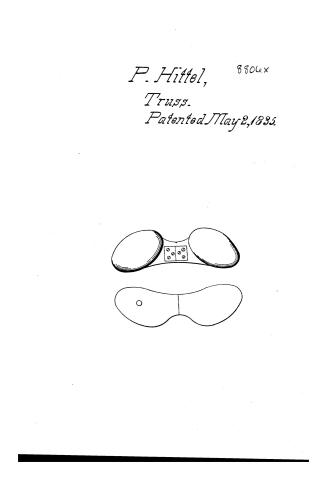 Page 1
-
 Page 2
-
 Page 3


U.S. Patent and Trademark Office · Google Patents
Show the transcription Hide (714 words)
Machine transcription (LightOnOCR) of the pages as scanned by the USPTO, most of them the handwritten copies made when the records were restored after the 1836 fire. Not checked; it can misread handwriting, so compare it with the scan.
Page 1.
P. Hittel, 8806x
Truss.
Patented May 2, 1835.

Page 2.
8806X
May 2, 1835
Philip Hittel.
Letter Patent.
The schedule referred to in these Letter Patent, and making part of the same, containing a description in the words of the said Philip Hittel himself, of his improvement in the Truss called the improved common convex Truss.
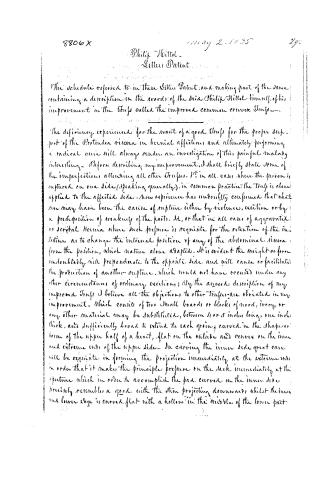
The deficiency experienced for the want of a good Truss for the proper support of the Protended viscera in hernial affections, and ultimately performing a radical cure, will always render an investigation of this painful malady interesting. Before describing my improvement, I shall briefly state some of the imperfections attending all other Trusses. 1st: In all cases where the person is ruptured on one side (speaking generally), in common practice the Truss is alone applied to the affected side. Now experience has undoubtedly confirmed that whatever may have been the cause of rupture, either by violence, exertion or by a predisposition of weakness of the parts, it, or that in all cases of aggravated or scrotal Hernia where such pressure is requisite for the retention of the intestine as to change the internal position of any of the abdominal viscera from the position, which nature alone adapts, it is evident the weight or force undoubtedly will preponderate to the opposite side, and will cause or facilitate the production of another rupture, which would not have occurred under any other circumstances of ordinary exertion; By the annexed description of my improved Truss I believe all the objections to other Trusses are obviated in my improvement, which consists of two small boards or blocks of wood, ivory, or any other material may be substituted, between 1 or 5 inches long, one inch thick, and sufficiently broad to extend to each groin, curved in the shape or form of the upper half of a heart, flat on the outside and convex on the inner and extreme ends of the upper side. In curving the inner side great care will be requisite in forming the projection immediately at the extreme ends in order that it makes the principle pressure on the sack immediately at the aperture which in order to accomplish the pad, curved on the inner side precisely resembles a gourd, with the stem projecting downwards, whilst the inner and lower edge is curved flat with a hollow in the middle of the lower part.
Page 3.
244.
So as to let without producing any uncomfortable pressure in the pubis, or penis, joined in the centre by a hinge in order to adapt itself the more ready, to the different position of the body, or the principle of applying the two convex organs shaped pads may if preferred be united by extending a piece of brass or tin fastened on each end of the pad, by means of a screw in the center of this plate, the spring should be fastened by means of a rivet or a small brass slide can be substituted, by which means the person can more readily lengthen or shorten the spring as the case may require. Being now finished, the whole should be covered simply with buckskin after which you fasten the one end of the spring on the rupture, pad, or portion thereby making lateral pressure on the other portion or side when placing the spring around the body and for the better security a bandage may be attached to the back pad passing it around the other portion of the body and fastened by means of a knot on the front pad. By this improved common convex truss I claim every principle of equal pressure of the convex pad, curved or cast on a plate of any material whatsoever. United in the centre by a hinge thereby making equal pressure, with the largest diameter of the convex portion above, gradually lessening downwards whilst giving general support to the lower parieties of the abdomen agreeably to the accompanying specifications and drawings all which I find to answer perfectly well.
Witnesses
Samuel D. Rose
Peter Snyder
Philip Hottel
To:
May 2, 1835 Patented
[650 108]
(Drawing)
Published accounts: journal notice
Notice in the monthly list of patents
Journal of the Franklin Institute, new ser., vol. 16 (1835), p. 70 · View the page
252. Truss.-Philip Hittel, city of Philadelphia,
Published accounts: journal notice
Notice in the monthly list of patents, with remarks
Journal of the Franklin Institute, new ser., vol. 16 (1835), p. 385 · View the page
2. For a Truss for Hernia; Philip Hittell, city of Philadelphia, May 2.
Remarks. This is denominated "the improved common convex truss." The pad is to be made of wood, or other hard substance, and is to bear equally upon the ruptured and unruptured sides, being carved in such a form as to enable it to do so; and to adapt it the more perfectly to the parts, it is to be divided vertically, in the centre, and the two parts united by a hinge, or spring. It is assumed by the patentee that if pressure is made on one side only, this pressure tends to rupture the opposite side, an opinion not at all sustained by experience, or founded in reason. Trusses with double pads are well known to surgeons, and have been frequently worn where the actual disease was on one side only, and the patient was believed to be predisposed to rupture. A claim is made to "the principle of VOL. XVI. No. 6. - DECEMBER, 1835.
About this record
- Patentee
- DATAMP
- Date
- the Name and Date index of patents, DATAMP, USPTO records
- Invention
- DATAMP
- Listed in
- the Name and Date index of patents, DATAMP, USPTO records, Jim Shaw's X-patent list, the Journal of the Franklin Institute, Burke's List of Patents (1847)
- The Franklin Institute's journal spells the name differently.
- Burke's 1847 Patent Office list gives the same patent.