

Drawings and documents
USPTO scan
The patent as scanned by the USPTO
-
 Page 1
-
 Page 2
-
 Page 3
-
 Page 4
-
 Page 5


U.S. Patent and Trademark Office · Google Patents
Show the transcription Hide (1,501 words)
Machine transcription (LightOnOCR) of the pages as scanned by the USPTO, most of them the handwritten copies made when the records were restored after the 1836 fire. Not checked; it can misread handwriting, so compare it with the scan.
Page 1.
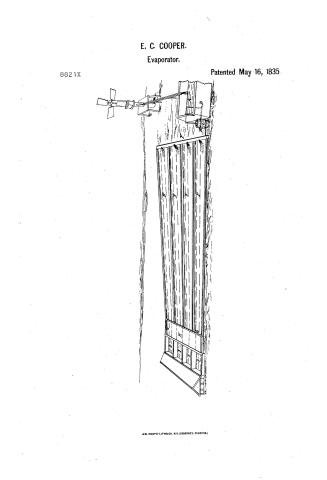
E. C. COOPER.
Evaporator.
8821X
Patented May 16, 1835.
AM. PHOTO-LITHO. CO. N.Y. (OSBORNE'S PROCESS.)
Page 2.
May 16, 1835
8621X
Edward C. Cooper of the City, County & State of N.Y.
Letters Patent.
The schedule referred to in these Letters Patent & making part of the same, containing a description in the words of the said Edward C. Cooper, himself of his improvement in the manufacture of salt by solar evaporation.
To all to whom these presents shall come.
Be it known, that I, Edward C. Cooper of the City, County and State of New York, have invented a new and useful improvement in the manufacture of salt by solar evaporation, and that the following is a full and faithful description of the construction and operation of said process as invented by me.
This improvement consists in the successful application of an inclined Plane Surface, to the evaporating of Ocean Water or other brines to a saturated brine while flowing down, the said inclined plane surface and also of the means by which this is rendered practical. These means consist first in making a water light surface by means of coating the natural surface with cement; 2d. the means for the even distribution of the salt water over the inclined plane surface and 3d. the means for regulating the quantity of salt water running on to the quantity evaporated while flowing down, the inclined plane surface; The above said works are to be constructed in the following manner, — Ground having a southerly aspect & a descent of from one to four inches in every ten feet being selected, and the extent of the inclined plane surface, being marked out at the top and at the bottom of this intended inclined plane surface, two horizontal lines at levels are to be made on the ground parallel with each other and about two hundred feet apart, and the lower line or level to be from five to six feet lower than the line parallel with it at the top, Between the above two lines or levels the whole
Page 3.
whole ground is to be evenly graded to a level plane regularly descending from the top line or level down to the line or level at the bottom, the surface being thus reduced to a regular inclined plane, trenches are then to be dug, perpendicularly from the top to the bottom, of the inclined plane surface, these trenches to be about four feet apart and one foot deep for draining the ground of superfluous moisture &c. The ground being made an inclined plane surface is now to be coated with a moderately stiff mortar composed of one part of hydraulic cement to two of clean sand. The mortar to be carefully laid on by a trowel or roller &c to the depth of one half an inch & raised on the edges one inch, when the cement has become well hardened, it is to be washed over with a thin coat of cement to close all fissures or holes. These being stopped and the cement being firmly set, the whole inclined plane surface is to be evenly strewn with gravel one fourth inch deep, which gravel constitutes the means for the even distribution of the water over the inclined plane surface while flowing down. At the top of the inclined plane surface is to be placed a cistern of ordinary construction and of any size that may be practically required, the bottom of said cistern to be about two feet above the top of the inclined plane surface. Upon a level with the top of the inclined plane surface and projecting half way under the cistern aforesaid is to be a water tight tub holding about 100 gallons, and being about two feet high. Immediately over the part of this tub (denominated the regulating tub) projecting under the cistern aforesaid is to be a hole in the bottom of the cistern one or more inches in diameter, upon this hole in the bottom of the cistern is a valve to be placed, connected by a rod to a lever attached to the upper edge of the cistern or reservoir and from the other end of this lever another rod is attached, which rod projects down into the regulating tub aforesaid and upon this last rod is a movable float of wood and to be fastened at any required length on the rod aforesaid. Along the whole extent of the top of the inclined plane surface runs a board log or logs, which communicate with the regulating tub aforesaid. Into these logs opposite the ends of each single breadth
Page 4.
of plane between the ditches one or more holes are to be bored and then plugged with lead and through each of these lead plugs a hole one fourth inch in diameter is to be bored. The valve and float (which may be constructed in any practical method, together with the regulating tub and the aperture in the log aforesaid together constitute the means for regulating the quantity of salt water flowing on to the quantity evaporated from the inclined plane surface in the same given time.
At the bottom of the inclined plane surface runs a gutter to receive the brine running off and away, it is fickle and salt room of ordinary construction and equal in extent of surface to one sixth part of the inclined plane surface. Having completed the structure of the inclined plane surface as well as all the parts necessary thereto, as herein before described, it is put into operation by pumping salt water or brine into the cistern from which it flows into the regulating tub, before mentioned and from the regulating tub into the log and through the aperture before stated in them, — out upon the inclined plane surface. The float in the regulating tub, being fixed on the rod as already described at any required length, the salt water rises in the regulating tub aforesaid and the float with it to the required length when it closes the valve in the cistern by means of the lever to which they are attached as herein before described, until a portion of the water in the regulating tub has run out and again lowered the float and thus reopened the valve aforesaid and thus by means of the valve and float the water can be constantly kept at any required height in the regulating tub, by raising or lowering the float upon the rod to which it is attached. The level of water in the regulating tub accurately regulates the quantity flowing through the aperture in the log and the salt water flowing on the inclined plane surface can at any time be regulated to the quantity evaporated from said surface by raising or lowering the float upon the rod in the regulating tub. The salt water flowing on to and down the inclined plane surface is evenly and equally distributed over the same by means of the affinity
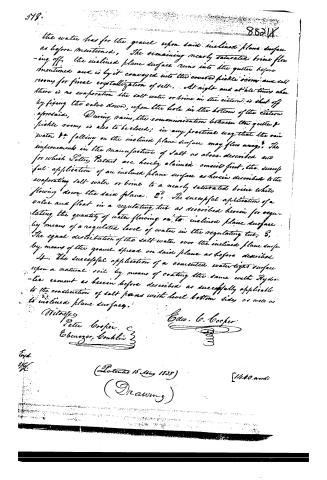
Page 5.
the water has for the gravel upon said inclined plane surface as before mentioned. The remaining nearly saturated brine flowing off, the inclined plane surface runs into the gutter before mentioned and is by it conveyed into the covered pickle rooms and cell rooms for final crystallization of salt. At night and at all times when there is no evaporation the salt water or brine in the cistern is shut off by fixing the valve down, upon the hole in the bottom of the cistern aforesaid. During rains, the communication between the gutter & pickle rooms is also to be closed; in any practical way that the rain water & falling on the inclined plane surface may flow away. The improvements in the manufacture of salt as above described and for which Letters Patent are hereby claimed consist first, the successful application of an inclined plane surface as herein described to the evaporating salt water or brine to a nearly saturated brine while flowing down the said plane. 2. The successful application of a valve and float in a regulating tub as described herein for regulating the quantity of water flowing on to inclined plane surface by means of a regulated level of water in the regulating tub. 3. The equal distribution of the salt water over the inclined plane surface by means of the gravel spread on said plane as before described 4. The successful application of a cemented water tight surface upon a natural soil by means of coating the same with Hydraulic cement as herein before described as successfully applicable to the construction of salt pans with level bottom sides as well as to inclined plane surfaces.
Witnesses
Peter Cooper
Ebenzer, Brooklyn
Edw. C. Cooper
( Patented 15 May 1838 )
(Drawing)
[1140 words]
Published accounts: journal notice
Notice in the monthly list of patents
Journal of the Franklin Institute, new ser., vol. 16 (1835), p. 71 · View the page
276. Evaporating for salt.-Edward C. Cooper, city of New York,
Published accounts: journal notice
Notice in the monthly list of patents, with remarks
Journal of the Franklin Institute, new ser., vol. 16 (1835), p. 393 · View the page
26. For an improvement in the Manufacture of Salt by Solar Evaporation; Edward C. Cooper, city of New York, May 16.
Remarks. An inclined plane is to be formed by properly preparing the ground, and covering it with a coating of hydraulic cement, and VOL. XVI.-No. 6.-DECEMBER, 1835. 50 down this plane the water to be evaporated is to run, there being proper receptacles for it at the bottom. To cause it to be distributed properly over the plane, the latter is to be covered with gravel to the depth of one-fourth of an inch. The water is to be pumped into a reservoir at the head of the plane, and from this it flows into a regulating tub, and distributing logs, furnished with perforations; means being adopted, by the employment of valves and floats, to regulate the supply. The claims are to the application of an inclined plane, as described; to the regulating tub, valves, and floats; to the equal distribution of the water by means of gravel; and to "the successful application of a cemented water-tight surface upon a natural soil, by means of coating the same with hydraulic cement, as hereinbefore described."
About this record
- Patentee
- DATAMP
- Date
- the Name and Date index of patents, DATAMP, USPTO records
- Invention
- DATAMP
- Listed in
- the Name and Date index of patents, DATAMP, USPTO records, Jim Shaw's X-patent list, the Journal of the Franklin Institute, Burke's List of Patents (1847)
- Burke's 1847 Patent Office list gives the same patent.