

Drawings and documents
USPTO scan
The patent as scanned by the USPTO
-
 Page 1
-
 Page 2
-
 Page 3
-
 Page 4
-
 Page 5


U.S. Patent and Trademark Office · Google Patents
Show the transcription Hide (1,136 words)
Machine transcription (LightOnOCR) of the pages as scanned by the USPTO, most of them the handwritten copies made when the records were restored after the 1836 fire. Not checked; it can misread handwriting, so compare it with the scan.
Page 1.
J. & W. C. BAILEY.
KITCHEN BOILER.
Patented May 22, 1835.
8830X

THE NORRIS PETERS CO., PHOTO-LITHO., WASHINGTON, D. C.
Page 2.
May 22, 1835 8830X 204.
John Bailey & William C. Bailey, Farmington
State of Maine,
Letters Patent
The Schedule referred to in these Letters Patent, and making part of the same containing a description in the words of the said John Bailey and William C. Bailey, the novelty of their improvement in a machine called a Kitchen Boiler,
To all to whom these presents shall come
Be it known that we John Bailey and William C. Bailey, both of Farmington in the County of Kennebec and State of Maine have invented a new and useful and improved machine called a Kitchen Boiler for the purpose of heating water for family use; and that the following is a full and accurate description of the said machine in its several parts.
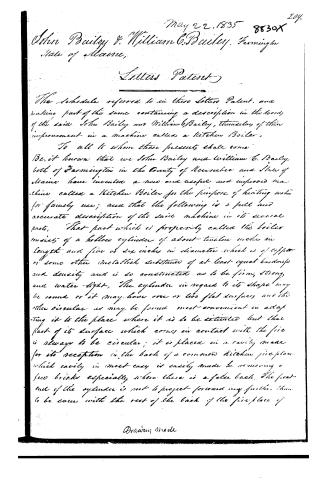
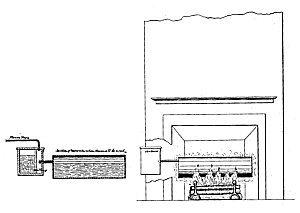
That part which is properly called the boiler consists of a hollow cylinder of about twelve inches in length and five or six inches in diameter which is of copper or some other metallic substance of at least equal hardness and density and is so constructed as to be firm, strong, and water-tight. The cylinder in regard to its shape may be round or it may have one or two flat surfaces and the other circular as may be found most convenient in adapting it to the place where it is to be situated but that part of its surface which comes in contact with the fire is always to be circular; it is placed in a cavity made for its reception in the back of a common kitchen fireplace which cavity in most cases is easily made by removing a few bricks especially where there is a false back. The front end of the cylinder is not to project forward any further than to be even with the rest of the back of the fireplace of
Drawings Made
Page 3.
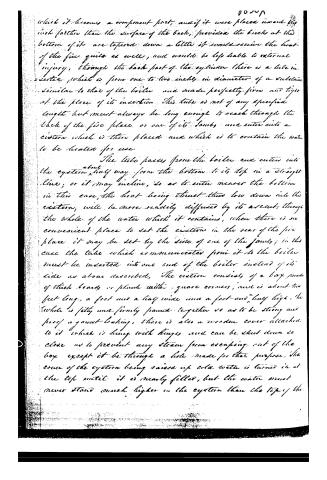
which it becomes a component part, and if it were placed inward five inches farther than the surface of the back, provided the bricks at the bottom of it are tapered down a little it would receive the heat of the fire quite as well, and would be less liable to external injury, though the back part of the cylinder there is a tube inserted which is from one to two inches in diameter of a substance similar to that of the boiler and made perfectly firm and tight at the place of its insertion. This tube is not of any specified length but must always be long enough to reach through the back of the fire place or one of its flanks and enter into a cistern which is there placed and which is to contain the water to be heated for use.
The tube passes from the boiler and enters into the cistern about half way from the bottom to its top in a straight line; or it may incline, so as to enter nearer the bottom in this case, the heat being thus thrown low down into the cistern, will be more readily diffused by its ascent through the whole of the water which it contains, when there is no convenient place to set the cistern in the rear of the fire place it may be set by the side of one of the family; in this case the tube which communicates from it to the boiler must be inserted into one end of the boiler instead of its side as above described. The cistern consists of a box made of thick boards or plank with square corners, and is about two feet long, a foot and a half wide and a foot-and-half high. The whole is fitly and firmly panelled together so as to be strong and proof against leaking. There is also a wooden cover attached to it which is hung with hinges and can be shut down so close as to prevent any steam from escaping out of the box except it be through a hole made for that purpose. The cover of the cistern being raised up cold water is turned in at the top until it is nearly filled, but the water must never stand much higher in the cistern than the top of the
Page 4.
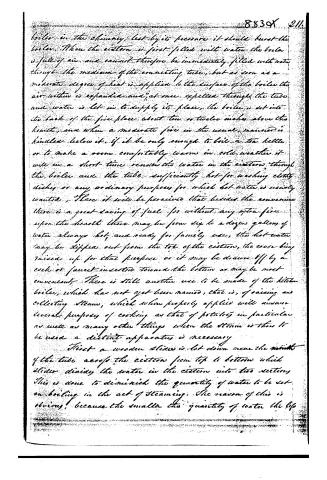
boiler in the chimney, lest by its pressure it should burst the boiler. When the cistern is first filled with water the boiler is full of air and cannot therefore be immediately filled with water through the medium of the connecting tube, but as soon as a moderate degree of heat is applied to the surface of the boiler the air within is expanded and at once expelled through the tube and water is let in to supply its place, the boiler is set into the back of the fireplace about ten or twelve inches above the hearth, and when a moderate fire in the usual manner is kindled below it, if it be only enough to boil a tea kettle or to make a room comfortably warm in cold weather it will in a short time render the water in the cistern through the boiler and the tube sufficiently hot for washing cloths, dishes or any ordinary purposes for which hot water is usually wanted. Here it will be perceived that besides the convenience there is a great saving of fuel for without any extra fire upon the hearth there may be from six to a dozen gallons of water always hot and ready for family use, the hot water may be sipped out from the top of the cistern, the cover being raised up for that purpose or it may be drawn off by a cock or faucet inserted toward the bottom as may be most convenient. There is still another use to be made of the kitchen boiler, which has not yet been named, that is, of raising and collecting steam, which when properly applied will answer several purposes of cooking as that of potatoes in particular as well as many other things when the steam is thus to be used a distinct apparatus is necessary.
First a wooden slider is let down near the mouth of the tube across the cistern from top to bottom which slider divides the water in the cistern into two sections. This is done to diminish the quantity of water to be set on boiling in the act of steaming. The reason of this is obvious, because the smaller the quantity of water the less
Page 5.
212. …
Published accounts: journal notice
Notice in the monthly list of patents
Journal of the Franklin Institute, new ser., vol. 16 (1835), p. 71 · View the page
286. Boiler for kitchens.-John and W. C. Baily, Farmington, Maine,
Published accounts: journal notice
Notice in the monthly list of patents, with remarks
Journal of the Franklin Institute, new ser., vol. 16 (1835), p. 398 · View the page
36. For a Kitchen Boiler; John and William C. Bailey, Farmington, Kennebec county, Maine, May 22.
Remarks. A cylindrical metal boiler five or six inches in diameter and twelve inches long, is to be let into the back of the chimney, just above the fire, so that one side of it will be exposed to its action. This boiler is to be entirely closed, excepting where a tube enters it, by which it is to be filled with water, and is to supply heat to that contained in a wooden cistern. This tube is to pass through the jamb, or in some other way to be conducted into the aforenamed cistern, which, being filled with water, will supply the boiler after the heat has expanded, and driven off the air from the latter. The water from the boiler is then to heat that in the cistern, which is to be employed for washing, steaming, or other domestic purposes. The cistern is to have a close fitting lid, to confine the steam, when necessary, and the specification contains directions for its use in various ways; the whole scheme appears to be considered as new, as there is no claim made; similar, but much better, contrivances, however, are well known; the present would be condemned, were there no other defect in it than the impossibility of cleaning out the boiler, but it is, in other respects, essentially imperfect in its arrangement.
DATAMP: illustration
Illustrations from DATAMP
DATAMP (Directory of American Tool and Machinery Patents), via the Internet Archive · Archived DATAMP page
About this record
- Patentee
- DATAMP
- Date
- the Name and Date index of patents, DATAMP, USPTO records
- Invention
- DATAMP
- Listed in
- the Name and Date index of patents, DATAMP, USPTO records, Jim Shaw's X-patent list, the Journal of the Franklin Institute, Burke's List of Patents (1847)
- Burke's 1847 Patent Office list gives the same patent.