

Drawings and documents
USPTO scan
The patent as scanned by the USPTO
-
 Page 1
-
 Page 2
-
 Page 3


U.S. Patent and Trademark Office · Google Patents
Show the transcription Hide (606 words)
Machine transcription (LightOnOCR) of the pages as scanned by the USPTO, most of them the handwritten copies made when the records were restored after the 1836 fire. Not checked; it can misread handwriting, so compare it with the scan.
Page 1.
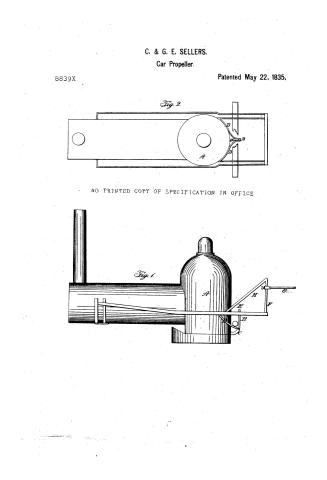
C. & G. E. SELLERS.
Car Propeller.
8839X
Patented May 22, 1835.
Fig. 2.
NO PRINTED COPY OF SPECIFICATION IN OFFICE.
Fig. 1.
Page 2.
8839x May 22 1835 1 429.
Charles Silling & George Silling of Philadelphia
Letters Patent
The Schedule referred to in these Letters Patent and making part of the same containing a description on the works of the said Charles Silling and George Silling Silling the inventors of their improvement on the construction of Locomotive Engines
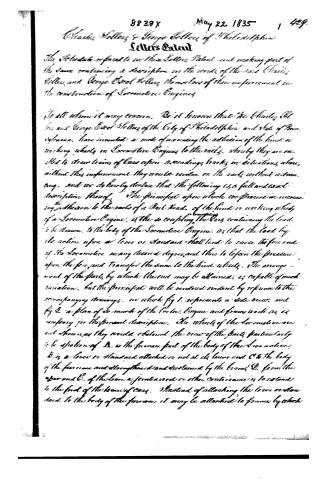
To all whom it may concern. Be it known that the Charles Silling and George Silling of the City of Philadelphia and State of Pennsylvania, have invented a mode of increasing the adhesion of the head or driving wheels in Locomotive Engines to the rails, whereby they are enabled to draw trains of Cars upon ascending tracks in elevations where, without this improvement they would reverse on the rails without acting, and we do hereby declare that the following is a full and exact description thereof. The principle upon which we proceed in increasing adhesion to the rails of a Rail Road, of the head or driving wheels of a Locomotive Engine, is the so coupling the Cars containing the load to be drawn to the body of the Locomotive Engine, as that the load by its action upon a lever or standard shall tend to raise the fore end of the Locomotive, many degrees, and thus to lessen the pressure upon the fore, and transfer the same to the hind wheels. The arrangement of the parts by which the end may be attained, is capable of much variation, but the principle will be rendered evident by reference to the accompanying drawings, in which fig 1. represents a side view, and fig 2. a plan of so much of the Locomotive Engine and frame work as is necessary for the present description. The wheels of the Locomotive are not shown as they would obstruct the view of the parts, particularly to be spoken of. A is the furnace part of the body of the Locomotive. B is a lever or standard attached or not at its lower end C to the body of the furnace and strengthened and sustained by the beam D. from the upper end E. of the lever a joint or rod or other contrivance is to extend to the front of the train of Cars. Instead of attaching the lever or standard to the body of the furnace, it may be attached to frames by which
Page 3.
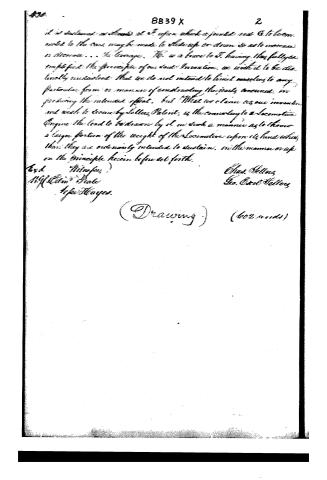
it is determined not to limit it to a form which is found not to be amenable to the same may be made to slide up or down so as to increase or decrease... the leverage. This is a breach to it having thus fully ascertained the principle of our said invention, we wish it to be distinctly understood that we do not intend to limit ourselves to any particular form or manner of constructing the parts named, in producing the intended effect, but that we claim as our invention and wish to secure by Letters Patent, is the connecting to a Locomotive Engine the lead to be drawn by it in such a manner as to throw a large portion of the weight of the locomotive upon its hind wheels, than they are ordinarily intended to sustain, in the manner set up on the principle herein before set forth.
Chas. Sellers
Geo. Croft Sellers
(Drawing) (602 words)
Published accounts: journal notice
Notice in the monthly list of patents
Journal of the Franklin Institute, new ser., vol. 16 (1835), p. 71 · View the page
284. Locomotive engines. Charles and G. F. Sellers, city of Philadelphia,
Published accounts: journal notice
Notice in the monthly list of patents, with remarks
Journal of the Franklin Institute, new ser., vol. 16 (1835), p. 397 · View the page
34. For Increasing the adhesion of the hind wheels of Locomotive Engines; Charles and Geo. Escal Sellers, city of Philadelphia, May 22.
Remarks. A patent was obtained by Mr. E. L. Miller, on the 19th June, 1834, (see p. 48, vol. 15) for a method of obtaining a similar end, by throwing the weight of a car, or tender, on to the hind part of a locomotive engine. The present patentees effect the object by "so coupling, or connecting the cars containing the load to be drawn, to the body of the locomotive engine, as that the load by its action upon a lever, or standard, shall tend to raise the fore end of the locomotive, in any desired degree, and thus to lessen the pressure upon the fore, and transfer the same to the hind wheels." The patentees say that they do not mean to limit themselves to any particular form or manner of constructing the parts concerned in producing the intended effect, but claim as their invention the connecting to a Locomotive Engine, the load which is to be drawn by it, in such a manner as to throw a larger portion of the weight of the locomotive upon its hind wheels than they are ordinarily intended to sustain, in the manner, or upon the principle hereinbefore set forth."
About this record
- Patentee
- DATAMP
- Date
- the Name and Date index of patents, DATAMP, USPTO records
- Invention
- DATAMP
- Listed in
- the Name and Date index of patents, DATAMP, USPTO records, Jim Shaw's X-patent list, the Journal of the Franklin Institute, Burke's List of Patents (1847)
- Burke's 1847 Patent Office list gives the same patent.