

Drawings and documents
USPTO scan
The patent as scanned by the USPTO
-
 Page 1
-
 Page 2
-
 Page 3
-
 Page 4


U.S. Patent and Trademark Office · Google Patents
Show the transcription Hide (812 words)
Machine transcription (LightOnOCR) of the pages as scanned by the USPTO, most of them the handwritten copies made when the records were restored after the 1836 fire. Not checked; it can misread handwriting, so compare it with the scan.
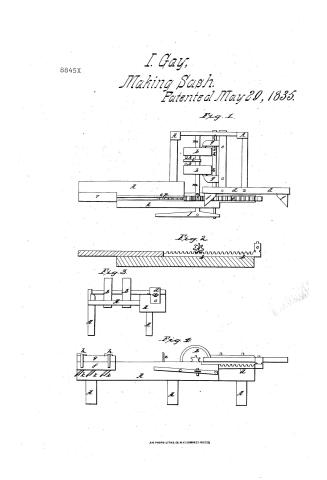
Page 1.
8845X
I. Gay,
Making Sash.
Patented May 29, 1835.
Fig. 1.
Fig. 2.
Fig. 3.
Fig. 4.
AM. PHOTO-LITHO. CO. N.Y. (OSBORNE'S PROCESS)
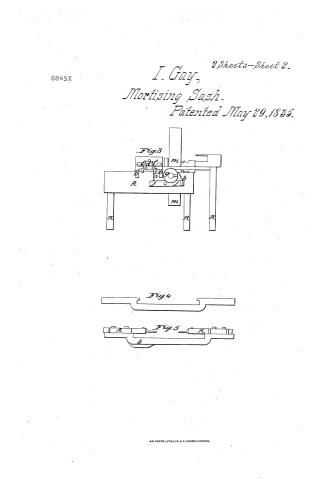
Page 2.
8845X
I. Gay,
Morising Sash.
Patented May 29, 1835.
2 Sheets—Sheet 2.
Fig. 3
Fig. 4
Fig. 5
AM. PHOTO-LITHO. CO. N.Y. (OSBORNE'S PROCESS)
Page 3.
8845x
May 29, 1835
25
Ira Gay of Dunstable, County of Hillsborough & State of New Hampshire
Letters Patent
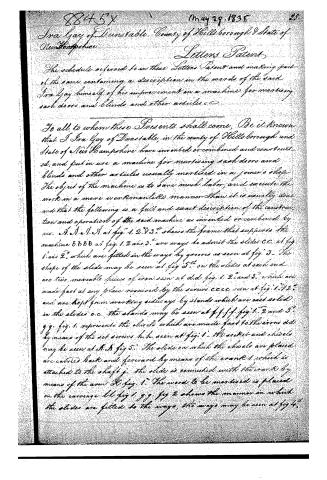
The schedule referred to in these Letters Patent and making part of the same containing a description in the words of the said Ira Gay himself of his improvement in a machine for mortising sash doors and blinds and other articles.
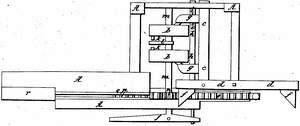
To all to whom these Presents shall come, Be it known that I Ira Gay of Dunstable, in the county of Hillsborough and State of New Hampshire have invented or combined and constructed and put in use a machine for mortising sash doors and blinds and other articles usually mortised in a joiner’s shop. The object of the machine is to save much labor, and execute the work in a more workmanlike manner than it is usually done and that the following is a full and exact description of the construction and operation of the said machine as invented or combined by me. A. A. A. A. at fig. 1. 2. & 3. shows the frame that supports the machine b b b b at fig. 1. 2 and 3. are ways to admit the slides c c. at fig. 1. and 2. which are fitted in the ways by grooves as seen at fig. 3. The shape of the slide may be seen at fig. 5. on the slides at each end are two moveable pieces of iron seen at d. d. fig. 1. 2. and 3. which are made fast at any place required by the screws c c c c. seen at fig. 1. & 2. and are kept from working sideways by stands which are cast solid in the slides c c. the stands may be seen at f f f f. fig. 1. 2 and 3. g g. fig. 1. represents the chucks which are made fast to the arms d d by means of the set screws h h. seen at fig. 1. the socket and chucks may be seen at A. A. fig 5. The slide on which the chucks are placed are carried back and forward by means of the crank 1 which is attached to the shaft j. the slide is connected with the crank by means of the arm K fig. 1. The wood to be mortised is placed on the carriage l l fig 1. g g. fig 2 shows the manner in which the slides are fitted to the ways, the ways may be seen at fig 4.
Page 4.
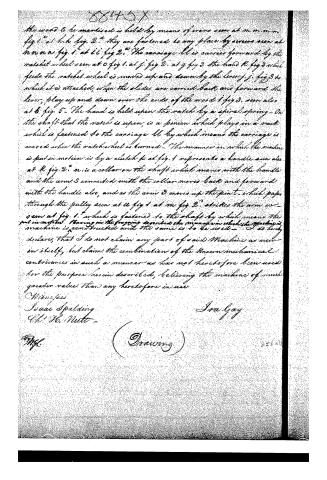
the wood to be mortised is held by means of irons seen at m m m m fig 1 at h h fig 2. They are fastened to any place by screws seen at n n n n fig 1 at i i fig 2. The carriage ll is carried forward by the ratchet wheel seen at o fig 1 at f fig 2 at g fig 3. The hand R fig 3 which feeds the ratchet wheel is moved up and down by the lever j j fig 3 to which it is attached, when the slides are carried back and forward the lever, play up and down over the ends of the wood l fig 3, seen also at b fig 5. The hand is held upon the ratchet by a spiral spring. On the shaft that the ratchet is upon, is a pinion which plays on a rack which is fastened to the carriage ll by which means the carriage is moved when the ratchet wheel is turned. The manner in which the machine is put in motion is by a clutch p, at fig 1 represents a handle seen also at R fig 2. m is a collar on the shaft which moves with the handle and the arm S connected with the collar moves back and forward with the handle also, and as the arm S moves up the point which passes through the pulley seen at u fig 1 at m fig 2, strikes the arm w - seen at fig 1 which is fastened to the shaft by which means the put in motion. Having in the foregoing described the manner in which the packing machine is constructed and the same is to be used. I do hereby declare, that I do not claim any part of said Machine as new in itself, but claim the combination of the known mechanical contrivances in such a manner as has not heretofore been used for the purpose herein described, believing the machine of much greater value than any heretofore in use.
Witnesses
Isaac Spalding
Chas H. Nutt
Ira Gay
(Drawing)
Published accounts: journal notice
Notice in the monthly list of patents
Journal of the Franklin Institute, new ser., vol. 16 (1835), p. 71 · View the page
304. Planing sash staff. Ira Gay, Dunstable, Hillsborough county, N. H.
Published accounts: journal notice
Notice in the monthly list of patents, with remarks
Journal of the Franklin Institute, new ser., vol. 16 (1835), p. 404 · View the page
52. For a Mortising Machine; Ira Gay, Dunstable, Hillsborough county, New Hampshire, May 29.
Remarks. After describing his machine, the patentee says, "I do not claim any part of said machine as new in itself, but claim the combination of the known mechanical contrivances in such a manner as have not heretofore been used for the purpose herein described." This indefinite mode of making a claim has become very common, of late, but it certainly does not fulfil that requirement of the law which makes it the duty of the patentee to distinguish his machine "from all other things before known or used." Two machines for the same purpose may be very differently arranged, and yet be substantially the same, in which case the difference of combination would be but colourable on the part of the last claimant, and his patent could not be sustained. We cannot, indeed, perceive any difference between the foregoing claim, and the not making any, as we should esteem it as claiming the whole machine.
Published accounts: journal notice
Notice in the monthly list of patents, with remarks
Journal of the Franklin Institute, new ser., vol. 16 (1835), p. 405 · View the page
54. For a Machine for Planing Sash Stuff; Ira Gay, Dunstable, Hillsborough county, New Hampshire, May 29.
Remarks. The claim to this machine is in the same terms as that made to No. 52, for mortising. The planes are to be made to travel back and forth, as in other machines for planing sash stuff; the method of effecting this differs from, but is not better than, the plans previously adopted.
DATAMP: illustration
Illustrations from DATAMP
DATAMP (Directory of American Tool and Machinery Patents), via the Internet Archive · Archived DATAMP page
About this record
- Patentee
- DATAMP
- Date
- the Name and Date index of patents, DATAMP, USPTO records
- Invention
- DATAMP
- Listed in
- the Name and Date index of patents, DATAMP, USPTO records, Jim Shaw's X-patent list, the Journal of the Franklin Institute, Burke's List of Patents (1847)
- Burke's 1847 Patent Office list gives the same patent.