

Drawings and documents
USPTO scan
The patent as scanned by the USPTO
-
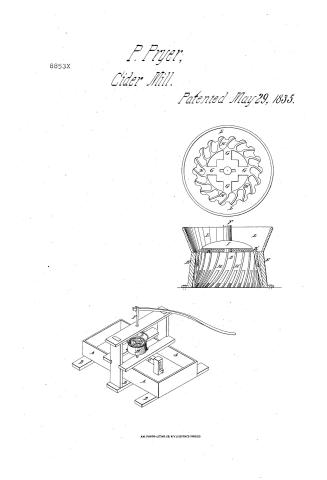 Page 1
-
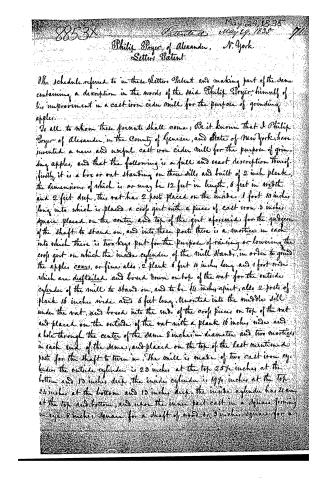 Page 2
-
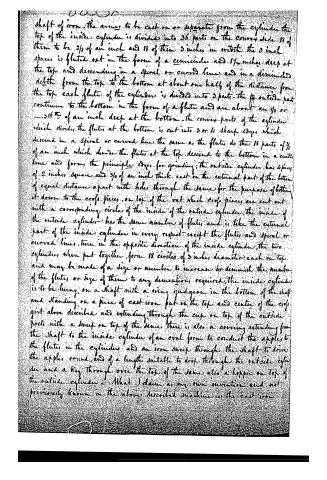 Page 3
-
 Page 4


U.S. Patent and Trademark Office · Google Patents
Show the transcription Hide (975 words)
Machine transcription (LightOnOCR) of the pages as scanned by the USPTO, most of them the handwritten copies made when the records were restored after the 1836 fire. Not checked; it can misread handwriting, so compare it with the scan.
Page 1.
8853X
P. Pryer,
Cider Mill.
Patented May 29, 1835.

AM. PHOTO-LITHO. CO. N.Y. (OSBORNE'S PROCESS)
Page 2.
88537
Patented May 24, 1835
Philip Poyer, of Alexander, N. York.
Letters Patent.
The schedule referred to in these Letters Patent and making part of the same containing a description in the words of the said Philip Poyer himself of his improvement in a cast iron cider mill for the purpose of grinding apples.
To all to whom these presents shall come; Be it known that I Philip Poyer of Alexander, in the County of Genesee, and State of New York, have invented a new and useful cast iron cider mill for the purpose of grinding apples, and that the following is a full and exact description thereof.
Firstly it is a box or vat standing on three sills and built of 2 inch plank, the dimensions of which is or may be 12 feet in length, 6 feet in width and 2 feet deep, this vat has 2 posts placed on the inside 1 foot 10 inches long into which is placed a cross girlet with a piece of cast iron 3 inches square placed on the center and top of the girlet aforesaid for the guidance of the shaft to stand on, and into these posts there is a mortice in each into which there is two keys put for the purpose of raising or lowering the cross girlet on which the inside cylinder of the mill stands, in order to grind the apples coarse, or fine also 2 plank 6 feet 10 inches long and 1 foot wide which are distailed and boxed down on top of the vat for the outside cylinder of the mill to stand on, and to be 14 inches apart, also 2 posts of plank 16 inches wide and 6 feet long tenonted into the middle sill under the vat, and boxed into the ends of the cross pieces on top of the vat and placed on the outside of the vat with a plank 16 inches wide and a hole through the center of the same 8 inches in diameter, and two mortices in each end of the same, and placed on the top of the last mentioned posts for the shaft to turn in. The mill is made of two cast iron cylinders the outside cylinder is 23 inches at the top 25 1/2 inches at the bottom and 13 inches deep, the inside cylinder is 19 1/2 inches at the top 24 inches at the bottom and 13 inches deep. The inside cylinder has 4 arms at the top and bottom, and upon the inner part cast in a square forming in eye 8 inches square for a shaft of wood or 3 inches square for a
Page 3.
shaft of iron, the arms to be cast on or separate from the cylinder the top of the inside cylinder is divided into 36 parts on the convex side 18 of them to be 3/8 of an inch and 18 of them 3 inches in width the 3 inch spaces is fluted out in the form of a semicircle and 1 1/2 inches deep at the top and descending in a spiral or curved line and in a diminished depth from the top to the bottom at about one half of the distance from the top each flute of the cylinder is divided into 3 parts the 1/3 outside part continues to the bottom in the form of a flute and are about an 1/8 or 3/16 of an inch deep at the bottom the convex parts of the cylinder which divide the flutes at the bottom is cut into 3 or 4 sharp edges which descend in a spiral or curved line the same as the flutes do the 18 parts of 3/8 of an inch which divide the flutes at the top descend to the bottom in a curved line and form the principle edges for grinding; the outside cylinder has spaces of 2 inches square and 3/8 of an inch thick cast on the external part of the bottom of equal distance apart with holes through the same for the purpose of bolting it down to the crofs pieces, on top of the vat which crofs pieces are cut out with a corresponding circle of the inside of the outside cylinder, the inside of the outside cylinder has the same number of flutes and is like the external part of the inside cylinder in every respect except the flutes and spiral or curved lines, turn in the opposite direction of the inside cylinder, the two cylinders when put together form 18 circles of 3 inches diameter each on top and may be made of a size or number to increase or diminish the number of the flutes or size of them to any dimension required, the inside cylinder is to be hung on a shaft with a ring gudgeon in the bottom of the shaft and standing on a piece of cast iron put on the top and center of the crofs girt above described and extending through the cup on top of the outside posts with a sweep on top of the same there is also a covering extending from the shaft to the inside cylinder of an oval form to conduct the apples to the flutes in the cylinders and an iron sweep through the shaft to drive the apples round, and of a length suitable to drop through the outside cylinder and a key through over the top of the same also a hopper on top of the outside cylinder — What I claim as my own invention and not previously known in the above described machine is the cast iron
Page 4.
8853X
agreed with all of them above described particulars in form and use.
Witnesses
George Warner
Judah Willis
Philip Poyen
(Stamping made)
7/2
TWO
1946
Published accounts: journal notice
Notice in the monthly list of patents
Journal of the Franklin Institute, new ser., vol. 16 (1835), p. 71 · View the page
296. Cider mill, cast iron.-Philip Pryer, Genessee, New York,
Published accounts: journal notice
Notice in the monthly list of patents, with remarks
Journal of the Franklin Institute, new ser., vol. 16 (1835), p. 402 · View the page
46. For a Cast-iron Cider Mill; Philip Pryer, Alexander, Genesee county, New York, May 29.
Remarks. This mill is formed much like the common bark mill, with a nut on a vertical shaft, revolving in a cast-iron box. The grooves, or flutes, in the nut and box, are sufficiently deep at top to receive the apples, and diminish as they run spirally down to the lower side, where the grinding is finished. The exact dimensions of the respective parts constitute nearly the whole of the description, and the claim is to "the cast-iron cylinders, with all their above described particulars in form and use." We should have been at a loss, had the task of making a claim devolved upon us, as there is an equal want of originality in the particular parts, and in their mode of combination.
About this record
- Patentee
- DATAMP
- Date
- the Name and Date index of patents, DATAMP, USPTO records
- Invention
- DATAMP
- Listed in
- the Name and Date index of patents, DATAMP, USPTO records, Jim Shaw's X-patent list, the Journal of the Franklin Institute, Burke's List of Patents (1847)
- Burke's 1847 Patent Office list gives the same patent.