

Drawings and documents
USPTO scan
The patent as scanned by the USPTO
-
 Page 1
-
 Page 2
-
 Page 3


U.S. Patent and Trademark Office · Google Patents
Show the transcription Hide (871 words)
Machine transcription (LightOnOCR) of the pages as scanned by the USPTO, most of them the handwritten copies made when the records were restored after the 1836 fire. Not checked; it can misread handwriting, so compare it with the scan.
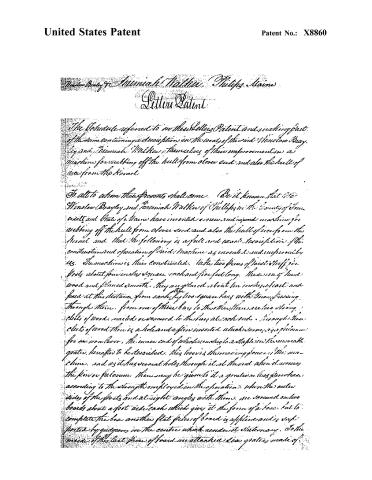
Page 2.
United States Patent
Patent No.: X8860
Windsor Brayley & Jeremiah Walker, Phillips, Maine
Letter Patent
The Schedule referred to in these Letters Patent and making part of the same containing a description in the words of the said Windsor Brayley and Jeremiah Walker themselves of their improvement in a machine for rubbing off the hull from clover seed and also the hull of rice from the kernel.
To all to whom these presents shall come. Be it known that We Windsor Brayley and Jeremiah Walker of Phillips in the County of Somerset and State of Maine have invented a new and improved machine for rubbing off the hull from clover seed and also the hull of rice from the kernel and that the following is a full and exact description of the construction and operation of said machine as invented and improved by us. The machine is thus constructed: Take two pieces of solid stiff pine boards about four inches square each and five feet long. These are of hard wood and planed smooth. They are joined about ten inches apart and fixed at this distance from each other by two square bars with strong bracing through them. From one of these bars to the other there are two strong cleats of wood nailed or screwed to the bars at each end. Through these cleats of wood there is a hole and a pin inserted which serves as a fulcrum for an iron lever, the inner end of which is attached to a staple in the movable grate, hereafter to be described. This lever is the moving power of the machine, and as it has several holes through it at the end when it receives the pin or fulcrum there may be given to it a greater or less power according to the strength employed in the operation. When the outer sides of the boards and at right angles with them are secured on two boards about a foot wide each which gives it the form of a box. But to complete the box another flat piece of board is applied and is supported by guides in the centre which render it stationary. To the inside of this last piece of board are attached two plates made of
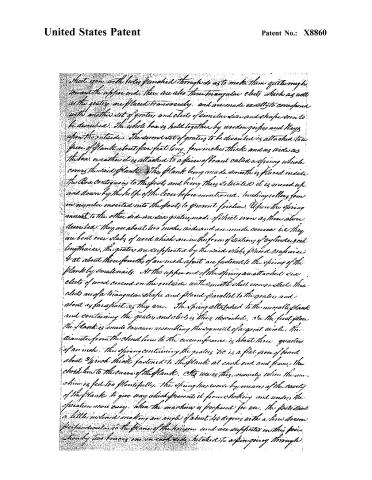
Page 3.
United States Patent
Patent No.: X8860
Sheet iron, with holes punched through so as to make them quite rough toward the upper end. There are also three triangular cleats which as well as the grooves are placed transversely, and are made exactly to correspond with another set of grooves and cleats of similar size and shape soon to be described. The whole box is held together by wooden gores and keys upon the outside. The second set of grooves to be described is attached to a piece of plank about five feet long, four inches thick and as wide as the box, or rather it is attached to a piece of board called a spring which covers the said plank. This plank being made smooth is placed inside the box contiguous to the grooves and being thus situated it is moved up and down by the help of the levers before mentioned, touching rollers four in number inserted into the grooves to prevent friction. Upon the spring nearest to the other side are six grooves made of sheet iron as those above described. They are about two inches wide and are made convex in they are bent over slabs of wood which are in the form of sections of cylinders cut lengthwise. The grooves are supported by the said slabs placed obliquely at about three-fourths of an inch apart are fastened to the spring of the plank by small nails. At the upper end of the spring are attached six cleats of wood secured on the outside with smooth sheet iron or steel. These cleats are of a triangular shape and placed parallel to the grooves and about as far apart as they are. The spring attached to the movable plank and containing the grooves and cleats is thus described. In the first place the plank is made concave resembling the segment of a great circle. The diameter from the chord line to the circumference is about three quarters of an inch. The spring containing the grooves &c is a flat piece of board about 3/4 inch thick fastened to the plank at each end and forms the chord line to the curve of the plank. It is used thus, namely, when the machine is felt too plentifully. The spring has room by means of the elasticity of the plank to give way which prevents it from chocking and makes the operation more easy. When the machine is prepared for use, the first stand a little inclined making an angle of about 45 degrees with a line drawn perpendicular to the plane of the horizon and are supported in this position by two braces one on each side, hinged to a pin going through
Published accounts: journal notice
Notice in the monthly list of patents
Journal of the Franklin Institute, new ser., vol. 16 (1835), p. 142 · View the page
318. Hulling clover, &c.-W. Braley, and J. Walker, Somerset co., Md.
Published accounts: journal notice
Notice in the monthly list of patents, with remarks
Journal of the Franklin Institute, new ser., vol. 17 (1836), p. 40 · View the page
8. For a Machine for Hulling Clover Seed and Rice; Winslow Braley and Jeremiah Walker, Phillips, Somerset county, Maine, June 6.
Remarks. This machine consists of a grater or rubbing board, worked up and down by means of a lever, the seed descending between this and a stationary grater. The graters are made of punched sheet iron, fixed upon wooden cylindrical segments crossing the rubbing boards. The machine is well described, but there is no claim made, although it certainly possesses sufficient originality upon which to have founded one. Several parts referred to in the specification, have been omitted in the drawing; it is therefore defective, as it would not be a sufficient guide to a workman about to make the machine it represents.
About this record
- Patentee
- DATAMP
- Date
- the Name and Date index of patents, DATAMP, USPTO records
- Invention
- DATAMP
- Listed in
- the Name and Date index of patents, DATAMP, USPTO records, Jim Shaw's X-patent list, the Journal of the Franklin Institute, Burke's List of Patents (1847)
- Burke's 1847 Patent Office list gives the same patent.