

Drawings and documents
National Archives restored drawings: drawing
T.M. Southwick's Patent Drawing for a Pyramidal Stove

National Archives, Restored Patent Drawings (Record Group 241) · Full-size scan at the National Archives · Catalog record
Show the text on the drawing Hide (126 words)
Words on the drawing as machine-read by the National Archives; not checked. Useful mainly for searching.
FURNACES / ating Stoves. / God 21. Page 527 / T.M.SOUTHWICK / ICATION / 8866-X / Pyramidat Store / Patented 6" 6"June 1835 / DIVISION. / --wrought inon / 4th. Section / section / a. Double bottom learing an air tight thambor Yacant space a'jorticated air / Sections opened / b. sliding cloor. C. Tubes reaching into 2 2ᵗʰ dsection / 2. Section / a. Slide belt. a'. Iron Rims RIMS b. cast Tronhorizonal rim. C. perpondicalar Rin / 3d sections / d. Soan stone furnace cased will 7.7.072 -e, drop grate. f sifter / 3th Section / a. Boiler. / 4th Sections. / C. Collarand Danner. b. Датрат / 6' / 2d Section / plan / 1."Section / Patent office June 28 1842 / Made under the direction of the commynowr of / Patents in conformety with ach of March 1834 / Strickland Del / of Patents
USPTO scan
The patent as scanned by the USPTO
-
 Page 1
-
 Page 2
-
 Page 3
-
 Page 4


U.S. Patent and Trademark Office · Google Patents
Show the transcription Hide (1,113 words)
Machine transcription (LightOnOCR) of the pages as scanned by the USPTO, most of them the handwritten copies made when the records were restored after the 1836 fire. Not checked; it can misread handwriting, so compare it with the scan.
Page 1.
T. M. Southwick,
Heating Stove.
Patented June 6, 1835.
8866X

Page 2.
June 6, 1895
Thomas M. Southwick, of Troy, New York,
Letters Patent.
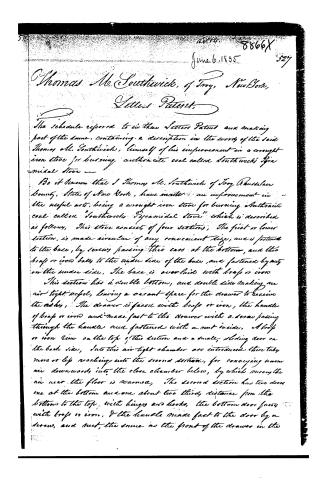
The schedule referred to in these Letters Patent and making part of the same, containing a description in the words of the said Thomas M. Southwick, himself of his improvement in a wrought iron stove for burning anthracite coal called Southwick's Pyramidal Stove.
Be it known that I, Thomas M. Southwick of Troy, Rensselaer County, State of New York, have made an improvement in the useful arts, being a wrought iron stove for burning Anthracite coal called "Southwick's Pyramidal Stove" which is described as follows. This stove consists of four sections. The first or lower section, is made circular of any convenient size, and is fastened to the base, by screws passing through ears at the bottom, and the brads or iron balls to the under side of the base, and fastened by nuts on the under side. The base is overlaid with brads or iron.
This section has a double bottom, and double sides making an air tight vessel, leaving a vacant space for the drawer to receive the ashes. The drawer is faced with brads or iron, the handle of brads or iron and made fast to the drawer with a screw passing through the handle and fastened with a nut inside. A brad or iron rim on the top of this section and a small, sliding door on the back side. Into this air-tight chamber are introduced three tubes more or less reaching into the second section, for conveying warm air downwards into the close chamber below, by which means the air near the floor is warmed. The second section has two doors one at the bottom and one about two thirds distance from the bottom to the top, with hinges and locks, the bottom door faced with brads or iron, and the handle made fast to the door by a screw, and nut, the same as the front of the drawer in the
Page 3.
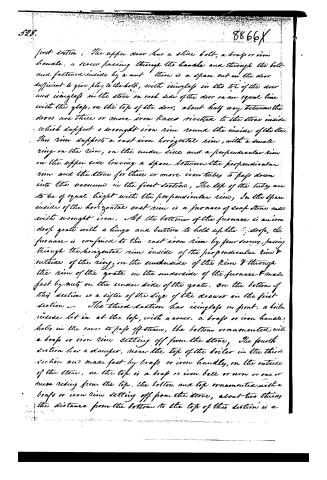
first section. The upper door has a slide bolt, a brass or iron handle, a screw passing through the handle and through the bolt and fastened inside by a nut. There is a space cut in the door sufficient to give play to the bolt, with a single lap in the top of the door and a single lap in the stove on each side of the door on an equal line with the gap, on the top of the door, about half way between the doors are three or more iron braces riveted to the stove inside which support a wrought iron rim round the inside of the stove. This rim supports a cast iron horizontal rim, with a small ring on the rim, on the under side and a perpendicular rim on the upper side leaving a space between the perpendicular rim and the stove for three or more iron tubes to pass down into the vacuum in the first section. The top of the tubes are to be of equal height with the perpendicular rim. In the space inside of the horizontal cast rim is a furnace of soap stone cast with wrought iron. At the bottom of the furnace is an iron drop grate with a hinge and button to hold up the drop, the furnace is confined to the cast iron rim by four screws, passing through the horizontal rim inside of the perpendicular rim & outside of the ring, on the underside of the rim & through the rim of the grate in the underside of the furnace & made fast by nuts on the under side of the grate. On the bottom of this section is a cistern of the size of the drawer in the first section. The third section has a single lap in front, a boiler inside set in at the top, with a cover, a brass or iron handle, holes in the cover to pass off steam, the bottom ornamented with a brass or iron rim setting off from the stove. The fourth section has a damper, near the top of the boiler in the third section and made fast by brass or iron handle, on the outside of the stove, on the top is a brass or iron bell or urn or one or more riding from the top. The bottom and top ornamented with a brass or iron rim setting off from the stove, about two thirds the distance from the bottom to the top of this section is a
Page 4.
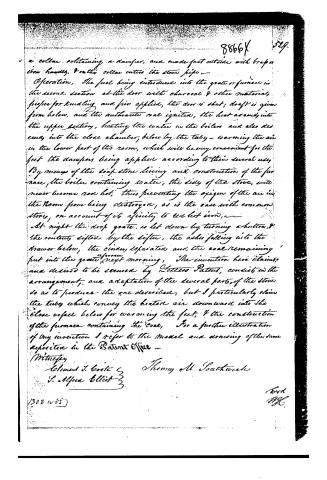
a collar containing a damper, and made fast outside with brass or iron handles, & on this collar enters the stove pipe.
Operation, The fuel being introduced into the grate or furnace in the second section at the door with charcoal & other materials proper for kindling and fire applied, the door is shut; draft is given from below, and the anthracite coal ignited, the heat ascends into the upper section, heating the water in the boilers and also descends into the close chamber below by the tube—warming the air in the lower part of the room, which will be very convenient for the feet the dampers being applied according to their several uses.
By means of the soap stone lining and construction of the furnace, the boiler containing water, the sides of the stove, will never become red hot; thus preventing the oxygen of the air in the room from being destroyed, as is the case with common stoves, on account of its affinity to red hot iron.
At night the drop grate is let down by turning a button, & the contents sifted by the sifter, the ashes falling into the drawer below, the cinders separated and the coal remaining put into the grate next morning. The invention here claimed and desired to be secured by Letters Patent, consists in the arrangement and adaptation of the several parts of the stove so as to produce the one described, but I particularly claim the tube which conveys the heated air downward into the close space below for warming the feet, & the construction of the furnace containing the coal. For a further illustration of my invention I refer to the model and drawing of the same deposited in the Patent Office.
Witnesses
Clement J. Coote
J. Alfred Elliot
Thomay M. Southwick
End
MGC
1302 w 85
Published accounts: journal notice
Notice in the monthly list of patents
Journal of the Franklin Institute, new ser., vol. 16 (1835), p. 142 · View the page
316. Stove, pyramidal.-Thomas M. Southwick, Troy, N. Y.
Published accounts: journal notice
Notice in the monthly list of patents, with remarks
Journal of the Franklin Institute, new ser., vol. 17 (1836), p. 40 · View the page
6. For a Pyrimidal Stove; Thomas M. Southwick, Troy, Rensselaer county, New York, June 6.
Remarks. This is a sheet iron stove lined in the furnace part with soap stone. The only peculiarity which we see in it, is the forming of an air-tight chamber at the lower part, from which tubes are to ascend up into the furnace. The object proposed is to heat the lower part of the stove by the descent of heated air into the chamber; it will be found, however, that more heat would be conducted down by solid rods than by the air tubes: the contrivance is, in fact, at variance with well known principles. "The invention claimed and desired to be secured by letters patent, consists in the arrangement and adaptation of the several parts of the stove so as to produce the one described; but I particularly claim the tubes which convey the heated air downward into the close vessel below for warming the feet, and the construction of the furnace containing the coal." The description is very confused and indistinct, and the claim corresponds well with it.
About this record
- Patentee
- DATAMP
- Date
- the Name and Date index of patents, DATAMP, USPTO records
- Invention
- DATAMP
- Listed in
- the Name and Date index of patents, DATAMP, USPTO records, Jim Shaw's X-patent list, the Journal of the Franklin Institute, Burke's List of Patents (1847)
- The Franklin Institute's journal spells the name differently.
- Burke's 1847 Patent Office list gives the same patent.