

Drawings and documents
USPTO scan
The patent as scanned by the USPTO
-
 Page 1
-
 Page 2
-
 Page 3
-
 Page 4
-
 Page 5
-
 Page 6


U.S. Patent and Trademark Office · Google Patents
Show the transcription Hide (2,143 words)
Machine transcription (LightOnOCR) of the pages as scanned by the USPTO, most of them the handwritten copies made when the records were restored after the 1836 fire. Not checked; it can misread handwriting, so compare it with the scan.
Page 1.
W. Grove.
Bee Hive.
No. 8,875 X
Patented Jun 12, 1835.
BEST AVAILABLE COPY
H. PETERS, PHOTO-LITHOGRAPHER, WASHINGTON, D.C.
Page 2.
BEST AVAILABLE COPY
June 12, 1870
So all to whom these Letters Patent shall come,
It is known that I William Grove, a Citizen of the United States have invented a "Fortified Bee Palace" on a new and original plan for which I have obtained a Patent under the Seal of the United States. This said invention has been pronounced by the best judges to be far superior to anything of the kind heretofore discovered for beauty, convenience and usefulness. The preservation of the bees, the procurement of pure and much larger quantities of honey without destroying or killing the bees—the great and remarkable increase of their number—the facility and ease with which the honey can be taken from the house without even disturbing their ingenious appliances; these are some of the most obvious advantages arising from the above mentioned invention. The following is a full and exact description of the construction and operation of said "Palace"—The partitions are made of different sizes according to the number of hives which they are to be connected with, but the most ordinary size is one of six feet long by two feet ten inches wide. They are made of inch boards, pine or poplar, etc. The gable ends are made just as precisely like the other. When they are prepared, both ought to be described inside and outside. Firstly, on the inside, before the boards are nailed on: First the centre, 16 inches from the top and sides. Then the circle, the square is then brought up to the circle, the top part is equally divided into five sections by allowing two inches in the top platform, and 2 inches above and below for the reception of large round glasses, 4 inches high by 12 wide, so that five sections will be each 14 inches wide on the outside. The doors are then described at 2 inches from the top platform and 13 inches wide, by 21 high. A glass 6 by 8 is inserted on the inside of each end door (and a little room as a lid on it, on the outside, and a hole 4 inches wide, square, and 2 inches from the side is cut out with a nail, to receive a slide level of 1/4 of an inch thick. The lines struck with dots, (see draft,) ought to be marked on the inside of the gable ends. After the gable ends are thus alike prepared, ploughed, grooved, and glued together, (and the boards all once planed off, warm tar with a pencil should then be applied to the edges of the gable ends and on in all the joints of the boards, as they are
Page 3.
BEST AVAILABLE COPY
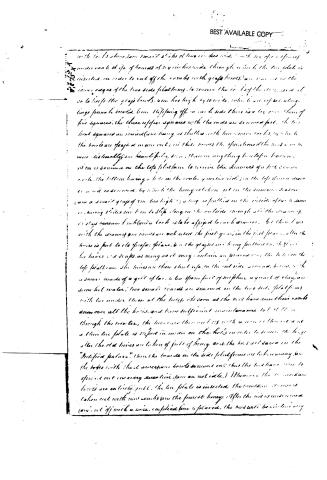
with its stone, (and small strips of two or three inches wide, through which the top plate is inserted, in order to cut off the combs with glass hives, are run in the inner edges of the two side platforms, to receive the in log of the combs, and it so to keep the glass combs, even has high up to ride, which is not very strong, large frame to combs, from slipping off, on each side there is a log over them of five squares, the three upper squares with the combs are so covered fast, the two lower squares are joined (and heavy as shingles with two square logs, by which the combs are fastened in place; in these combs the operations of the bees are more easily performed, and more beautifully, than in anything heretofore known.
It is a custom on the top platform to receive the drawers of the combs, the bottom having a hole in the center, opening into the log of combs, and is secured, by which the honey is taken out on the summer season, and a small group of 300 bees high is kept in the inside of the hive, having sticks set in to slip along on the outside through which the combs are kept in place. The combs are not used the first year, in the first place, after the hive is put to its proper place, but the grapes are being put into the hive, and the bees are kept as many as they can contain, and joined over the log on the top platform. The hives are then shut up, on the east side around, being with a screen made of a grid of tar, a box spout full of scuttle, a quart of clay, and some hot water, two small boards are secured on the two side platforms with tar under them at the top, also so as the bees have run their combs down over all the hives, and have sufficient maintenance to let it go through the winter, the hives are then cut up with a wire or thread, and a thin line plate is inserted in order on the holes in order to secure the log, after the old hives are taken off full of honey, and the hives are saved in the "Inflated places," then the boards on the side platforms are taken away, and the boxes with the combs are secured on; thus the bees have room to spread out on every side, (and are not idle.) Whenever the combs are entirely full, the top plate is inserted, the combs are taken out with new combs and the purest honey, after the ice is removed, and cut off with a wire, employed fine as placed, the bees will be in their way.
Page 4.
BEST AVAILABLE COPY
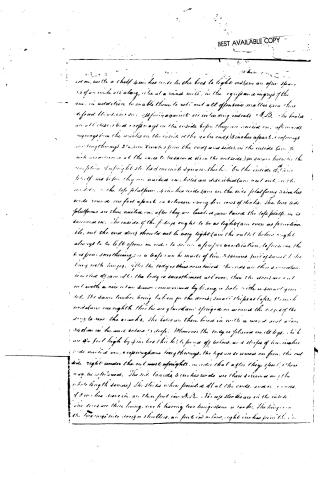
room, with a shelf 4 inches wide for the bed to light on (use an open space 18 of an inch all along, like at a wind mill, in the equipment in grip of the arm, in addition to enable them to roll out all offensive matter from the refused thimble, so as to fight against all incoming insects. A.B. The boards are all close fit, a 1/8 inch gap on the inside before they are nailed on; afterwards, runways from the nails on the inside of the 4 boards, 5 inches apart, 1/8 inch long through 2 1/2 inch boards from the ends and sides, on the inside (and 1/8 inch across at the ends to keep a 1/8 inch on the outside). For small holes in the reception, 1/8 inch thick. 1/8 inch thick. On the inside of the 1/8 inch thick, not before they are nailed on, holes are also cut (use not out on the inside). The top platform, 4 inches wide, (use on the side platform 3 inches wide round, one foot apart or between every four rows of sticks). The two side platforms are then nailed on; after they are level, a 1/8 inch board the top platform is screwed on. The inside of the top ought to be as light (and even as friction is), but the end does should not be very light (and the outlet below ought always to be left open in order to secure a proper ventilation, to preserve the bed from smothering; a trap can be made of 1/8 inch 3 square feet of small 1/8 inch thick with lumps, if the body is thus constructed, the rods are then screwed on in the same way as the body is smoothed all over, then the doors are cut out with a circular saw, commencing by boring a hole with a small gimlet, the same lumber being taken for the doors; small strips as lags, 1/8 inch wide, one eighth thick are placed and spread on around the edges of the doors to cover the cracks. The holes are then filled in with a wood and stone system in the same before 1/8 inch. Whenever the body is placed on its legs, it is 1/8 inch high by 4 inches thick, 1/8 inch off below, and strips of iron, inches wide nailed on, a 1/8 inch long through, the legs are screwed on from the outside right under the cut most uprights, in order that after they spread, there may be no friction. The side boards, 5 inches wide are then screwed on (the whole length 3 inches). The sticks when pointed all at the ends, and 1/8 inch of 3 inches wide on, are then put in A.B. The top sticks are on the inside, the legs are then hung, one having two hinges and a lock. The hinges on the two large side doors or shutters, are put in below, right in the grain of the wood.
Page 5.
BEST AVAILABLE COPY
Assured, in abundance,
...the same voracious nature!
...in removed with the slightest danger or trouble. As soon as the bees
...run their combs to the holes behind the door, two other large bee houses
...are secured one hole upon hole, or lines the door with some of the above-mentioned...
...thirty and around the holes; when the slides are removed,
...a great quantity of bees will come out of the fault into the empty houses;
...one after they have completed their way into the empty ones they remove others
...others replaced for the consumption of more, &c. from the main body below.
The honey is taken in winter time, when a door is opened in a cold morning,
...upon the frame is quite full, the bees will retire and become stiffened
...then the combs are cut through right in the middle between the sticks,
...with a sharp pointed, thin handle, in place, and a stick with its end
...then removed, then a thick pull can be taken out from the woven honeycomb
...hulls every morning, until the one half end is removed away. In the spring
...then sticks are to be replaced; thus the honey of every other half end can
...be taken out every winter. By pursuing this plan the bees continue in making
...new combs, but filling up every other half end every summer, 1, 3, 5, etc.
...we have of these "hives" being so large as to contain upwards of three 1-gal
...beehives, we have with eight hundred, one hundred and sixty gallons
...of honey have been taken out of one house in one year. The superiority of
...this invention over any thing of the kind hitherto in use, is unquestionable
...and individuals who have made use of this plan are common in saying
...that the bees thrive better, and make in time the quantity of honey which
...they did in the former places.
We now all know by these presents, that we the undersigned
...have had a perfect trial and examination of the "Improved Patent Bee"
...House, two summers (and we candidly believe that it will answer every
...purpose, as it is recommended; any person wishing to see a honey comb
...made in two summers right-till long (and poor wretches can be gratified with
...the sight by a view with us, have no objection. Sometimes it is here, now
...is not. Thistle Gable, Reading Berks County, Pa. December 7, 1834.
On this 26th day of May, 1835, before the subscriber, a justice of the Peace in
Page 6.
BEST AVAILABLE COPY
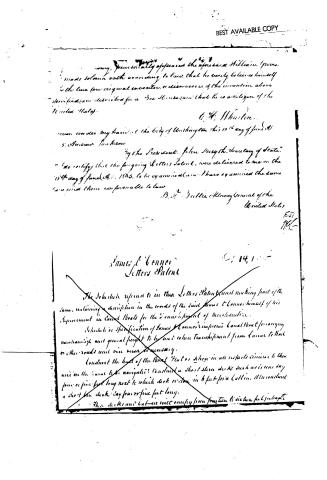
any, personally appeared the aforesaid William Groves, made solemn oath according to law, that he verily believes himself to be the true and original inventor, or discoverer, of the invention above specified, and described for a Bee House, and that he is a citizen of the United States.
C. H. Wharton.
in witness my hand, at the City of Washington this 12th day of June 1835.
S. Andrew Jackson
By the President: John Story, Secretary of State.
"I do certify that the foregoing Letters Patent, were delivered to me on the 12th day of June A. 1835, to be examined (and I have examined the same) have found them conformable to law.
B. H. Butler, Attorney General of the United States
Ends
1835
James F. Conner
Letters Patent
The Schedule referred to in these Letters Patent, and making part of the same, containing a description in the words of the said James F. Conner himself of his improvement in Canal Boats for the transportation of merchandise.
Schedule or Specification of James F. Conner's improved Canal Boat for carrying merchandise and general freight to be used when transportation from Lakes to Rail or other roads will be more necessary.
Construct the hull of the Boat Flat as shown in all respects similar to those used on the Canal to be navigated. Construct a short stern deck such as is now say four or five feet long next to which deck or stern in 6 feet from Cabin. Also construct a short bow deck say four or five feet long.
These decks and cabin will occupy from 10 feet to 12 feet in length.
Published accounts: journal notice
Notice in the monthly list of patents
Journal of the Franklin Institute, new ser., vol. 16 (1835), p. 143 · View the page
343. Bee house. William Groves, Harrisburg, Penn.
Published accounts: journal notice
Notice in the monthly list of patents, with remarks
Journal of the Franklin Institute, new ser., vol. 17 (1836), p. 48 · View the page
33. For a Bee House; William Groves, Harrisburg, Dauphin county, Pennsylvania, June 12.
Remarks. Houses, or large hives, for the more convenient management and security of bees, have been variously constructed by apiarians, several of which have been made the subject of patents. In that before us their are some variations of form and management, the absolute value of which is a question of experience, and as we perceive but little of originality, and have a long list to go through this month, we shall not give the claims or attempt any description.
About this record
- Patentee
- DATAMP
- Date
- the Name and Date index of patents, DATAMP, USPTO records
- Invention
- DATAMP
- Listed in
- the Name and Date index of patents, DATAMP, USPTO records, Jim Shaw's X-patent list, the Journal of the Franklin Institute, Burke's List of Patents (1847)
- Burke's 1847 Patent Office list gives the same patent.