

Drawings and documents
National Archives restored drawings: drawing
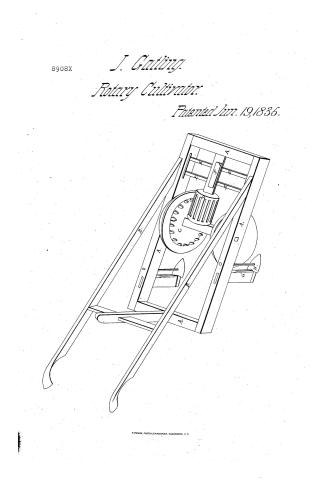
G. Gatlin's Patent Drawing for a Cotton Thinner


National Archives, Restored Patent Drawings (Record Group 241) · Full-size scan at the National Archives · Catalog record
Show the text on the drawing Hide (562 words)
Words on the drawing as machine-read by the National Archives; not checked. Useful mainly for searching.
Sheet 1. PLOTO / Entered. / Cotton Jhoppers / J.GATLIN'S / CLASSI TICATION / 8908-X / Cotton Thinner. / LIVISION, / Patented June 19th 1835 / Cot choh / Д / / ASSUM / References / A. Frame, / B. Handles. / [*] / C. Cog Wheel. / D, Trundle, / E.Arms. / F. Hoes. / G. Coulter / H. Horse Hoes / Patent Office april 214"1838 / Made under direction of the commy of / Patents in conformity with the lect of 3 "March 1837- / ML Whoch / Commissioning
Sheet 2. Explanation of Drawing / Frame / B. Cylunder c. Anrow upon which the hahers laid to be ruled / 909 Guide against which the edge of the paper is laia, that it may hals through the Machine / thought Frames upon which the here are placed attached to the Grame of the Machine / by Buts on hinges that the here may be thrown back from the eyemper at pleasure by / the latches or levers V. F. a cylinder as shown by letter B a Roll tumed by the fretion / of the under aprove and carries the cords by which the pageless is held to the cylinder / H. Hand attached to the back of the Machine. upon which the haper is laid to feed / the Machine I. Roll creased fine quicking the cords as they return between the here / J. Roll numning in shalls to strain the cords. K. Roll quiding the liaper as it enters between / the aprous and is carned by the cords. I. Roll turned by the fuction of the upper amou / and carries the cords by which the haper is held to the cylinder M. Roll as shewn by / letter. I. N. noll creased, by which the Cords are kept from coming in contact with the / Cylinder as theyretum to the Rolls M and Cc- 0. spiral things by which the here are kept / leasing against the haper P. Bands or turning the Cylin ders Q Roll creased, and / running in slides for straining the cords and carrying off the haher after it is ruled / R. Roll running on Hide lookes for straining the under amoud and keeping it in contact / with the upper aprov. and is moved by the sereive I. S. Under amoud I. serews for / straining the under aprow U. serews for strawing the upper aprove V. latches or levers by / which the here are thrown back from the cylinders W: Heads upon which the cylinders and Rolls / Tun X. Roll fixed in stides for thaming upper aprou Y. Double Pulley running upon / a shaft haping through the frame turned by the crank. &. there is also a pulley upon the / shaft of each Cylinder at the back of the Ma chin attached to hulley by Bands or Betts / Z. shows the course of the cords which carry off the haper afterit is ruled.& Crank by / which thereachine put in motion / No. 2. section of the Machine showing the arrangement of the aprous cords ter / Fig.2 Plane of Boards attached to sides of Frame and under the amou C / Fig1. Cords Z / F193. Cords which hold the haper to the cylunder. B / Elg.4 cercular board attached to sides of France and bearing down upon the aprom / to provent the haper from being displa in its course between the amount / [@PO3. Pulleys and Belts / CN: 4. Pen as seh to cylinder / Fig. L. Fountain or Pau in which the Ink is put / Fig. 3. Pen-
USPTO scan
The patent as scanned by the USPTO
-
 Page 1
-
 Page 2
-
 Page 3


U.S. Patent and Trademark Office · Google Patents
Show the transcription Hide (959 words)
Machine transcription (LightOnOCR) of the pages as scanned by the USPTO, most of them the handwritten copies made when the records were restored after the 1836 fire. Not checked; it can misread handwriting, so compare it with the scan.
Page 1.
8908X
J. Gating.
Rotary Cultivator.
Patented Jun. 19, 1835.

Page 2.
June 19, 1835
Jordan Gelling, Mufasterough, North Carolina 8908X
Sutter Patent
The schedule referred to in the Sutter Patent and making part of the same, one stating a description in the words of the said Jordan Gelling himself of his improvement in the machine for thinning Cotton.
To all to whom these presents shall come, Be it known that Jordan Gelling of Mufasterough in the County of Halifax and State of North Carolina have invented to a new and useful improvement in the machine for thinning Cotton, and that the following is a full and exact description of the construction and operation of the said machine as invented or improved by me. It has been devised for the purpose of facilitating and reducing labor of thinning Cotton and that the operation of thinning up may follow immediately after that of thinning and may be easily done by one person or any other.
The construction on a long frame is made of convenient width to suit the use in order that the center of it may drop on the Cotton, from it may be of about the ordinary length of a plough and the two ends of the side pieces are connected by a bar running across from one to the other. At that end intended for the back is to rise an upright standard at each end of the crop piece through the upper part of which runs a brace for the purpose of sustaining the arms or handles of the frame at their proper distance as under and which slope downwards to the frame which they join at the side pieces when about the center of the length. At the front crop piece is attached a swinging tree for the horse to draw by. In about the center of the sides of this frame, or axle is long secured from one to the other parallel with the tree already described.
At each end of this piece is placed a wheel to be loosely thrown over between the sides and of such a diameter as to raise the horse enough to clear the plants and on these two wheels the weight of the frame is sustained which causes them to revolve. One (say that on the right hand) is simply a wheel without teeth but the other has a row of cogs standing out from the side towards the center of the frame or in line parallel with the axle which work in those of a minute wheel of similar dimensions proportioned to the number of revolutions of the cogs of the other wheel. This knuckle is secured upon an axis running through
Page 3.
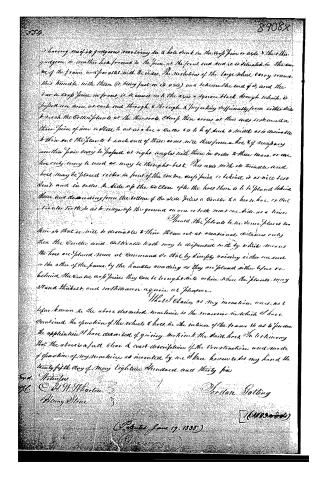
it having one of its gears revolving in a hole sunk in the crop piece or axle & that the gear gear in another hole formed in the piece at the front end and it is situated in the same of the frame and parallel with the sides. The revolution of the large wheel carry round this handle with these (it being fast on its axis) and between the end of it, and the bar or crop piece in front, is secured in the axis a square block through which is passed one arm at each end through & through & projecting sufficiently from either side to reach the cotton plants at the thin roots. Upon these arms at their ends is secured a thin piece of iron or steel to act as a hoe or cutter so to be of such a width as is desirable to thin out the plants & each end of these arms will then form a hoe & if necessary another pair may be passed at right angles with these in order to thin more or one hoe only may be used as may be thought best. This axis with its handles and hoes may be placed either in front of the centre crop piece or behind it as will best suit and in order to slide up the cotton after the hoes there is to be placed behind them and extending from the bottom of the side pieces a center & a horse hoe or cast iron or to step as to ridge up the ground on one or both sides of the row.
Should the plants be in dense places too thin so that it will be desirable to thin them out at occasional distances only then the center and cultivator tools may be dispensed with by which means the hoes are placed more at command so that, by simply raising either one end or the other of the frame by the handles according as they are placed either before or behind the center crop piece they can be brought into action where the plants may stand thickest and withdrawn again at pleasure.
What I claim as my invention and not before known in the above described machine is the manner in which I have combined the operation of the wheels & hoes in the interior of the frame so as to produce the application I have described of giving motion to the said hoes. In testimony that the above is a full clear & exact description of the construction and mode of operation of my machine as invented by me I have hereunto set my hand the twenty fifth day of May Eighteen Hundred and thirty six
Byd. W. H. Wharton
Henry Stone
Sardan Sotting
Patented June 19, 1836
(Drawing)
Published accounts: journal notice
Notice in the monthly list of patents
Journal of the Franklin Institute, new ser., vol. 16 (1835), p. 143 · View the page
354. Cotton, thinning. Jordan Gatling, Murfreesborough, N. C.
Published accounts: journal notice
Notice in the monthly list of patents, with remarks
Journal of the Franklin Institute, new ser., vol. 17 (1836), p. 53 · View the page
56. For a Machine for Planting Cotton; Jordan Gatling, Murfreesborough, Hertford county, North Carolina, June 19.
Remarks. Machines for planting seeds are very numerous; the one before us consists of the various apparatus for opening the ground, dropping the seed, and closing the furrows, and differs but little from others. The claim is to that part of the machine which performs the operation of distributing the portions of seed intended to be dropped from the first hopper to the second, and consists of the combination formed by the slide board attached, as described, to the hopper and moved from side to side by the shaft suspended from the brace by the eye, and working with the slide board by means of the pivot, or pin: also, the use of the second hopper below, adjusted with the hole through the beam.
About this record
- Patentee
- DATAMP
- Date
- the Name and Date index of patents, DATAMP, USPTO records
- Invention
- DATAMP
- Listed in
- the Name and Date index of patents, DATAMP, USPTO records, Jim Shaw's X-patent list, the Journal of the Franklin Institute, Burke's List of Patents (1847)
- Burke's 1847 Patent Office list gives the same patent.