

Drawings and documents
National Archives restored drawings: drawing
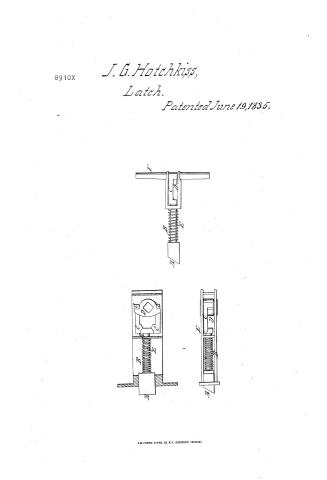
J. G. Hotchkiss' Patent Drawing for a Mortice Lock and Latch

National Archives, Restored Patent Drawings (Record Group 241) · Full-size scan at the National Archives · Catalog record
Show the text on the drawing Hide (78 words)
Words on the drawing as machine-read by the National Archives; not checked. Useful mainly for searching.
tab / 70 / 70. LOCKS & LATCHES. / Latches, Sliding. / And / classistration / 8910-+ / Knot Latches / J.GHOTCHKISS / Patented 19 June 1835) / Mortice Lock&Putch / A Bolt / B. Spiral spring / C. Case / D. Tumbler / I Shank of Bolt / section / F. Spendle / AND / Ton View / Patent office December 31 1/842 / Made under the ctrection of the Commynous of Paleul / in Conformity with ich of 3 March 1837 / Strickland Del'll / Commynow of Patents
USPTO scan
The patent as scanned by the USPTO
-
 Page 1
-
 Page 2
-
 Page 3


U.S. Patent and Trademark Office · Google Patents
Show the transcription Hide (629 words)
Machine transcription (LightOnOCR) of the pages as scanned by the USPTO, most of them the handwritten copies made when the records were restored after the 1836 fire. Not checked; it can misread handwriting, so compare it with the scan.
Page 1.
8910X
J. G. Hotchkiss,
Latch.
Patented June 19, 1835.

A.M. PHOTO-LITHO. CO. N.Y. (OSBORNE'S PROCESS)
Page 2.
8910X 174
John G. Hatchkies.
Letters Patent. (Dated June 19, 1835.)
The Schedule referred to in these Letters Patent and making part of the same, containing a description in the words of the said John G. Hatchkies himself of his improvement in the Mortice Lock & Latch for chamber doors called "Hatchkies's Mortice Lock & Latch."
Be it known that I, John G. Hatchkies of New Haven, County of New Haven, and State of Connecticut, have made an improvement on the mortice lock & latch for chamber doors—called "Hatchkies's Mortice Lock & Latch" which are described as follows: This lock consists of the bolt, spiral spring, & the case in which the tumbler acts; the tumbler which acts on the shank of the bolt, and to which is attached the spiral spring, the spiral spring, wound round, and fastened or clipped on to one end of the bolt, and the bolt & guard of the lock all these parts of the lock are similar to those now in use, except the tumbler & the case in which it acts & wherein my improvements for which I claim a patent rests. The case is made of brass or any other suitable metal, it is attached to the shank of the bolt round which the spiral spring is wound, and has an opening in it to receive the spindle and to allow it to play freely, it has also a shoulder against which the tumbler acts to carry the shaft of the bolt back as well as to compress the spiral spring. The tumbler is made the segment of a circle having a square opening in a projecting piece to receive the spindle. This tumbler when turned by the knot & spindle carries back the case with the shank attached to it & compresses the spiral spring. A guard or tumbler to the lock secured to the plate, serves as a rest to support the spiral spring with the bolt, & through which the shank passes. This guard is also used as a tumbler to the bolt of the lock. This invention may be used in the latch (singly) by making the tumbler upon the spindle & forming a step or tumbler channel, through the end of which the shank of the bolt passes & upon which the spring rests, the case at the end of the bolt works within the step or tumbler channel & the end of the step fits the circumference of the spindle & tumbler. Operation. The spindle which is attached to its knots or handles
Page 3.
is inserted into the square opening in the tumbler, and being turned partly round contracts the spiral spring by forcing the case backwards of the striker, admitting the door to be opened. The latch can be set alone without the tumbler, thus forcing the head of the latch bolt out by inserting a peg through which the shank of the bolt of the latch passes & upon which the spring rests. The invention here claimed & desired to be secured by Letters Patent consists in the case & tumbler as before described, with the arrangement and adaptation of the several parts of the same. For a further illustration of my invention I refer to the models & drawings of the same deposited in the Patent Office.
Witnesses.
J. C. Lee.
Clement F. Porter
John G. Hotchkiss.
(585 words)
Published accounts: journal notice
Notice in the monthly list of patents
Journal of the Franklin Institute, new ser., vol. 16 (1835), p. 143 · View the page
361. Mortise lock. John G. Hotchkins, New Haven, Conn.
Published accounts: journal notice
Notice in the monthly list of patents, with remarks
Journal of the Franklin Institute, new ser., vol. 17 (1836), p. 52 · View the page
51. For a Mortise Lock and Latch; John G. Hotchkins, New Haven, Connecticut, June 19.
Remarks. This is a kind of lock, or latch, somewhat similar to several which have been patented within a few years, excepting that before us is claimed to be new in the forming of the case and tumbler as described. To ascertain the peculiar difference between this and some others, would require more time than we can bestow upon the subject. The drawing does not make this point clear, for although it is good enough as a picture, it gives no sections, makes but three references, and that to parts partially obscured.
About this record
- Patentee
- DATAMP
- Date
- the Name and Date index of patents, DATAMP, USPTO records
- Invention
- DATAMP
- Listed in
- the Name and Date index of patents, DATAMP, USPTO records, Jim Shaw's X-patent list, the Journal of the Franklin Institute, Burke's List of Patents (1847)
- The Franklin Institute's journal spells the name differently.
- Burke's 1847 Patent Office list gives the same patent.